![MaritimeJournal[Seawork]](https://www.maritimejournal.com/wp-content/uploads/2026/09/MaritimeJournalSeawork.svg)



Multraship joins the green tug club
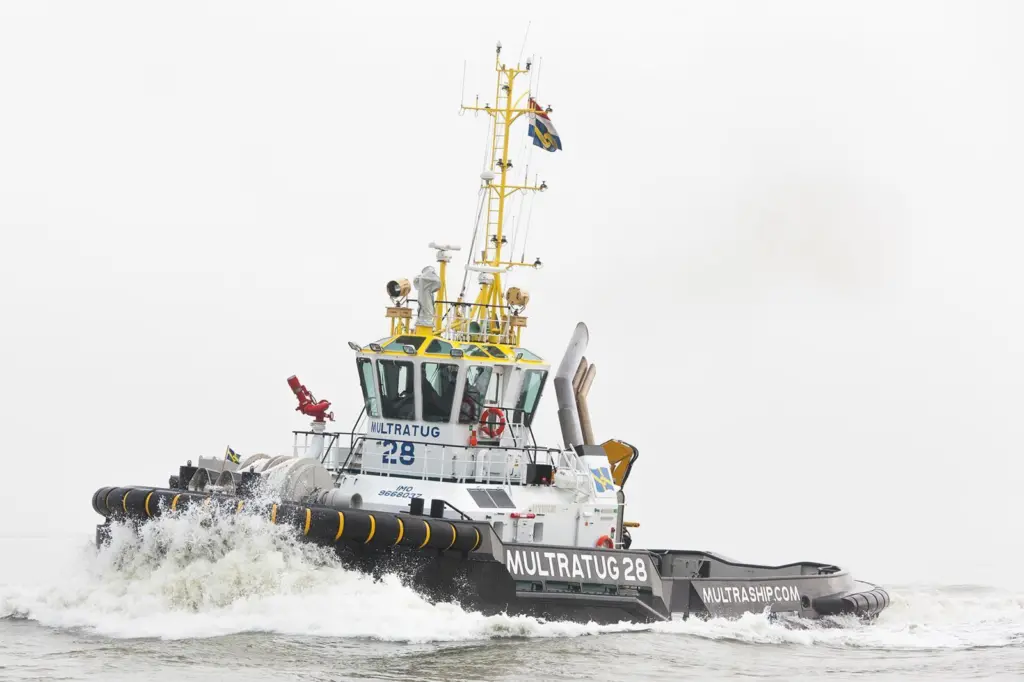
The Netherlands based towage and salvage specialist Multraship has become the latest owner to join the ‘green’ tug club with delivery of the Damen ASD Tug 2810 Hybrid Multratug 28.
Not that long ago, when providing background to this particular news story every new and prospective green tug could have been given a mention. The increase in number of tug owners opting for the benefits of operating efficiencies, along with the just as important advantages of reduced emissions now precludes this.
The current choice of green tugs is either LNG-powered (pure LNG and dual-fuel) or diesel/electric hybrid. Norwegian owners such Buksér og Berging and Østensjø Rederi, have chosen the LNG route, understandable perhaps given the country’s development of LNG-powered shipping. Looking further south and taking the Netherlands as an example, for owners such as Kotug, Iskes Towage & Salvage and the Royal Netherlands Navy it is the diesel/electric hybrid option that is gaining ground, with a number of deliveries and orders.
Multraship are currently in the middle of a fleet expansion programme (MJ February 2015) and first of the three vessel order from Damen has now been completed with the on time and on budget delivery of the hybrid ASD 2810 Multratug 28. The vessel was built at Damen’s facilities at Galati in Romania and is the second such hybrid ASD Tug 2810 following the lead vessel in the new marque, Bernardus for Iskes Towage & Salvage. The advantages of this particular design are explained simply by Dinu Berariu, Project Manager at Damen Shipyards Galati: “This hybrid tug is a very unique concept. It features a diesel-direct, diesel-electric and battery powered propulsion system. This hybrid configuration will enable Multraship to lower fuel costs by up to 30 percent and emissions by up to 60 percent.”
VESSEL DETAILS
Multratug 28 is built to Lloyd’s Register rules and carries the class notation +100 A1 Escort Tug [+] LMC UMS IWS with basic functions of: towing, mooring and fire-fighting operations. When reviewing the basic description of the vessel much is in common with the conventionally powered ASD Tug 2810 but obviously the specification changes when the inclusion of the hybrid elements of the design are considered.
Main dimensions are: LOA 28.67m, beam overall 10.43m, depth at sides 4.6m, draught 4.95m, displacement 574 tons and a gross tonnage of 294 tonnes. Tank capacities include: fuel oil 72.5 m3, fresh water 14.9 m3, foam 6.6 m3, lubricating oil 9.1 m3, dirty oil 3.2 m3, sewage 2.2 m3, sludge 3.2 m2, bilge water 5.2 m3 and Urea 6.4 m3.
Main propulsion is provided by two MTU 16V4000M63R diesel engines with a total output of 3,680 bkW (4,935 bhp) at 1,600 rpm. These in turn drive two Rolls-Royce US 205 azimuth thrusters each with a propeller of 2,400mm diameter. MTU also provide a propulsion generator set in the form of a 12V2000M41B, 800 kVA, 440V-60Hz model. Two ABB M3LP450LA (2 x 230 bkW) main electric engines are also included in the list of machinery along with a Caterpillar C4.4, 107 kVA, 230/400V, 50Hz general generator set. The all-important battery pack comprises two 120 kWh sets. A forced ventilation system provides 55,000 m3/hr. Performance figures are quoted as bollard pull ahead 60.7 tonnes and 56.8 tonnes astern with vessel speeds of 13.4 knots (diesel direct), 8.8 knots (diesel electric) and 4 knots (battery pack).
Other machinery includes a DOC+DPF+SCR exhaust gas treatment system which is IMO Tier III compliant. Sterling provide two AKHA 5101 bilge pumps, AKHA 4101 and 3101 fuel pumps and a freshwater AOHA 1202 pressure set. The main engine cooling system comprises box cooling along with an anti-growth system. One of the propulsion generator diesels powers a 1,200m3/hr fire-fighting pump which in turn supplies a single water/foam monitor mounted forward of the wheelhouse. The vessel’s hydraulic requirements are provided by an electrically driven hydraulic pump.
TOWING PROVISION
Multratug 28 is equipped for towing over the bow via an electrically driven two speed winch with split drum and warping head. Winch pull is 35 tons at 9.1m/min, slack rope speed up to 28m/min and 150 ton brake load. The anchor-lifting element of the forward winch accommodates two 360 kg Pool (high holding power) anchors. Aft towing options are in the form of a Mampaey 65 ton towing hook and provision for installation of a towing winch at a later stage if required. Fendering provision includes D-fenders at the sides, cylindrical fenders at transom corners and cylinder and W-block bow fenders with water spray. The afterdeck is also home to a Heila HLM 20-3S crane.
Accommodation is provided for eight persons with a captain’s cabin, chief engineer’s cabin, three double crew cabins, galley, mess/dayroom, dry store and sanitary facilities. The accommodation is to Damen’s usual high standard, insulated and finished with durable modern linings, air conditioning and floating floors also an acoustical ceiling in the wheelhouse.
A comprehensive list of navigation and communication equipment has been included in Multratug 28’s specification. Furuno provide a lot of what is to be found in the wheelhouse including: a GP-150 GPS, FE-700 echo sounder, NX-700 Navtex, FA-150 AIS, DS-80 speed log, FS-1575 SSB MF/HF radiotelephone and a Felcom 18 Inmarsat Ship Earth Station (plus spare). The radar system comprises a JRC JMA-5212-4BB set (with 19 inch screen) while Simrad provides the autopilot with an AP-70 model. VHF radio is of course the day-to-day means of communication and Sailor have supplied two Compact 6222 sets, one with DSC while mobile communication is provided by two Jotron Tron TR-20 hand-held VHF sets. Other associated equipment includes a Jotron SART, two Persch 1000W searchlights, an Anschutz standard 22 compact gyro compass and a Magnetic Kotter compass.
Visit Damen Shipyards on stand A75 at this year’s Seawork International.
By Peter Barker
Related Articles
 SPECIAL REPORTS
 TUGS & SALVAGE
 EQUIPMENT