![MaritimeJournal[Seawork]](https://www.maritimejournal.com/wp-content/uploads/2026/09/MaritimeJournalSeawork.svg)






China joins the LNG-powered tug club
The recent delivery of Asia’s first tug powered solely by LNG provides an indication that the adoption of the fuel is attracting attention globally with elements of particular interest for Rolls-Royce and China.
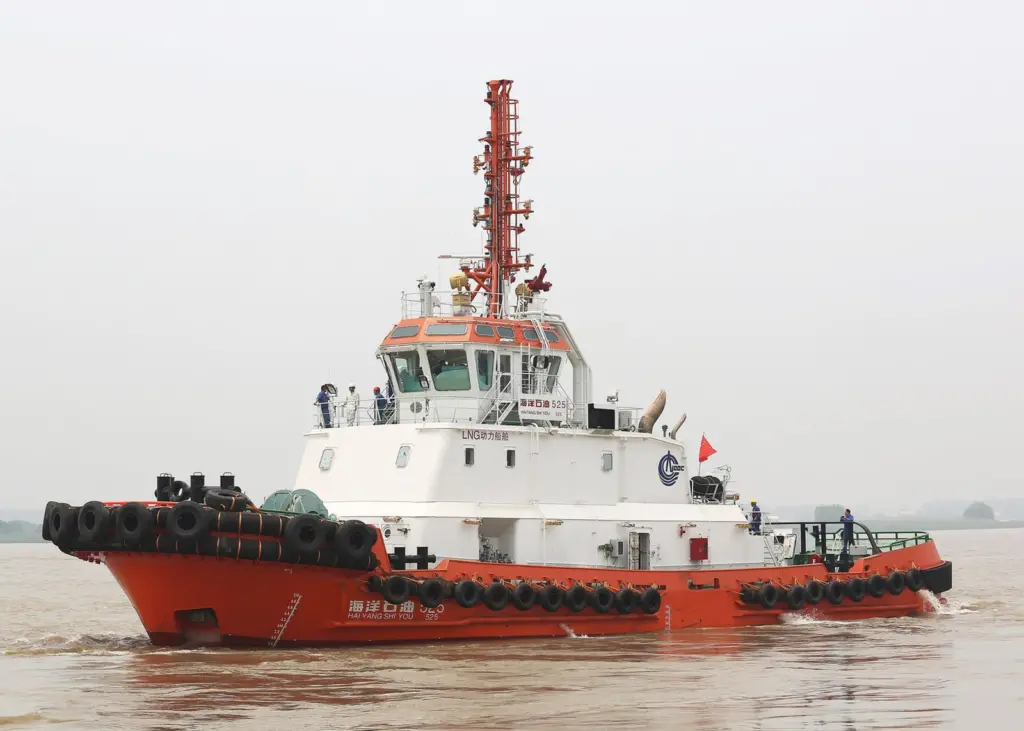
While destined for service outside MJ’s usual geographical region of coverage the European element to the new tug, named Hai Yang Shi You 525 is worthy of note, not to mention being a development that will be of interest to the industry worldwide.
The new tug is the first of two similar vessels ordered from China’s Zhenjiang Shipyard (Group) Co Ltd for China National Offshore Oil Corporation (CNOOC) and the choice of LNG to power the tugs follows the Chinese government’s 2011 plan to strengthen its maritime base with the manufacture of high-end, ecologically-efficient ships and technology. Zhenjiang Shipyard states: “The successful building of this vessel conforms to the history momentum of environmental protection and sustainable development under the new normal.”
The selection of Rolls-Royce to provide the propulsion package follows their similar involvement supplying machinery for the world’s first two LNG-powered tugs Borgøy and Bokn for Buksér og Berging. The package for Hai Yang Shi You 525 is based on twin Rolls-Royce Bergen C26:33L9PG engines and a pair of Rolls-Royce US 205 CP azimuth thrusters. The Bergen C26:33 gas engines reduce CO2 emissions by 25 per cent and NOx emissions by up to 90 per cent. Oxides of sulphur and particulates are also removed, minimising emissions, a feature of importance for China’s coasts and inland waterways.
Richard Wang, Senior Vice President – Rolls-Royce Commercial Marine, said: “This order marks a new era for tugboat propulsion technology in China. As its shipbuilding industry shifts focus from standard designs to more sophisticated tonnage, more owners and operators will see the benefit of using cleaner, more efficient fueling solutions for their vessels.”
By Peter Barker

Related Articles
 SPECIAL REPORTS
 TUGS & SALVAGE
 EQUIPMENT