![MaritimeJournal[Seawork]](https://www.maritimejournal.com/wp-content/uploads/2026/09/MaritimeJournalSeawork.svg)




Uzmar delivers push-tugs for South American operation
Uzmar Shipyard in Turkey has delivered eight Robert Allan Ltd (RAL) designed push-tugs, part of an optimised tug-barge system delivering ore from Brazil down the Paraguay-Paraná river to Uruguay, a distance of 2,500km.
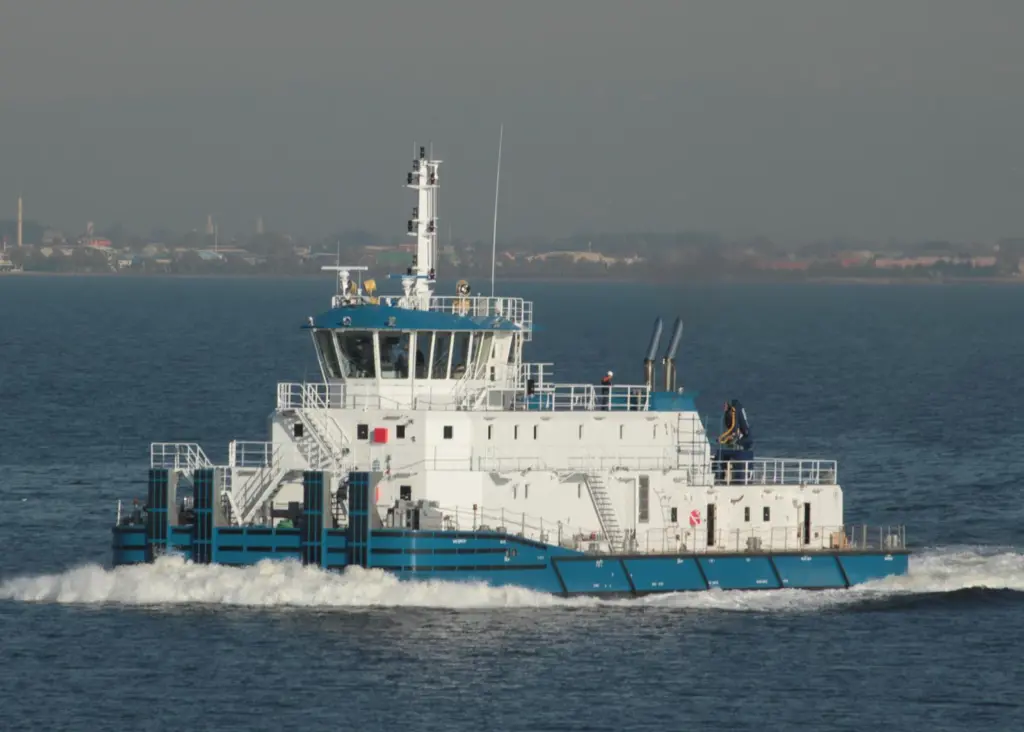
While some veteran Mississippi push-boats and barges have been used on South American inland waterways, this particular operation presented challenges which led to logistics corporation Hidrovias do Brasil turning to RAL to design a purpose-built shallow draft system including eight triple-screw azimuthing thruster RApide 4600-Z3 class push-tugs. Also part of the project, 128 Robert Allan designed open hopper barges were supplied by Shanghai Zhenhua Heavy Industry Co Ltd (ZPMC).
The iron ore transporting operation is demanding to say the least and RAL drew on their experience designing craft for the shallow rivers of Canada’s frontier northland. The service is an all year-round 24 hour operation along a sprawling waterway flowing through the centre of the continent, connecting Brazil, Bolivia, Paraguay and Argentina between Corumba and Nueva Palmira.
Shallow water makes the task particularly challenging calling for a degree of accurate designing to optimise efficiency given that less water under the keel means more fuel consumption. Fuel consumption figures were calculation with simulation to match load profile using data from the river with a key factor in this market being the ability to accurately predict vessel performance using CFD, an area in which RAL have invested in involving a supercomputer cluster and specialised staff.
TRIPLE-SCREW ARRANGEMENT
The eight Uzmar built push-tugs are 46.5m in length with a breadth of 16.5m and full load draft of 2.5m or reduced draught of 2.1m for low water conditions. They have a range of over 5,000km (one full round trip) at full load draught or a one-way trip at 2.1m reduced draught. A double-hull mitigates risks of fuel spillage from grounding or collision damage.
Each tug handles 16 barges in a four by four arrangement. This results in a sizeable convoy spanning 290m by 60m wide transporting 45,500t of ore at current river draught limits. At a draught of 3.96m the barges can accommodate 50,000t of cargo.
An important requirement for approval of the project was Brazilian authority stipulation that a crash stop of a convoy running downriver at full-speed could be achieved in 2.5 convoy lengths. This was essential because of varying channel widths and depths along with limited sightlines around bends and increasing traffic volumes.
After considering several alternatives RAL developed a triple-screw azimuthing thruster design, an arrangement allowing immediate full reverse thrust and enhanced manoeuvrability. Each tug has accommodation for eighteen persons.
It is stated that they are “the most powerful triple Z-drive shallow push-boats to date”. The propulsion system is diesel-electric with three independent Wärtsilä 9L20 medium-speed diesel gensets each developing 1,710ekW. AC current motors supplied by ABB power three Schottel SRP 1215 azimuthing thrusters incorporating custom-designed nozzles which reduce draught and include heavy-duty drive components to withstand impacts with river debris. The combination provides a bollard pull of 69t ahead and 63t astern and the engines are capable of operating on MGO but will normally run on less expensive HFO. The choice of diesel-electric propulsion provides advantages with flexibility in positioning engines and drives to ensure best operating trim in shallow waters.
The eight push-tugs are only part of the operation of course and essential to the project are the 128 open hopper barges, designed by RAL and built by ZPMC. The barges each measure 61m in length with a 15m beam, half of which have single rakes ends, the remainder having no rakes: the barge rakes are optimised to improve crash stop capability. Bart Stockdill is project engineer leading the RAL CFD team and states: “We were able to compare our own hopper barge design with the ones designed by a local shipyard for this project. Ours had 7% less resistance representing a very significant fuel saving.”
Involvement of RAL also extended to the design of a 1,800t floating drydock to service the fleet, and was also built by ZPMC. The barges were delivered 32 at a time by heavy lift ship to Montevideo Uruguay with 16 additional barges also contracted to CIE shipyard in Paraguay.
The completed push-tugs and barges are now at work on the Paraguay-Paraná waterway and reported to be achieving their calculated speeds and fuel consumption. Free running speed of the tugs is 13.2 knots and the operation has so far confirmed RAL’s prediction that including propeller nozzles would save 7% to 8% on fuel.
Of course a project of such scale will produce challenges as RAL President Michael Fitzpatrick explains: “There were no real surprises on the project. The force of turning the convoy initially broke some of the wires connecting the barges. The owner replaced them with synthetic lines that have more stretch capacity, a higher breaking strength and are easier to handle.”
The success of this project has prompted RAL to explore the concept further. They are now busy designing other tug-barge systems for South American clients including Hidrovias do Brasil and a number of other companies transporting various commodities along the Paraguay-Paraná and Amazon River systems. Push-boats designed for the Amazon are shorter and deeper than those on the Paraná meaning such shallow-draught projects are unique with each river system and each client requiring a customised design solution.
RAL state that a key factor in this market is the ability to accurately predict vessel performance using CFD, their investment (mentioned above) allowing the company to quickly and effectively model alternative hull designs at full scale to establish optimal design configurations. A complete proposed system can thus be assessed before anything is built, at the same time they point out that CFD has not completely replaced model tank testing at the company.
By Peter Barker

Related Articles
 SPECIAL REPORTS
 TUGS & SALVAGE
 EQUIPMENT