![MaritimeJournal[Seawork]](https://www.maritimejournal.com/wp-content/uploads/2026/09/MaritimeJournalSeawork.svg)


Unmanned tugs – the ultimate crew protection?
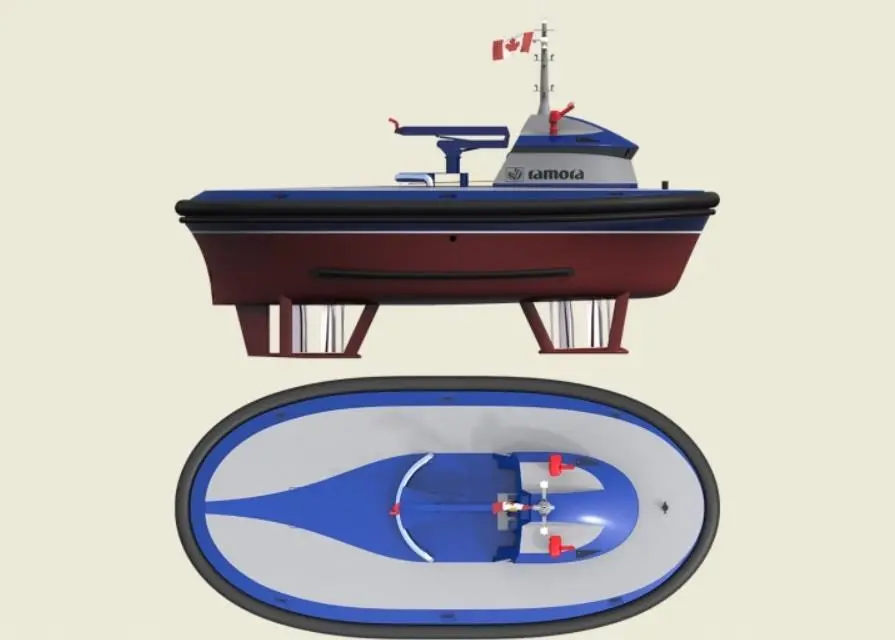
Canadian naval architects Robert Allan Ltd have unveiled a revolutionary concept with their vision of an autonomous unmanned tug, named RAmora and the flagship of their TOWBoT (Tele-operated Workboat or Tug) series.
For generations, followers of the towage industry witnessed very gradual developments evolving from conventional hull-forms with single or twin propellers. In relatively recent times we have seen VSP propulsion, azimuth thrusters, Rotortugs, render-recovery winches, hybrid propulsion and many other innovations to transform in particular, the ship-handling towage scene.
The idea of taking humans away from the scene of operating machinery is nothing new of course. Unmanned autonomous vehicles and drones are examples and in the port world Rotterdam’s Maasvlakte 2 container terminals are largely automated, their ship-to-shore gantry crane operators located in a building remote from the cranes themselves.
The tragic capsizing of the tug Fairplay-22 in the Nieuwe Waterweg in 2010 with the loss of two lives serves as a reminder of the dangers involved in operations carried out hundreds of times a day in ports around the world. Your correspondent remembers watching close hand the Gravesend tug Sun Mercia repeatedly enveloped in toxic smoke fighting a fire on the container ship Ever Decent following a collision off the north Kent coast in 1999. The possibility to reduce the risk for tug crews is a strong incentive for what to some may appear just a little too futuristic.
THE CONCEPT IN DETAIL
“Imagine the impact of a workboat designed to operate in hazardous environments, but without risk to crew. One that can fight a fire for extended periods and more closely than a conventional fire-fighting vessel, without danger to life or limb. Picture an ultra-manoeuvrable high-performance tug in the command of an experienced tug master that can work safely at LNG terminals, within confined channels or locks, or under the bow of a ship while underway”. These words introduce Robert Allan’s concept, the result of over a year of research and development and influenced by drone technologies.
The new autonomous tug concept involves a 55tbp tug designated RAmora 2400, featuring hybrid propulsion with substantial battery storage capacity allowing extended operation, even in potentially hazardous environments including LNG terminals or fire-fighting situations. It is designed to leverage (not lose) the capabilities of a traditional tug master, operating RAmora remotely from a ‘command tug’.
What are described as ‘immersive telepresence’ features are built into the tug’s console including 360 degree live video and real-time electronic position-sensing capturing a continuous on-board perspective for safe and efficient ship-handling. An advanced real-time control system provides the interface for the operator, as well as on-board manoeuvring/positioning controls, equipment and workspace monitoring along with safety management functionality.
The control system has been developed in partnership with Canadian company International Submarine Engineering and derived from proven ROV, AUV and surface vessel applications. This allows flexibility for operation at various levels of autonomy from a low level where the operator pilots the tug directly, to a high level where it is left to undertake work functions semi-autonomously under the operator’s supervisory control.
FURTHER INNOVATION
While the description of RAmora centres on the concept of an un-manned tug driven remotely by an operator located elsewhere, there are however other surprises under the bonnet illustrating that designers at Robert Allan Ltd clearly wished to go further with their degree of innovation.
Voith Schneider propulsion is far from pioneering of course and here the choice of twin VSP units arranged in fore/aft configuration has been made, gaining from experience of Robert Allan’s RAVE (Robert Allan Voith Escort) tug. The hull form is designed for high stability and good seakeeping performance, the product of extensive development work including CFD and towing tank testing. And of course with no requirement for a conventional wheelhouse, accommodation, domestic systems or lifesaving equipment RAmora is simpler and more compact than conventional tugs of comparable performance.
When considering the role of humans aboard ship-handling tugs, nothing happens without someone making the all-important connection with the assisted vessel: here again, a degree of innovation has answered that question. Stabilised cranes are now coming into vogue, particularly with the latest walk-to-work offshore vessels. The idea is nothing new however with Robert Allan having introduced them to manned tugs in the 1970s. On RAmora, a stabilised line-handling crane is used to pass the towline to the ship.
Of equal interest is the winch, installed forward in a well-protected deckhouse. A unique curved and slotted towing staple midships keeps the towline close to the deck, its lead minimising heeling when towing from abeam. The combination of a clear working deck, slotted staple design and fore/aft VSP makes for a versatile vessel, and more importantly safer ship-handling operations which present high risk to crewed tugs, for example when working in close proximity to ships’ bows while underway, or within confined channels and locks.
Secondary functions include emergency response which may not be readily available from crewed tugs. Fire-fighting to fi-fi1 standard are included with two 1,200m3/hr monitors driven by electrically powered pumps. The crane boom is utilised here with optional inclusion of a smaller 600m3/hr monitor and camera. Importantly, since no crew are on board, the tug can fight a fire closer and for longer periods than with conventional fire-fighting vessels.
Robert Allan Ltd has been working with operator clients, classification societies, Voith and other supplier partners to ensure the RAmora TOWBoT system is fully viable, safe, highly reliable and meeting requirements of local authorities. As futuristic as this project may seem the technology is largely already in existence. Winning of hearts and minds may be as much a challenge as mastering the technology but somehow there is perhaps an air of inevitably to Robert Allan’s concept depending on your view of course!
By Peter Barker
Related Articles
 SPECIAL REPORTS
 TUGS & SALVAGE
 EQUIPMENT