

Rondo class patrol
The St. Petersburg based shipyard Sredne-Nevsky which is part of the United Shipbuilding Corporation has delivered the R1650 which is the first of the Rondo class fast patrol boats built to a design developed by the shipyard.
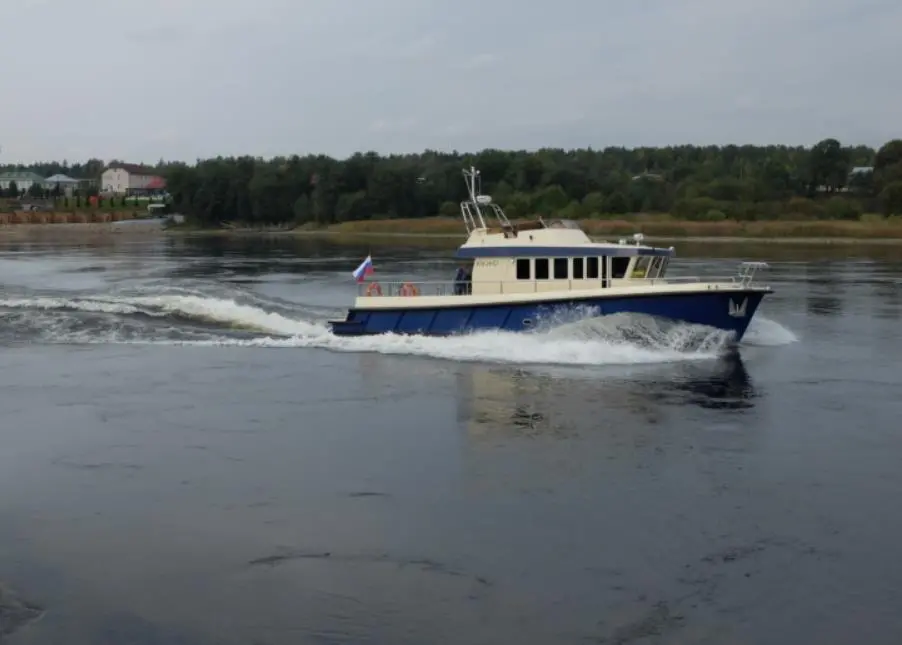
This patrol boat has been built for the Russian FSB Border Service and it will be used for a variety of patrol duties in the Russian sector of the Baltic. The contract for this R1650 was signed in February 2014 and the vessel will be used for patrol and inspection duties in its designated areas of operation, for the transport of personnel to and from ships that are being inspected, the transport of both personal and cargoes for special forces applications on operational duties and on search and rescue operations in coastal areas.
The R1650 is based on a hull that has been constructed in steel which was chosen to give the patrol boat the capability of operating in ice covered waters. This will extend the operation window of the boats during the winter months. The steel hull is combined with a deck and superstructure that are constructed from composites in order to achieve a significant reduction in the overall weight and to reduce the draft which will allow the vessel to operate in shallow waters. The hull is of the semi-displacement type with a skeg to give good directional stability.
The hull has an overall length of 16.50 metres with abeam of 4.05 metres. The hull has a chine that starts low at the bow and runs aft into a hard chine hull. When fully loaded with maximum fuel and water the draft is 1.40 metres which equates to a displacement of 27 tonnes. This low draft gives the boat access to shallow water areas when on search and rescue missions.
The boat will operate with a crew of 3 and can accommodate up to nine passengers. With a fuel capacity of 2200 litres this will give the boat an endurance of 19 days at low speeds with just the 3 man crew on board. This endurance is also limited with amount of provisions and fresh water carried with the fresh water tank holding 700 litres. With the 9 passengers on board the endurance is limited to 5 days.
The patrol boat is powered by a pair of Iveco FPT diesel engines of type C13 ENT M50 with each producing 500 hp at the continuous rating for heavy duty operation which allows for 3000 hours of operation at 100% load. These drive through a reduction gearbox to fixed pitch propellers with a diameter of 685 mm with the propellers protected by the central skeg of the hull. This power gives the boat a maximum speed of 19 knots and at this speed the maximum range is 220 miles. When the speed is reduced to 10 knots and with the hull working in displacement mode the range extends out to 500 miles. It is anticipated that for much of the time the vessel will operate at low speeds which will provide for the extended endurance time at sea.
The engines are equipped with a normal alarm system to monitor the operation of the engine and this, combined with the control equipment allows for the unmanned operation of the engine room. The engines and steering can be controlled both from an internal steering position in the wheelhouse and from the elevated open control station above.
The three man crew have their own dedicated accommodation that includes toilet and galley facilities whist provision is made for bunk berths for the additional passengers when they are carried. These are all in the lower section of the hull whilst in the wheelhouse there is dedicated seating to accommodate the crew and passengers. The wheelhouse has windows all round to give a panoramic view and heating is provided for winter operations. The sandwich construction of the GRP laminate used for the construction of the wheelhouse offers good sound and heat insulation.
The upper control station is open to the elements and offers a good all round view. This is the maneuvering station and it is equipped with controls and a combined chart and radar display for navigation information. Above is a tubular steel arch mast that supports the navigation lights and the radar antenna.
In the wheelhouse is a wider range of electronics including a full range of Raymarine equipment including displays for the radar, chart plotter and controls for the autopilot and loud hailers. The Jabsco searchlight mounted on the top of the superstructure can be operated remotely from inside. A Side Power bow thruster aids maneuverability and a Maxwell anchor capstan can be operated from the wheelhouse. There is a full walk around deck with wide side decks and rails above the bulwarks that allow access to other vessels from the bow. At the stern there is a large cockpit with adequate space for carrying cargoes and a transom door allows easy access.
The Sredne-Nevsky Shipyard is located in Saint-Petersburg and is a subsidiary of the United Shipbuilding Corporation. The yard was established in 1912 and is a leading builder in composite construction in Russia. The yard offers construction in a wide range of materials including conventional steel, composite materials, low-magnetic steel and aluminium-magnesium alloys. The shipyard specialises in military construction and has built over 500 warships and vessels of 43 different designs for the Russian Navy and foreign customers.
United Shipbuilding Corporation (USC OJSC) is the largest shipbuilding company in Russia. It was set up in 2007 and is 100% federal owned. The holding company comprises 60 companies and organizations (major shipbuilding and ship-repairing companies as well as leading design bureaus). Currently, USC consolidates about 80% of the domestic shipbuilding complex. The Russian market is the main focus of the state corporation though it also exports its products to 20 countries worldwide.
By Dag Pike