
The fastest lifeboat in the world
All-weather lifeboats that put out from the shore or patrol the seas with the aim of rescuing people or vessels in distress tend to be relatively slow, with a top speed of around 25 to 30 knots.
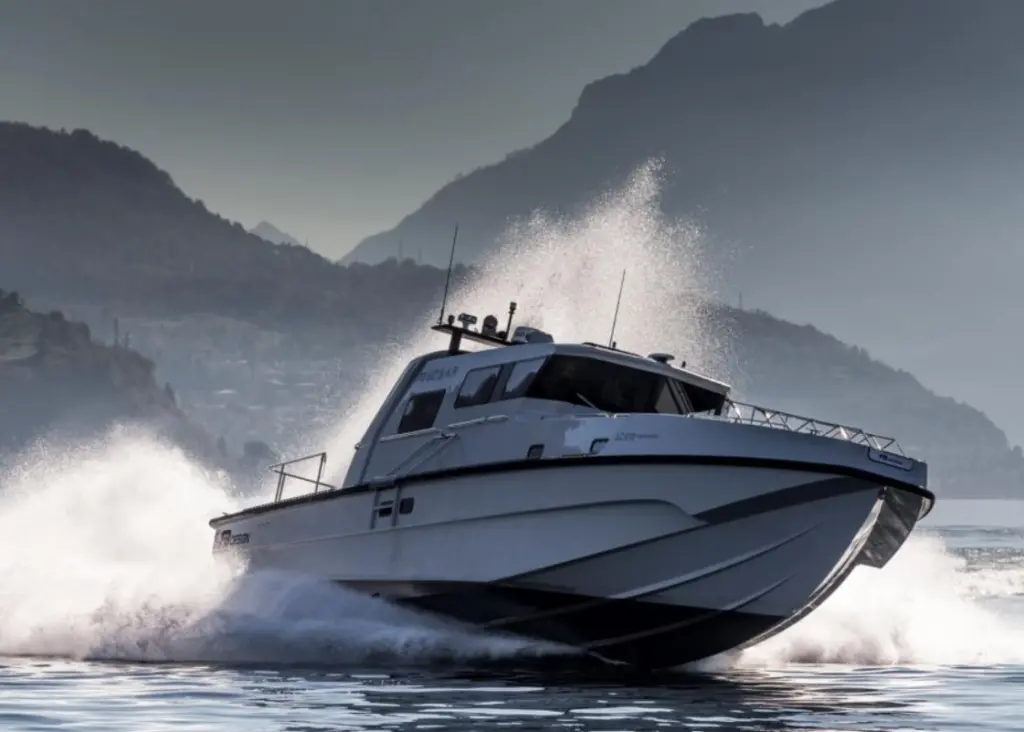
There are a few exceptions, notably in Scandinavia where some of the latest designs can achieve 40 knots but a new design developed in Italy takes the concept of fast lifeboats a quantum step forward with a top speed of over 60 knots.
This new concept has been designed and built by FB Design based on Lake Como. Drawing on their extensive experience of building some of the best high performance patrol boats for the World’s military, the concept was developed initially as a solution for rescuing refugees attempting to cross the Mediterranean. Speed can be an essential factor in these rescues which tend to involve a considerable number of people. As Fabio Buzzi, the owner of FB Design says, “When we analysed rescues we found that around 90% of them occurred in fine and moderate conditions where high speed could be a great benefit. With our huge high speed design experience we were able to combine this high speed requirement with extreme seaworthiness and durability and the result is the new SAR60.”
The SAR60 uses a lot of the technology developed for the FB Design range of high speed patrol boats which in turn were developed from 40 years of very successful offshore powerboat racing. Like all modern fast lifeboats the hull is based on a deep vee design. On the SAR60 the deadrise of the hull at the transom is 24° and the hull has a single step moulded into the vee section. Buzzi comments, “The typical length of current lifeboat designs is 15 metres with a beam of 4 metres. We maintained the 4 metre beam on the new design even though the hull was 3 metres longer in order to allow a superior capability in rough seas.” The overall length of the hull is 19 metres making the SAR60 probably the largest fast lifeboat in the World.
The extra length was required to incorporate a large survivor compartment in the hull. “With refugees being rescued the numbers can be high so we allocated a dedicated compartment that can accommodate 20 survivors with its own toilet.” Further survivors can be accommodated in the crew space forward if necessary.
To improve the capability of the performance in heavy following seas the bow incorporates ‘anti-stuff’ fins. These moulded-in fins provide additional buoyancy if the bow should start to bury in following waves and they were developed from experience in offshore racing. They taper cleanly into the hull with an upper, spray-reducing chine running aft. The lower hull has spray rails and a pronounced chine to develop lift and to deflect spray and to help stabilise the hull.
The hull is moulded in advanced composites including Kevlar in order to combine adequate strength with reduced weight and is based on a balsa core sandwich. To further stiffen and strengthen the hull the space between the inner and outer moulded sections is filled with a patented Structural Foam system where foam is injected under pressure to fully fill the space and to provide additional security should the outer hull be penetrated. The foam is closed cell polyurethane with a high density of 75 kg/m2.
Protecting the hull is a patented fendering system. This comprises a neoprene pipe 100 mm in diameter which is reinforced with polyester fabric and filled with elastic foam. The tube is supported on a dedicated polyurethane base plate and attached in 2.5 metres long sections so that any damaged lengths are easily replaceable.
On the deck there is a full walk-around capability with no outside rails except at the stern. This is done to reduce the chance of damage when alongside a ship and the lifeboat can heel up to 20° before damage to the superstructure is possible. The wheelhouse has forward sloping windows to maximise the visibility and its volume has been sized so that the boat is fully self-righting in the event of capsize. Special attention has been paid to securing and protecting the antennae on the wheelhouse to so that they remain active after capsize.
For propulsion the SAR60 is fitted with a pair of MTU V-10 diesels from the 2000 Series. These have been modified with the ‘Rough Kit’ from MTU that incorporates a number of features to enable to engines to survive under extreme sea conditions. The features include a baffle sheet in the standard oil pan and multi-stage crankcase ventilation to prevent oil spilling. The dipstick is secured to prevent it coming out in the event of a capsize and the engines have sturdier mounts and damping elements along with a special engine exhaust compensator to allow for extreme stress and movements.
In addition to these engine modifications FB Design has added air inlet and exhaust cut-outs operated pneumatically so that these are closed off in the event of a capsize. This system is designed to protect the engines during a capsize and to allow them to be restarted immediately afterwards.
Each engine produces 1620 hp and they drive through a flange mounted ZF 2000 gearbox. The propulsion system is a pair of ZF Trimax 3500 surface drives which are mounted within a recess moulded into the hull at the stern. These are fixed surface drives although vertical adjustment is possible during the set-up stage by means of bolted clamps. Ventilation for the upper blades of the propeller is provided by the engine exhausts exiting just above and in front of the propellers.
The propellers are contained within the depth of the hull so that they are protected in the event of grounding but the spade rudders extend below this point. However they are protected by the patented FB Design Safety Rudder that allows the rudder to kick up rather than suffer damage.
To ensure that the boat comes quickly onto the plane it is equipped with another FB Design patented system, the Tritab. This comprises two conventional flaps or trim tabs at the extremities of the lower edge of the inner transom combined with a third flap on the centre line right at the stern. These are controlled by an automatic GPS based system that lowers and raises the flaps as required according to the speed of the boat. The effectiveness of this system can be seen that even with a payload of an extra 5 tonnes on board the speed only drops by 2 knots.
To improve performance in head seas a 1000 kg ballast tank is located in the bow. This can be filled and emptied via remote control valves with the filling water coming from a take off from the engine seawater cooling system.
The top speed on trials was a shade over 60 knots. The fuel tank is a full width, full height unit installed as part of the hull structure between the engine compartment and the survivors’ cabin. The fuel capacity is sized to give a range of over 500 miles and with crew accommodation forward plus a galley and bathroom facilities this lifeboat can operate autonomously for 3 days.
For recovering survivors from the water the SAR60 has two options. On the starboard side within full view of the coxswain at the helm is a recovery station comprising a platform that can be deployed from the side of the hull which provides a place for a crew member to stand whilst a survivor is recovered in the Jason’s Cradle close alongside. This Jason’s Cradle is designed to recover survivors in the recommended horizontal position and is operated by an electric winch on the wheelhouse top. An inflatable settee located in the wheelhouse can perform the dual role of a liferaft platform when deployed in the water as a staging post prior to rescue and two 100 person liferafts are stowed on the aft deck.
On the foredeck is a recovery ladder that can slide out to create a ladder/gangway at the bow. This can be used by survivors to climb on board from the water or from another boat and it can also provide access to a beach when required.
The wheelhouse is equipped with six Tecno sprung seats to a design developed by FB Design. These are fitted with a full restraining harness to locate the crew securely in the event of capsize and the seat squabs allow both a sitting and standing position. These Tecno seats are some of the most advanced sprung seats available and on the SAR60 they provide secure and supportive location for the crew.
In front of the seats a variety of displays can be located and on the prototype the dashboard is fitted with a range of Raymarine navigation displays such as a chart plotter, radar and autopilot. A vital feature is the Starlight Italia night vision equipment that can operate on low light TV and infra red from a wheelhouse top mounted camera and has its own dedicated 17 inch touch screen display. All of the electronic equipment was supplied by Electtronica Marittima.
The design of this remarkable new lifeboat has been developed to be as versatile as possible. Many of the features incorporated into the prototype are optional and it is possible for a purchasing organisation to specify in some detail exactly the equipment and features to be incorporated. This allows the design to be developed as a dedicated lifeboat capable of operating over long distances and being autonomous. It can also be equipped as a dedicated military patrol boat again capable of autonomous operation which makes it a significant addition to the FB Design range of patrol boats that can meet most military requirements.
The high performance of this new design makes it a significant advance in lifeboat design. Up till now most lifeboat organisations around the World have developed their own designs because they argued that there was nothing on the market that would meet their specific requirements. Now with this new SAR60 they can purchase a design that has a significantly greater speed and range than anything on the market, a design that can be adapted to specific requirements and one that can meet a number of specialised requirements to bring a new dimension to search and rescue operations. The SAR60 is likely to be the vessel of choice for coastguard operations where both patrol and search and rescue are part of their requirements. FB Design is remarkable in being a designer and builder of fast boats that has developed much of the equipment specific to fast boats because they could not find suitable equipment on the open market.
By Dag Pike