![MaritimeJournal[Seawork]](https://www.maritimejournal.com/wp-content/uploads/2026/09/MaritimeJournalSeawork.svg)


New ETVs for South Africa?
The South African Maritime Safety Authority (SAMSA) are considering building or leasing two emergency standby tugs to provide Emergency Towing Vessel (ETV) cover around the country’s coastline.
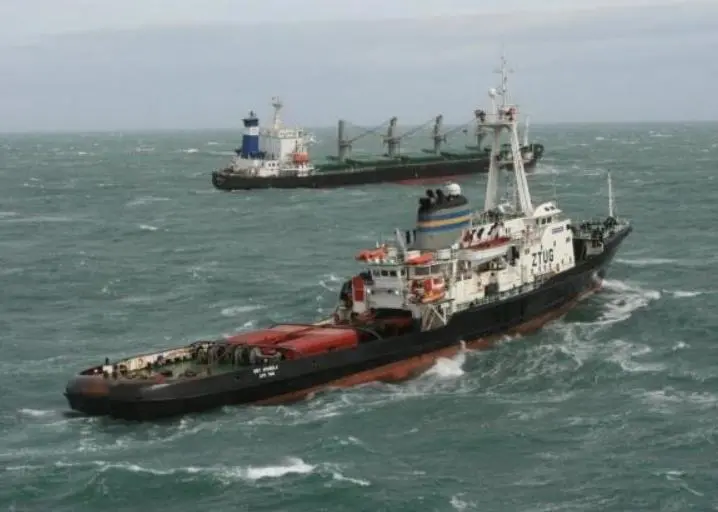
Considering the UK for background, the vexed question of ETV provision regularly features in local newspapers, particularly in Scotland. Back in 1994 the anchor-handling tug supply vessel Brodospas Moon started a winter-only charter to the Maritime & Coastguard Agency providing ETV coverage in the Dover Strait.
Subsequently, four ETVs maintained a year-round service in the Dover Strait, Western Approaches and around the north and west Scottish coasts. Following the UK coalition government’s Comprehensive Spending Review of October 2010 the contracts for the four vessels were not renewed upon expiry in October 2011. Strong opposition locally resulted in retention of one of the Scottish tugs although the question of this lone survivor’s future is constantly raised and currently being debated again.
Many other countries have however persevered with the provision of ETVs, South Africa being widely recognised as the first western country to operate dedicated state-sponsored stand-by tugs. The John Ross and Wolraad Woltemade subsequently became two of the most respected and well-suited rescue/salvage tugs in history but now only the former remains, sailing as Smit Amandla and providing emergency cover around the South African coastline.
Built in 1976 and regardless of any political consideration in the debate, the ex John Ross is perhaps in the twilight of its career and future options will certainly be on the agenda. Given the latest reports coming out of the country it appears the future provision of ETVs around South Africa’s coastline is assured.
A feasibility study carried out in 2009 established that the considerable length of South Africa’s coastline left the environment at risk from having just one tug (Smit Amandla) stationed in Cape Town. Given the time-lapse since that report, a new feasibility study was completed in the 2015 financial year and SAMSA’s annual report states that it identified the risks to the country’s coastline from a catastrophic mishap at sea as being significant, particularly with the number of nuclear-powered and other vessels passing the country expected to increase.
The study considered if the Department of Transport should operate ETVs themselves or as part of a Public Private Partnership. In December 2015, MJ highlighted the local involvement in a series of nine tugs under construction for TRANSNET and likewise with the ETV provision the study examined the question of building locally or at a foreign shipyard.
It is suggested one tug could be stationed at Cape Town to cover the west coast with a second based at Port Elizabeth covering the east coast. Funding options suggested a leasing arrangement would allow funding from operational funds rather than capital expenditure sources which could be subject to process delays. Leasing also allows the assets to be maintained to agreed standards and avoiding the government having to support the operational and upkeep aspects, something that would otherwise probably have to be outsourced.
The report also mentions however the desirability for maintaining support for the local shipbuilding industry with the government’s shipbuilding requirements being allocated evenly between the various ‘local’ yards with a number of government and naval projects (including the TRANSNET tugs) currently in the pipeline. One commentator suggested that indeed a long-term public private partnership would be ideal with the private sector making the investment and the government offering a long-term contract (15 to 20 years is suggested) without having to make what would could be the substantial initial investment. It is also suggested that between R550m and R600m would be required for a single tug.
South Africa’s exposed coastline overlooks one of the busiest sea routes in the world while at the same time experiencing some of the world’s worst weather conditions. With the country’s 200nm EEZ adding a further 75% to the nation’s surface area, the significance of the environmental responsibility is clear to see.
By Peter Barker

Related Articles
 SPECIAL REPORTS
 TUGS & SALVAGE
 EQUIPMENT