![MaritimeJournal[Seawork]](https://www.maritimejournal.com/wp-content/uploads/2026/09/MaritimeJournalSeawork.svg)


Workhorse Voe Earl excels in salvage debut
Dismantling of the ill-fated cruise ship Costa Concordia is now well underway at the Port of Pra Voltri, Genoa in Italy.
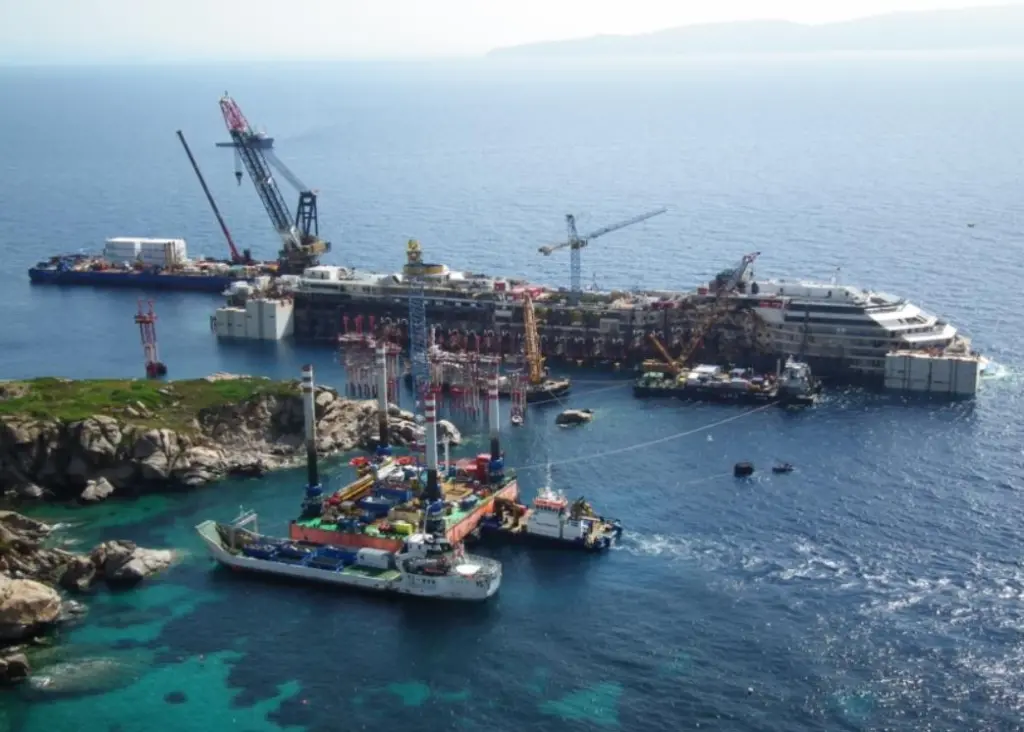
The vessel, which notoriously hit rocks and sank just off the Italian island of Giglio in January 2012, was subject to the most complex and expensive ($1.2bn) salvage operation ever undertaken before being towed to the Port of Genoa in July 2014.
The Ship Recycling Consortium, consisting of Italian engineering giant Saipem (51%) and San Giorgia del Porto (49%) is carrying out the £87m dismantling and recycling project which is due for completion in the second half of this year.
The Consortium produced a four phase Ship Recycling Plan which prioritised environmental safeguards and also contained a Waste Management Plan which detailed the disposal, recycling or reuse of all materials from a ship which was twice the size of Titanic. The intention of these plans is to recycle up to 80% of the ship’s materials, with some 50,000 tonnes of steel expected to go for reuse and 2,000 tonnes of copper.
Phase 1 began with Costa Concordia being moored initially along a seawall in the port of Pra Voltri in late July 2014. The salvage consortium Titan Micoperi handed the vessel over to the Ship Recycling Consortium, which then prepared for the first steps of the ship breaking to follow. This included the installation of onboard fire fighting equipment, lighting, elevators, and a range of safety measures. Two cranes were installed and openings made in the ship to allow for the removal of materials. Then commenced the stripping and removal of furnishings and fittings from the decks above water, which reduced the draft of the wreck, allowing it to be moved to a second dock where Phases 2 and 3 were to take place.
Once in the Molo Ex Superbacino dock, Phase 2 saw decks 14 to 2 dismantled, with care taken to remove the structures without jeopardising the stability or longitudinal integrity of the hull.
The 30 sponsons welded to the hull, which were key to the successful parbuckling, refloating and towing of the wreck, are being removed in Phase 3. This becomes possible as the stripping process makes the vessel lighter and less buoyancy is required to keep it afloat. This is the state of progress at the end of 2015. Some remaining compartments of the vessel will be made watertight to enable towing to a drydock where Phase 4, the final and complete disassembly of the wreck will take place.
With demolition moving towards the final stage later this year, there is time for further reflection upon the extraordinary salvage operation that followed Costa Concordia’s sinking.
Three months later a salvage contract was awarded to a joint venture consisting of Titan Salvage and Micoperi. Work began securing the vessel, constructing a support platform upon which to right it, and attaching buoyancy caissons to the out of the water port side.
Various workboat operators were subcontracted to work on the challenging salvage of Costa Concordia, including UK based Dalby Offshore, which had recently observed Shetland based Delta Marine’s Damen Multicat 2613 Voe Earl performing ship to ship transfer works in Great Yarmouth. Dalby chartered the vessel and Voe Earl arrived at the island of Giglio in August 2012, initially to provide for the removal of plant away from the work site should there be sudden changes of weather as well as general marine assistance.
However, what Dalby and Delta Marine already knew, that Voe Earl was equipped to make a much broader contribution than simply providing emergency support, was quickly noticed by the salvage specialists on site, the majority of whom had never worked with a Multicat before.
No sooner had the Multicat arrived on site than she was laying anchors and helping to position cables which would secure Costa Concordia on the sloping ledge where she lay and prevent the wreck from sliding into deeper waters.
The work site was crowded with vessels and there was no lay down area for storage in the tiny harbour at Giglio, with jack-ups being used to store plant and those jack-ups being serviced by crane barges. So the arrival of Voe Earl also quickly reduced unnecessary barge traffic as she was able to transport plant direct from the mainland to jack-ups and fabricated assemblies directly to the crane barges. She assisted cargo barges into position for arriving underwater platform components to be lifted by M30, the largest crane barge on site. Voe Earl also assisted the accommodation support vessel (ASV) Pioneer and numerous other supply vessels.
“Voe Earl was like a bumblebee”, said Delta Marine’s operations manager Neil Spanswick,.”You should see its AIS track, it was flying all over the site. Clients were changing work schedules based on what Voe Earl could do.”
On site logistics proved to be the vessel’s bread and butter but among those additional activities were provision of harsh weather ferry services for site personnel, numerous dive support activities, and even a bit of direct salvage work using Voe Earl’s 100t anchor handling winch to help remove Costa Concordia’s 65 tonne rudders whilst manoeuvring beneath the wreck’s overhang, which was denying access to crane barges.
In preparation for the parbuckling, and with grave concerns remaining that adverse weather could send the wreck into deeper water, Voe Earl supported welding operations to put padeyes on Costa Concordia and ran wire bundles to anchors on the inshore side of the vessel, making a basket which held it to the island.
Voe Earl also pulled chains under the wreck’s hull for sponsons and holdbacks. It transported ten 38 tonne anchor blocks which were used to pull the underside of the ship during parbuckling, which were then used to hold position to the west after floating. Voe Earl transported bilge protection plates for the port side of the wreck. As blister tanks were installed on the bow of the wreck, part of a process to alleviate fears that the bow might snap off, Voe Earl held a ballast control barge alongside for over 48 hours. She assisted the barges Navel Mare 1, Micoperi 1 and Micoperi 2, which were carrying sponsons for the starboard side of the wreck so that the crane barge Conquest could lift them off for installation.
Two memorials to lives lost have been left at the wreck site to honour those who lost their lives and Voe Earl was involved in the placement of both. She removed an eight tonne rock from a hole on the side of Costa Concordia, lifted it onto her deck and took it to shore, where an engraved plaque has been mounted and the rock placed on a pier near the wreck site. Voe Earl also laid a memorial stone on the seabed where Costa Concordia was first holed.
By the end of 2012 it was deemed necessary to charter another Multicat from the Delta Marine fleet. Voe Venture arrived on 21 January 2013 and spent that entire year on site before proceeding onwards to South Africa to participate in the salvage of the grounded and broken bulk carrier MV Smart.
Prior to float off of the Costa Concordia, Voe Earl rescued the tug Aran, which had suffered engine failure during gales just off Giglio harbour and had to be towed to a sheltered area on the north of the island.
Voe Earl continued working on the Costa Concordia salvage until November 2014, by which time the wreck was parbuckled, prepared for towage and escorted to Genoa by a fleet of workboats which included Voe Earl.
During the float off Voe Earl had assisted in laying two sets of piggy backed anchors connected to the stern of the wreck which held it in place until pulled by tugs around to the east for final departure. Voe Earl then disconnected the hold-back anchors and followed the tow with an oil pollution kit on board in the event of spills. A noxious gas sensor was mounted on the wheelhouse as well as an infra-red camera to monitor the wreck and personnel onboard the wreck during the tow.
The float off and tow to Genoa was undertaken in July 2014 but Voe Earl remained chartered and on site until November as the post-departure site clean-up and general demobilisation of the world’s largest ever salvage operation continued.
By project’s end Voe Earl and Voe Venture had achieved much more than merely contributing to a successful operation. They had shown the salvage world the scale and range of contribution which vessels such as Delta Marine’s Multicats were capable of making.
Their involvement in the Costa Concordia salvage operation also inputs to future workboat design, the initial manifestation of which will be the first of class Damen Renewables Service Vessel (RSV) 3315 which Delta Marine has been developing in cooperation with the Damen Shipyards Group over the past two years. Although developed specifically for the marine renewable energy sector, when the first RSV 3315 is launched early in 2017 it will have just a bit of salvage experience pulsing in its veins.
By Larz Bourne
Related Articles
 SPECIAL REPORTS
 TUGS & SALVAGE
 EQUIPMENT