![MaritimeJournal[Seawork]](https://www.maritimejournal.com/wp-content/uploads/2026/09/MaritimeJournalSeawork.svg)



Delta Marine completes wave energy converter tow
Lerwick-based Delta Marine has reported completion of the 719nm tow of a wave energy convertor from Kirkwall, in the Orkney Islands to Falmouth on the UK south west coast.
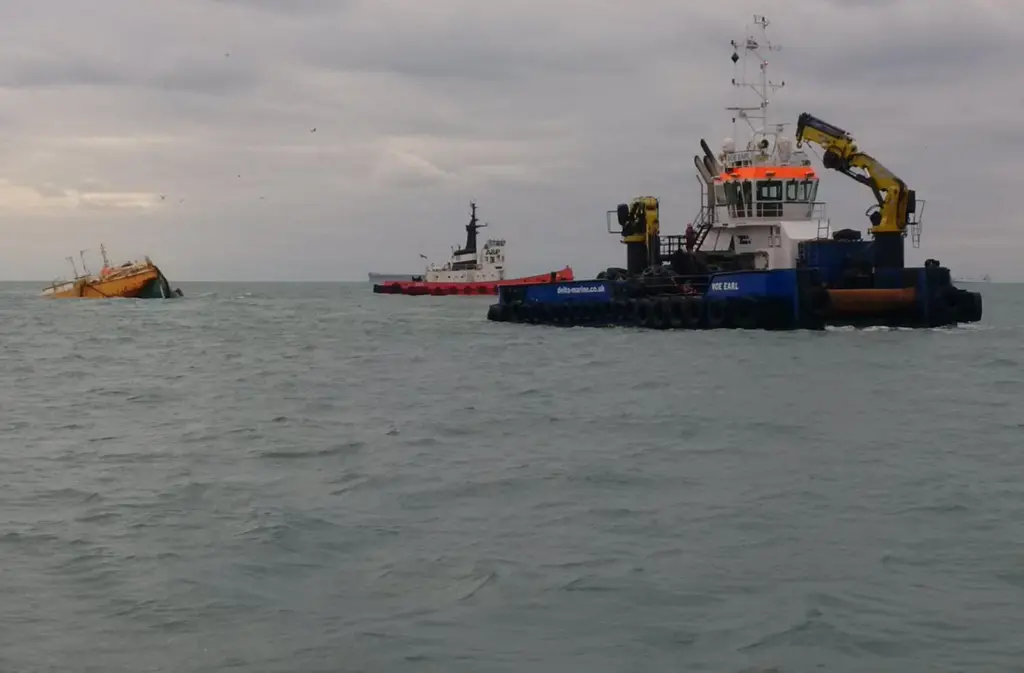
Towing assignments often involve strange shaped objects and the Wello Penguin Wave Energy Converter fits the bill being an asymmetrical-shaped, steel-hulled structure displacing 1,200t with a length of 30m, beam of 19m and draught 6.8m. It converts wave energy to electrical energy through continuous rotational movement rather than the more common back and forth movement.
Delta Marine allocated their most powerful vessel, the 54tbp, Damen Multi Cat 2613 Voe Earl for the tow. The versatility and capability of the Multi Cat design is demonstrated with its employment for this coastal tow and Delta Marine has provided MJ with details of the passage providing an interesting insight into the planning of the tow from one end of the UK to the other.
Smit Towing Brackets were fitted to the Penguin for connection of the tow line using Voe Earl’s 700m long 48mm diameter tow wire connected to a bridle and stretcher on the Penguin. An emergency tow rig was also provided. Green Marine’s Damen Stan Tug Green Chief (an ex Delta Marine vessel) assisted with un-berthing and streaming of the emergency tow messenger before departure.
Particular attention was paid to passage planning given the timing of the voyage (January) and routing down the UK west coast. Departure from Kirkwall was followed by passage through the String and Shapinsay Sound, south down the east side of Orkney then west through Pentland Firth. The convoy then headed south through Minch towards the North Channel, through the Irish Sea, down St George’s Channel to Lands’ End, TSS East Bound to Lizard Point and up to Falmouth.
The passage involved 37 waypoints and covered a total of 719nm over 205 hours at average speed 3.5 knots. Weather routing information was provided and forwarded to the tug via both Inmarsat and where possible, land-based connection. Criteria for diversion and the seeking of shelter included restrictions of wind force 6 maximum and wave height 2m.
While previous experience of towing Penguin indicated a speed of up to 5 knots the likelihood of bad weather determined a towing speed of 3.5 knots. Total fuel requirement for the trip was estimated at 75,400 litres.
Extensive emergency contingencies were included. Availability of two main engines on Voe Earl provided a high level of redundancy to such an extent that continuing the voyage in the event of losing one engine was considered acceptable. As boarding of the Penguin following a towline failure would be unlikely the emergency towing provision would be deployed until reconnection of the main towline could be considered.
By Peter Barker

Related Articles
 SPECIAL REPORTS
 TUGS & SALVAGE
 EQUIPMENT