
Composite survey vessel
UK-based boatbuilder and regular Seawork exhibitor CTruk Group has made a significant breakthrough into the survey vessel market with the delivery of a first-of-class boat to the Port of London Authority (PLA).
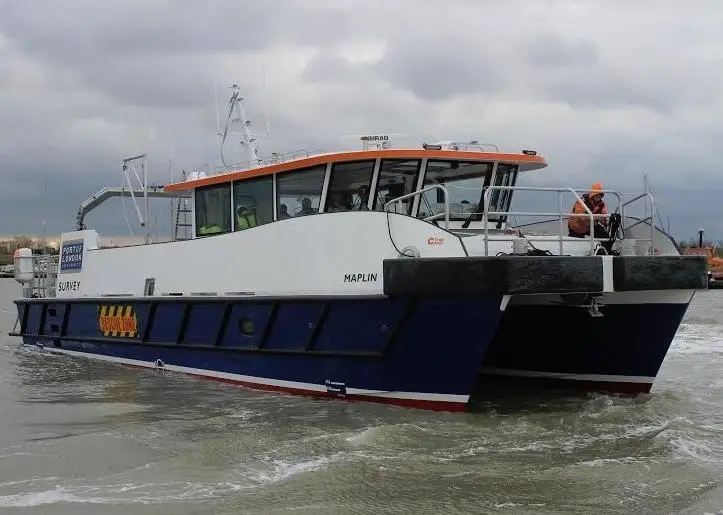
The 17m Maplin builds on CTruk’s pedigree as a leading supplier of composite catamaran workboats to the offshore wind farm support market and the company has incorporated many of the lessons learned from building these vessels (WFSVs) into its survey boat design.
Maplin, which was built at CTruk’s Colchester facility, will serve the PLA in Thames river and estuarial waters where its flexibility will prove invaluable, providing the advantages of a catamaran hull form that offers considerable working deck space and a composite structure that will significantly reduce maintenance costs. The boat has deck space of over 30 square metres and displaces 28 tonnes.
Added flexibility results from a matrix of fixing points on deck that enables additional cargo to be lashed, carried and stored, including items such as small buoys lifted on board using the boat’s deck crane, a Bonfiglioli 2300 that has a 720kg capacity at three metres. In addition, a Hercules Hydraulics fixed winch, with maximum capacity for 1200kg, allows for the launch and recovery of a daughter craft, while a C-MAX CM2 portable sonar winch can be removed to facilitate further use of outside space.
PLA Port Hydrographer John Pinder explained: “We have a wide ranging fleet which enables us to work on the river or out into the North Sea and nowadays we are doing more and more environmental and geophysical case management work. With things like acoustic current profiling, parametric sonar or magnetometers, we need to deploy more equipment. Although we have been getting excellent results with the multi-beam sonar for a number of years, the increased working deck space of the catamaran allows us this greater flexibility. Maplin has a high freeboard and good working areas inside and out. Indeed, the quality of the fit out has been to a very high standard.”
“We intend operating Maplin in the river but also out in the estuary and I envisage we will experiment with using the boat to work longer days, which will enable us to exploit a wider weather window.”
CTruk Chief Executive Andy White added that the company’s experience working in the demanding offshore wind environment had been a key factor in tailoring the hull form to the survey market.
“Having built nearly 30 WFSVs, developing a catamaran for the survey market was a natural progression. The boat’s attributes and its structure are ideally suited to carrying out a wide range of tasks around ports and harbours and several other port authorities are looking closely at our designs.”
The vessel is based on the CTruk MPC19 catamaran which has been proven to have good stability and seakeeping characteristics. The stability will enhance survey capability, allowing more effective use of the multi-beam deployable sonar unit built into the hull, while the boat’s versatility as a workboat will benefit from the bollard push characteristics also utilised in the design’s offshore wind application.
As composite workboat construction costs compare more favourably with aluminium and steel, operators of small survey craft are increasingly favouring composites, which eliminate the corrosion problem.
“By going for FRP construction, we have achieved a considerable reduction in weight which we expect to result in a fuel saving of up to 20 per cent. After problems with corrosion in metal boats over the past few years, we also expect composite to provide considerable maintenance benefits,” adds John Pinder.
The first-of-class PLA boat, which displaces 28 tonnes, has another special feature in a low profile wheelhouse and retractable mast, specially designed for the boat to gain access under the low bridges of the Thames.
Maplin is powered by two Volvo Penta D13-700 engines providing 700bhp (515kW) which power twin Rolls Royce FF45 water jets, giving a maximum speed of 24 knots. A Simrad 6kW Open Array radar is fitted, while other equipment includes an Autopilot AC70; Saab AIS communications system; Simrad NS EVO2 GPS and an HS70 GPS compass.
By Phillip Rood