

Seeadler joins Weser workboat fleet
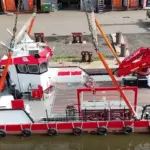
Weser operator Bremenports has taken into service the €1.4 million eco-friendly sounding and survey boat Seeadler – the latest addition to a fleet of versatile workboats serving the River Weser and the German sister ports of Bremen and Bremerhaven.
The new boat was not being officially named until the spring, Bremenports told Maritime Journal. However the compact 16.1m, 4.94m wide Seeadler has actually been in trial operation since the end of February.
It is replacing the bremenports 14m long and 4.65m wide survey boat Kiek ut, which has operated in Bremerhaven for 25 years. That boat in turn is being moved to Bremen to replace Habau 24, a sounding and survey boat which has been in service for 46 years and is now being mustered out.
Seeadler was built by the small Schiffswerft Hermann Barthel in Derben on the Elbe and was also designed by that yard with the approval of owners and operators Bremenports.
Barthel has a well-earned reputation as a designer, builder and supplier of specialist workboats of quality – not only for private use but also for state and government water and shipping agencies. In 2007 Barthel also delivered the multi-purpose 18m x 6m Taucher Bremenports to Weser ports authorities for diving support and a comprehensive range of other project work. Bremenports reports “good co-operation” with the yard.
Among the duties of the latest Barthel newbuilding, which cost about €1.4 million and draws just 1.3m, are the measurement of water depths to maintain navigational safety in the ports and the locating of underwater objects. It also determines shipping possibilities in fluid mud areas and carries out underwater inspections on locks, bridges and quays. Those works all take place at regular intervals or if needed when dredging operations are required or at the request of the Harbourmaster.
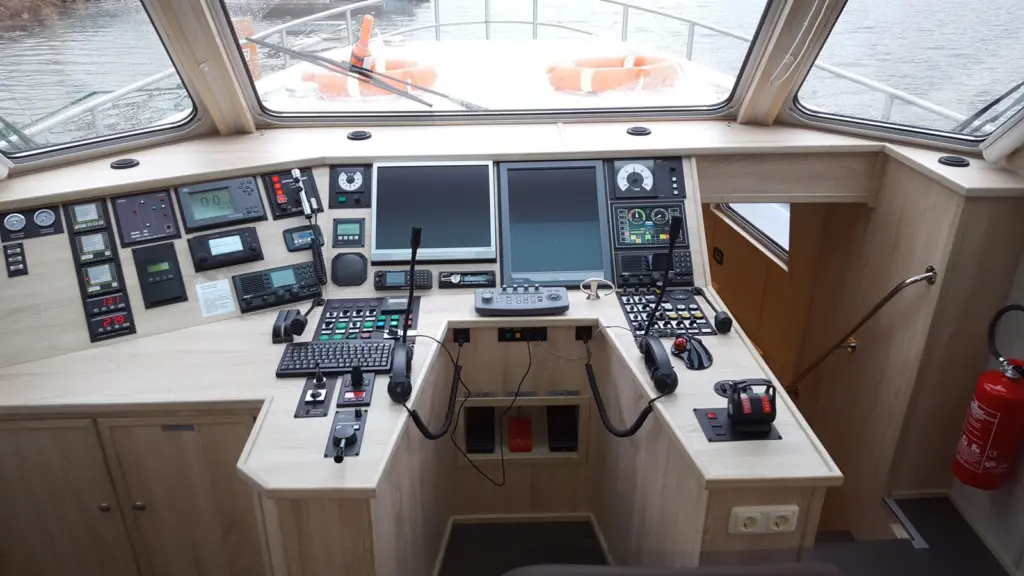
Generously outfitted with high-resolution state-of-the-art survey, sounding and data acquisition equipment, Seeadler carries a multi-beam sonar plant Type R2Sonic 2024 of 700kHz which has additional backscatter options for high-resolution object recognition and ground classification. Also on the boat is a Trimble SPS 855 RTK GNSS sensor positioning system, combined with an iXBlue Hydrins inertial navigation unit for the acquisition of navigational and ship movement data. The inertial system also provides positioning data during short shading breaks in GPS satellite cover. Seeadler also boasts a 2-frequency single vertical beam sonar (15/210 kHz) for fluid mud determination and Eiva NaviSuite hydrographic software for navigation and date collation.
Eco-friendly and emission free propulsion was a requirement for the newbuilding from the outset and part of a now consistent Bremenports green power policy.
The owners plumped for an unusual, eco-friendly hybrid propulsion system for Seeadler that has drawn attention. It consists of a modular High Torque Power Drive (HTP) from Torque Marine in Hamburg and a Scania DI13 075M Diesel genset of 323kW at 1500/min and 376kW at 1,800/min, with a flanged, water-cooled permanent-magnet generator of 230 KWe and a water-cooled redundant torque motor of 220 kWe. The motor is powered by a thrust bearing without an intermediate gearbox and provides 9 knots over a 5-bladed Thies fixed propeller. The genset’s double frequency characteristics mean it can be deployed at 1500/min for manoeuvering or for lock and other movement while the electronics switch automatically to 1800/min when higher performance is required.
Scania says that its engine’s own management system in combination with electronic pump injector units deliver “excellent fuel economy and low emissions”. Elaborating on that, Bremenports spokesman Rüdiger Staats said the Scania Diesel “lowers fuel consumption by 25%” while clean operation meant “up to 85% less N2O and up to 20% less carbon dioxide emissions”.
Staats said another speciality of Seeadler were its built-in lithium iron Li Fe PO4 batteries which can be used to store surplus energy from the propulsion plant. The boat has ten battery modules with a combined nominal total rated output of 105.4 kWh at 528 V.
Staats said “using just its batteries the boat can be operated completely emission-free during short trips in port”. He added “that’s a completely new propulsion system for us and personnel are having to be especially trained to operate it”. Also available on Seeadler is a Side Power transverse thruster of 40kW capacity which aids manoeuvrability.
The new survey boat is the latest in a series of specialist boats with wide capabilities which Bremenports has brought into service in Bremen/Bremerhaven in recent years. They are part of an ongoing fleet modernisation programme in the Weser ports – which make up Germany’s second biggest universal port complex after Hamburg and handle some 8,000 ships and 80 million tons of cargo a year.
In 2014 Bremenports introduced the 16.76m long and 5.94m wide multi-purpose tug Albatros. The Damen-built Type STAN 1606 tug tackles a wide range of jobs, one of them icebreaking.
A year earlier another multi-functional workboat joined the fleet. The 16.25m long and 4.5m wide Moewe was built at the Bolle Shipyard on the Elbe and its main job is the inspection, maintenance and repair of port facilities. It complements the work of Barthel’s Taucher Bremenports and of the 40m water injection silt and sand dredger Hol Blank, built by local yard Lloyd Werft Bremerhaven in 2006.
More specialists will follow Seeadler this year as part of Bremenports’ Green Port strategy, introduced several years ago. This spring the operator will take delivery of Greenport 1, claimed to be the world’s first hopper barge with optional LNG drive capability.
The 70.5m hybrid-propulsion barge was being finished off at the Dutch yard of DBI Borkum in Foxhol and will have a capacity of 840 m3. It is a pilot project costing €4.9 million, of which the EU is putting up about €1.65 million.
By Tom Todd