

Tidal flats newbuild is jack-of-all-trades
North German authorities have taken a new, multi-talented maintenance boat into service to guarantee regular ferry access in the tidal flats between the mainland and the East Frisian Islands.
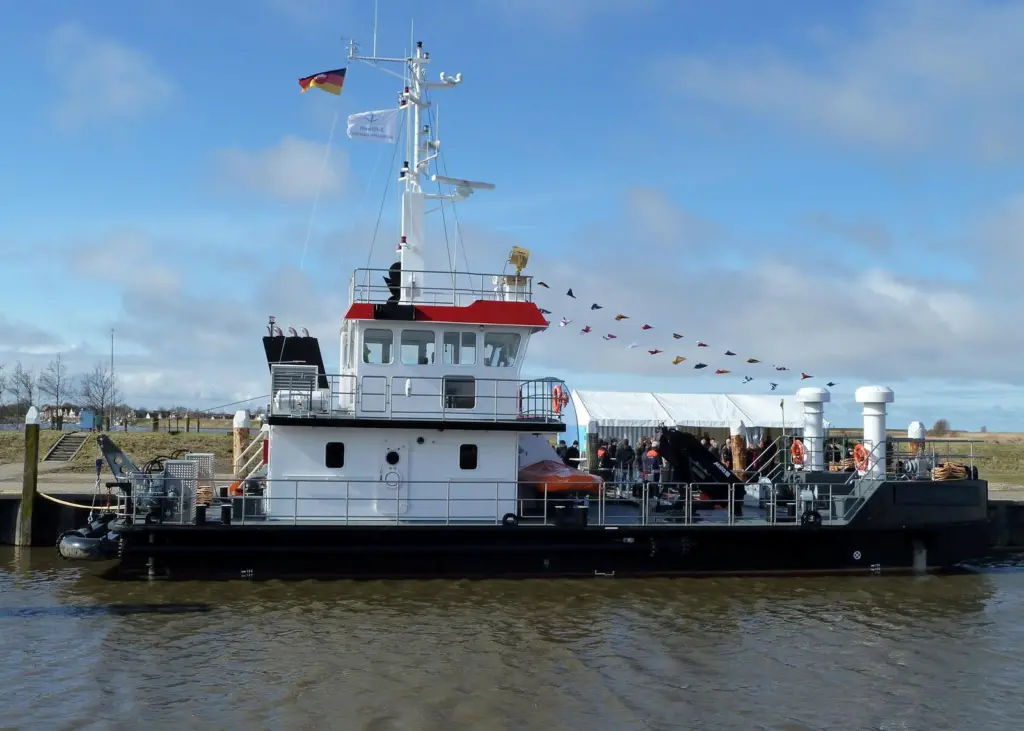
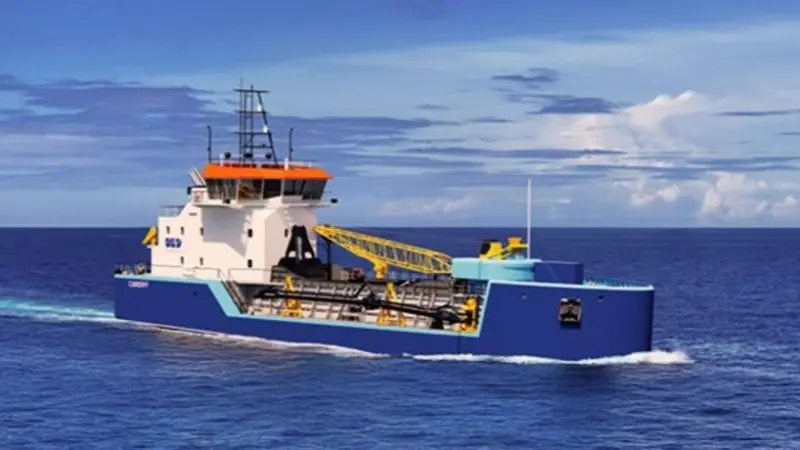
The 23.5m and 7m wide Utlandshörn was built at the Schiffswerft Hermann Barthel inland at Derben on the River Ebe. That small ship and boat facility is a yard of choice these days for many local authorities operating specialist small workboats.
Utlandshörn was built for the Lower Saxony Water Management, Coastal Defence and Nature Conservation Agency (NLWKN) in Norden. It replaces a 60 year old predecessor which had to be mustered out in 2010 because it was not technically up to the job.
Since then the work has been undertaken by the NLWKN’s only other maintenance boat Hooge Hörn. Lower Saxony Government official Almut Kottwitz said at a naming ceremony that the new boat had become “absolutely indispensible” because Hooge Hörn had also not been capable of meeting the demands on it.
Kottwitz said the job of the new boat would be to guarantee the maintenance of water depths along the east Frisian coast and in the Ems Estuary and functional access to inland areas. It is however not just a local unit and is classed for national coastal waters operation.
NLWKN official Stephan-Robert Heinrich said the new ship would also be used for ‘push and pull’ work and coastal protection as well as for oil and other pollution accidents and for small-scale transport tasks.
The versatility of Utlandshörn is reflected in the ca. €4 million which the state of Lower Saxony has invested in it because of the absence for several years of a new boat for tidal flats maintenance.
That absence has embarrassed even experienced local island ferry operators of late because several have run aground in shifting sands. In January the 63.5m Frisia II grounded on a sandbank between Juist and the mainland for 12 hours with 650 passengers. Two ferries grounded together last year and rescue services took off passengers.
Utlandshörn has two main SCAN engines each of 276kW @1800 revs/min driving two stern rudder propellers from Schottel, each of 190kW and 2100 revs/min. The NLWKN said along with the boat’s 40kW/1800 revs/min Jastram bow thruster, ample manoeuverability and turning capability is provided,
To cope with regular maintenance work, the newbuilding is fitted with a water injection system which the NLWKN described as “appropriate and efficient“ and which boasts two circulating pumps from Germany’s KSB, each capable of delivering a maximum 1500 m3/hour but which can be regulated. L+P Naval Consult Lasse und Pache in Bremen along with the boat’s builders Hermann Barthel helped the NLWKN through the complex planning a EU tenderingt process for the boat.
By Tom Todd