



Dual fuel drive for new German specials
Two new German multi-purpose emergency response ships planned for operation from 2019 will get dual fuel LNG/Diesel propulsion.
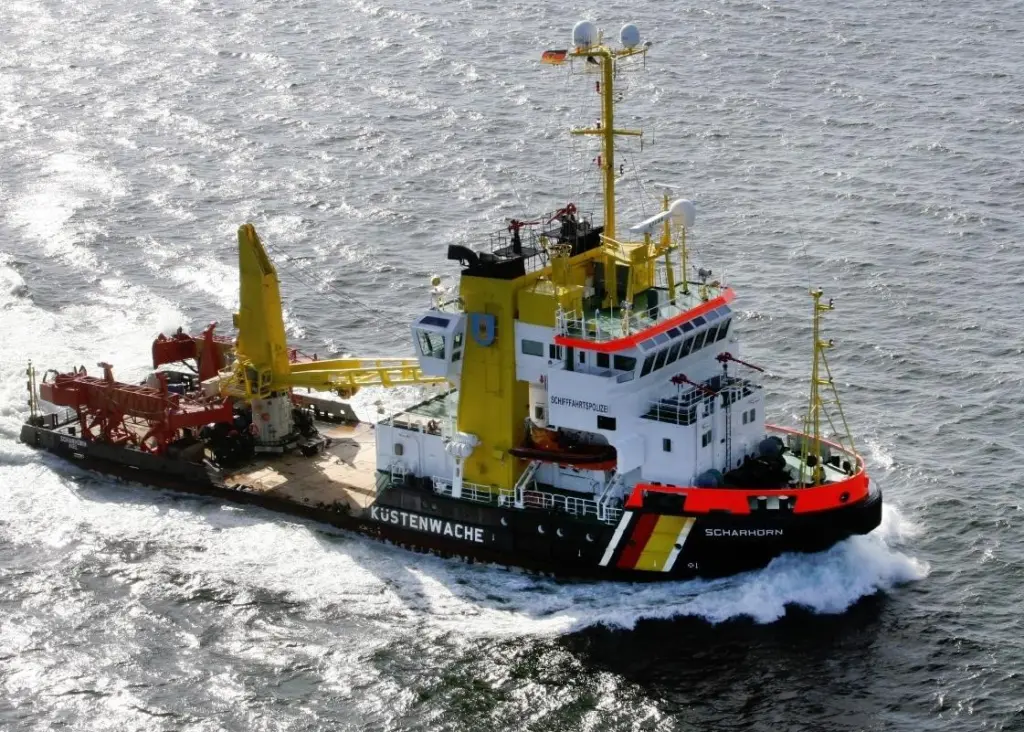
The Budget Committee of the German Bundestag (Parliament) in Berlin approved the plans to acquire the two new ships, up to 85m long, to replace the existing emergency response ships – the 51m, 42 year old Scharhörn and the 80.4m, 32 year old Mellum.
It also decided the new ships would get as yet unspecified LNG propulsion systems and it allocated €13 million per ship. The original tender invitation stipulated Diesel-electric propulsion.
Coalition Government spokespersons Bettina Hagen and Norbert Brackmann said the additional cash meant each planned newbuilding now had funding totalling €113 million, of which €67 million is available in the 2017 budget.
Hagen and Brackmann said the Government’s long-term aim was to provide “secure and clean shipping, particularly in the light of EU climate goals”. The potential of dual-fuel (LNG/Diesel) propulsion was particularly significant, they said.
For service in the North Sea the two ships will be equipped to deal with accidents involving oil and other dangerous substances such as chemicals as well as fight fires and act as tugs.
They are just two of many specialist ships being renewed over the next few years by a German Government not only anxious to replace ageing specialist service tonnage but keen also to introduce eco-friendly propulsion systems.
As news of the propulsion plans surfaced, so too did speculation that a decision was likely before year’s end on who would build the 75m replacement for another sophisticated German vessel – the 30 year old hydrographic, wreck search and research ship Atair.
An invitation to tender closed in 2015 but operators the Federal Maritime and Hydrographic Agency (BSH) in Hamburg have so far not revealed which shipyard will build the new ship.
German media reports however said a decision was expected to be announced in December –something which a spokeswoman for the BSH appeared to neither confirm nor deny. She told Maritime Journal in late November “we are not able to release any information (about Atair) before the end of December 2016”.
The existing 51.4m Atair is one of three specialist hydrographic, wreck search and research ships operated by the BSH on behalf of the German Government. Its replacement will be up to 75m long with a service speed of 11 knots.
The tender also stipulated the ship would be innovative, economic, energy-efficient and eco-friendly, accommodate 18 crew and 15 scientists and carry laboratory containers and two on-board tenders.
Reports in 2015 said it would be the biggest German ship of its kind and spoke of anticipated costs of around €80 million. The plan, they said, was to have it in service by 2018.
By Tom Todd
Related Articles
 POWER & PROPULSION
 VESSELS
 POWER & PROPULSION