![MaritimeJournal[Seawork]](https://www.maritimejournal.com/wp-content/uploads/2026/09/MaritimeJournalSeawork.svg)


Lengthy salvage operation for Five Oceans Salvage
The recent salving of a stranded bulk carrier demonstrated the difficulties of operating in remote locations with limited local resources, in the end damage to the environment was minimised but the ship lost the battle.
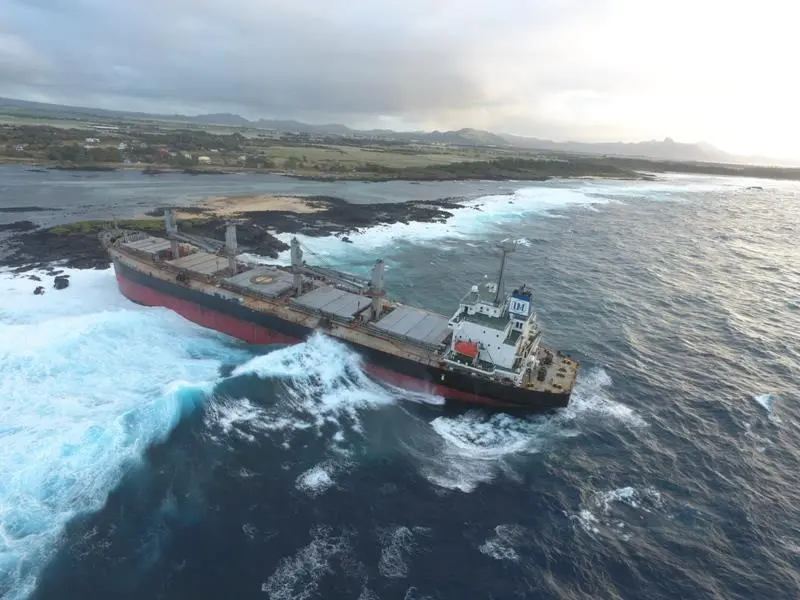
The bulk carrier Benita (44,100dwt) was on passage from India to Durban, South Africa when it ran hard aground on the coast at Le Bouchon, Mauritius. Athens-based Five Oceans Salvage agreed a LOF contract with the owners the same day, its tug Ionian Sea Fos sailing immediately from its salvage station in Port Louis while a 15-strong salvage team were despatched from Greece. Over the next few days the tug Coral Sea Fos sailed from Dubai to assist and an additional 30 people including welders, riggers and divers were also mobilised.
Damage to Benita was severe with most of the double-bottom tanks, three of the five holds and the engine room flooded. Following a common procedure, steps were taken to maintain the vessel in its grounded position to allow the removal of its bunkers to minimise the threat to the environment. The vessel was sitting on a reef with surf waves of between four and eight metres ruling out transfer of personnel and equipment by sea. The salvors were however able to secure the services of local police helicopters to assist in the transfers.
Restrictions with the helicopters’ lifting capacities required heavy equipment to be broken down into components of less than one ton and reassemble them once on board. Removal of the bunkers and other pollutants also had to be conducted by air as the tugs could not approach closer than 200m and in a herculean task the pollutants, including 145t of fuel oil were transported ashore by helicopters in a total of 235 cubitanks.
JV partner Swire Emergency Response Services mobilised an array of antipollution equipment and personnel to Mauritius to deal with any oil spill and clean-up requirements ashore. Oil spill response specialists from around the world were brought in along with equipment including: pumps, skimmers, booms along with specialist ROV and drone technology to observe the vessel and coastline.
Logistical complexities included problems with access to the ship which called for construction of a 10m x 10m platform and access way ashore to act as a work platform and local command centre.
With the two tugs unable to approach closer than 200m, making a towing connection presented a particular challenge and they were eventually able to link up with Benita using lightweight Dyneema towing lines. The vessel was successfully refloated some five weeks after the initial grounding with the original plan being to tow it to India. The extensive bottom damage proved however to be too severe and Benita sank around a week into its voyage in a charted depth of 4,400m around 93nm north west of Mauritius. The clean-up operation ashore was to continue for many weeks after the refloating.
By Peter Barker

Related Articles
 SPECIAL REPORTS
 TUGS & SALVAGE
 EQUIPMENT