
14m aquaculture workboat
Scotland’s Macduff Shipyards Limited has recently signed over its latest new build, ‘Lily Mae’, to Scottish Sea Farms Limited, Shetland Division.
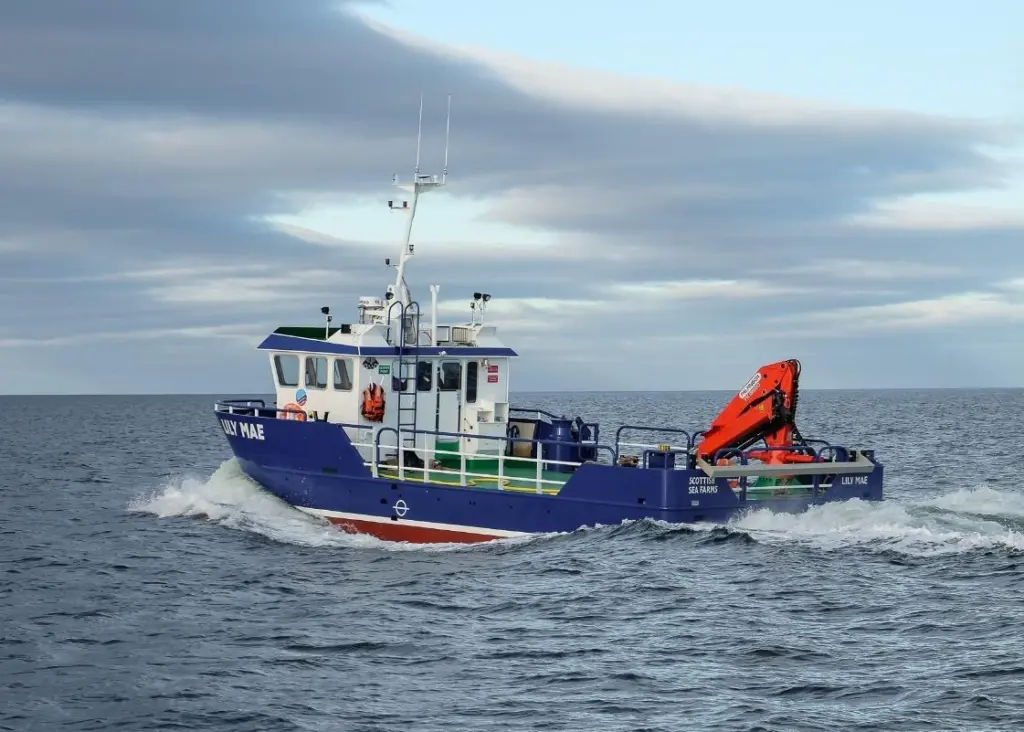
Designed to be a general purpose workboat specifically focused towards working within the aquaculture industry, Lily Mae recently completed trials in the Moray Firth successfully and has now been sailed back to the vessel’s home port.
The vessel is arranged above deck with the wheelhouse and raised deck forward and a large open deck aft. Below deck the hulls are sub divided with an aft peak containing the steering gear, engine rooms in the centre and a forward peak. The wheelhouse has been fitted to the yard’s typical high standard and is laid out with a helm station on the starboard side and a galley/mess area to the port side.
A catamaran with a length of 14.00m, beam of 6.20m and a depth of 2.10m, Macduff says the vessel exhibits great stability and large working deck of approx. 60m2 and is capable of carrying 20t. A Palfinger PK18500(M)B deck crane is fitted which is capable of hoisting 1600kg at 10.1m outreach along with two separate Rapp Marine capstans with a pull of 5t and 1.5t. Operations are designed to take place primarily over the starboard side and transom where there are removable railings which fit into flush mounted stainless steel sockets. A large HDPE sacrificial wear panel is fitted along the starboard side of the vessel in the region that contacts and rubs against the salmon cages to provide extra durability.
The propulsion package consists of two Iveco N67 diesels with a power of 260hp each driving 965mm diameter open propellers through PRM 4:1 reduction gearboxes. On trials the vessel achieved an average top speed of 10.0 knots.
The vessel was designed between the yard and Macduff Ship Design who also created the hull construction plans and drew the profiles for the steel kit. The steel was supplied in kit form by Macduff Profilers using their gas and plasma CNC profiling machines. Macduff Ship Design also carried out the incline test and produced a full stability booklet for the vessel.
By Jake Frith