
Germans go abroad for new research ship
For the second time in less than six months the German Government has ordered a new state-of-the-art research vessel – only this time, unusually, the order has gone to a foreign shipyard.
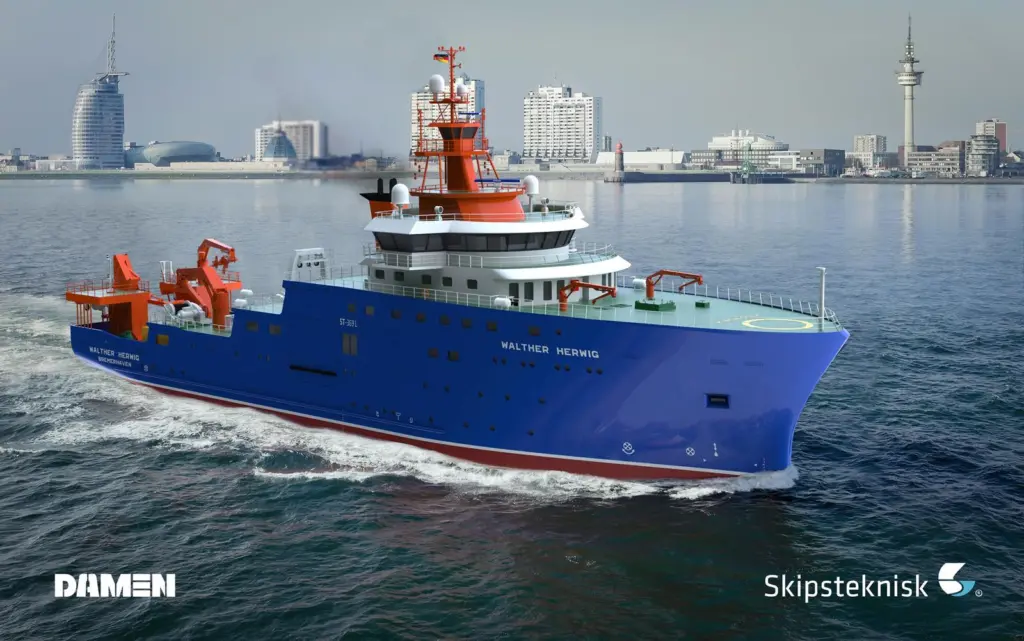
The German Federal Office for Agriculture and Food (BLE) placed the €85 million contract for the new 84.7m long, 17.4m wide fisheries research ship Walther Herwig with Dutch shipyard Damen. It will be built at Damen’s Galati Yard in Romania for delivery expected in January 2020 and based on a design developed by Damen and Norwegian designers Skipsteknisk.
The German Government usually orders research ships at home and this correspondent cannot remember one ever being built abroad.
In December Berlin ordered the €113.8 million DF drive survey, wreck location and research ship Atair at Fassmer Werft.
Asked why a foreign shipyard had been selected this time, BLE spokeswoman Barbara Moitz told Maritime Journal the invitation to tender had been a European one. “The most economical tender won the contract. However the word “economical” does not refer exclusively to price”, she added.
The newbuilding will draw 5.5m and be of 4,450dwt. It will have an eco-friendly diesel-electric propulsion system of total 4,800kW with SCR and soot particle filters. An as yet unspecified main engine of 3,000kW will drive a shaft and fixed propeller and the ship will also have a 1,000kW bowjet and bow and stern thrusters of 548kW.
The Federal Waterways Engineering and Research Institute (BAW) is supervising design and construction. Spokesman Benno Lenkeit told this correspondent in late March the choice of technical components, equipment and fittings were not yet known. They were being selected and determined during the development stages of the project, he said.
In terms of scientific facilities and equipment however, the ship will have a 300 m2 fisheries and work deck and be outfitted with two hangars, wet and dry laboratory areas and trawling gear for fisheries research. For physical and biological oceanographic studies, the ship’s scientists will have winches capable of operating equipment to depths of up to 6,000 metres.
The new Walther Herwig will serve with the Thünen Institute which operates three fishery research vessels on behalf of the BLE. It will be the biggest in the BLE fleet. Currently the biggest is the vessel it will replace in three years time – the 64.5m research stern trawler Walther Herwig 111, which will be nearly 30 years old in 2020.
Barbara Moitz said that as of late March this year it had not been decided what would happen with Walther Herwig 111 after its replacement.
The new Walther Herwig will accommodate 26 crew and 26 scientists and its main areas of operation will be the North Sea, Baltic and North Atlantic.
By Tom Todd