![MaritimeJournal[Seawork]](https://www.maritimejournal.com/wp-content/uploads/2026/09/MaritimeJournalSeawork.svg)


Natural gas fleet concept receives approval in principle
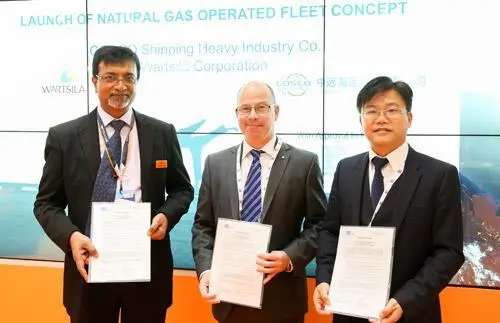
A consortium of Wärtsilä and COSCO Heavy Industry Co (CHI) have announced the joint development of a natural gas operating fleet concept which includes a dual-fuel tug as part of the operation.
Development of the use of alternative fuels in the shipping industry is proving to be a disciplined master to please. Certain factors, including the availability for example of LNG, influence the economic and operational viability of deciding whether or not to go down what is considered to be a greener (and hopefully cheaper) road.
The fluctuating price of conventional fossil fuels also affects the equation, the towage industry recognised as having an operating profile that could attract a more economical and environmentally-friendly solution with alternative fuel options.
The typical profile for example with ship-handling tugs where only a small percentage of their time is spent using full power is attracting the development of hybrid and LNG or dual-fuel powered machinery to achieve a more economical and cleaner solution.
The Wärtsilä, COSCO LNG natural gas operating concept has now obtained Lloyd’s Register’s Approval in Principle, the project carried out under terms of a memorandum of understanding signed in June 2016 between the three companies.
The aim is to offer global operators a more efficient and economical fleet design meeting current and anticipated environmental requirements according to classification society rules. The fleet comprises four vessels: a pusher tug, LNG storage barge, LNG regasification barge and a floating liquefaction natural gas barge. The pusher tug can be used to transport the three barges.
Advantages of the concept are stated as including flexibility and the fleet’s competitive CAPEX and OPEX costs, the pusher tug making the units mobile and transportable. The number and choice of units will depend on the project as not all of the units would necessarily be needed for every project. For example, it can be utilised to act as an LNG carrier (using only the pusher tug and LNG storage barge) or can be used for more complex projects involving liquefaction and regasification utilising all units.
The modular design of Wärtsilä’s liquefaction and regasification units is claimed to be an ideal concept for gas plants in the 50-200MW range, the low draught would also make it attractive for gas power plants in South East Asia.
The design and engineering development, especially the hinge joint, mooring arrangements, ship type and seakeeping analysis has been carried out by CHI. Wärtsilä brings its experience and expertise in LNG systems to the project including its dual-fuel engines and steerable thrusters. Its contribution could also involve its LNGPac gas storage and supply system, a Wärtsilä liquefaction module along with its LNG cargo handling system and regasification module.
By Peter Barker

Related Articles
 SPECIAL REPORTS
 TUGS & SALVAGE
 EQUIPMENT