

Hybrid alternatives
Saft has provided the energy storage for a number of different vessels, but two, in particular, highlight the very different issues that hybrid configurations are now answering.
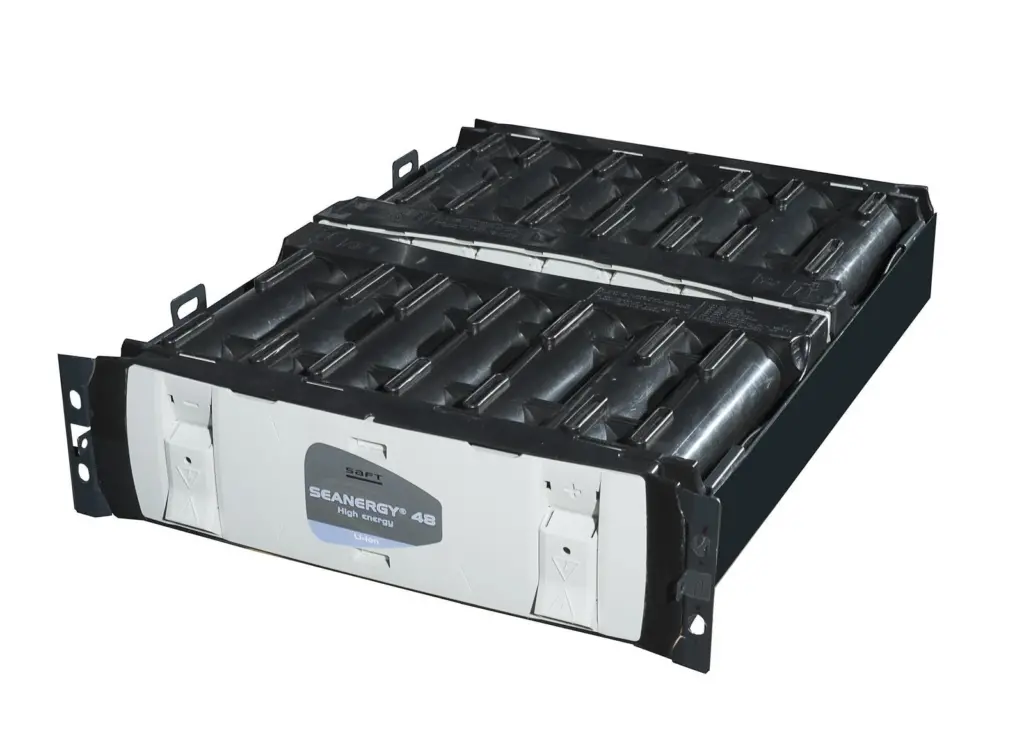
The Natural Environment Research Council (NERC)’s polar research vessel, RRS Sir David Attenborough, is being fitted with a pair of 4.5m diameter propellers giving it a 13 knot transit speed, powered by four Rolls-Royce Bergen B33:45 gensets. However, alongside them will sit a pair of Saft Li-ion battery banks.
These two hefty 700kWh units will power the 129m vessel during periods of ‘silent running’ – either while in close proximity to fish or mammals, or while towing sensitive recording equipment.
Further, they will be called on to shave the peaks from the most acute loads. While not unusual, this goes well beyond supporting dynamic positioning and hotel functions: the batteries have also been sized to shoulder the enormous demand from the engines as Sir David hammers its way through metre-thick ice, explained Jayesh Vir of Saft.
Moreover, the banks will have to keep running reliably as operations will take Sir David some 19,000 nautical miles from home: “The most critical missions are passed through the battery,” he pointed out.
However, even with a capacious battery array, the extra heat generated by the draw could cause problems. Mr Vir underlined he’s not so concerned about dramatic thermal runaway issues of the kind illustrated by aircraft fires and battery explosions. He explained SAFT’s ‘Super Phosphate’ chemistry (lithium iron phosphate combined with another element) “is inherently much more stable” than the common lithium cobalt oxide (LiCoO2) varieties found in consumer electronics or lithium nickel manganese cobalt oxide (LiNiMnCoO2 or NMC) proposed by various other actors in the marine market.
Further, while energy density is a little lower, contrarily, power density – the rate that energy can be drawn from these cells – is actually a little higher. The batteries also have a very constant 3.2V discharge voltage, as it doesn’t tail off at the end it allows the system to squeeze more from the cells.
Despite all this, a rise in temperature does artificially age the cells, cutting down their cycle life. As a result, the system needs extremely efficient cooling, and so Saft worked on upgrading the fan and heat extraction units in Sir David’s dedicated battery room. He added that the adaptation proved so successful, Saft “will be using this on all its systems; it’s a real advantage”.
The onboard energy system has to cope with more than just heat, there’s the other extreme to consider: “We needed to make sure the battery array would work in polar regions,” he explained. Although the cells can withstand temperatures below zero, they won’t pick up a charge and other elements of the system are likewise affected by the cold. “So, we need to keep the system out of the colder temperature ranges even if it’s not being used,” explained Mr Vir.
GREEN EFFICIENCY
By contrast, Caledonian Maritime Assets Limited’s latest hybrid ro-ro ferry, MV Catriona, isn’t focused on extreme environments or even a high power draw. Despite this, its battery array is also very tailored: Mr Vir explained CMAL’s overriding concern “is to be as green as possible… combining the batteries and diesel in the most efficient way”.
The 43.5m Catriona can accommodate 150 passengers, 23 cars or two HGVs and will initially be deployed on the Claonaig to Lochranza route, making 10 or so crossings a day. Surprisingly, it relies only on three, modestly sized Volvo Penta Marine D13 MG gensets, supported by a large battery bank of 800kWh, to power its 375kW permanent magnet motors and Voith 16 R5 EC/90-1 propulsion units.
However, CMAL’s green agenda means the pattern of operation, “is to discharge during the day and recharge during the night… eventually from renewable, clean energy” explained Mr Vir, minimising onboard charging from the gensets.
It’s plausible because there’s a distinct pattern to the ferry’s operational profile – and of course, it benefits from a shore power link at its home berth.
Therefore Catriona could set out on a single engine or even battery alone to avoid polluting the more populated zones, boosting the genset power with the hybrid installation during acceleration when clear of the harbour to give the engines time to pick up the load, then settling into steady running for the 9 knot transits.
Interestingly, the 800kWh Seanergy system is, Mr Vir explained, 50% larger than either of its sisters’, MV Hallaig and MV Lochinvar. Operational experience with the first two vessels “showed that it would be possible to use battery power for more of the operation and further lower emissions on the same size of ferry”. The proof has been in the running: besides cutting out over 3,000 tonnes of CO2 during the vessel’s lifetime, there’s a 28% fuel economy: “A remarkable result,” said Mr Vir, going far, far beyond the usual, ball-park 20% savings.
These two vessels highlight the very different advantages that energy storage can yield. However, he pointed out detailed analysis is necessary in every case: “It’s never a matter of just supplying what’s been asked for,” said Mr Vir. SAFT’s in-house MATLAB simulation software, loaded with all the parameters, verifies the scale of the bank alongside other variables such as thermal behaviour, lifetime, and potential draw “to make sure we won’t be asking too much of the batteries”.
Even if the environment is asking a lot of the vessels themselves.
By Stevie Knight
Related Articles
 POWER & PROPULSION
 VESSELS
 POWER & PROPULSION