![MaritimeJournal[Seawork]](https://www.maritimejournal.com/wp-content/uploads/2026/09/MaritimeJournalSeawork.svg)


New eco-friendly tug designs from Wärtsilä
Helsinki-based technology group Wärtsilä has introduced three new tug designs featuring its HY propulsion system adding to designs and innovations aimed at addressing environmental and efficiency issues.
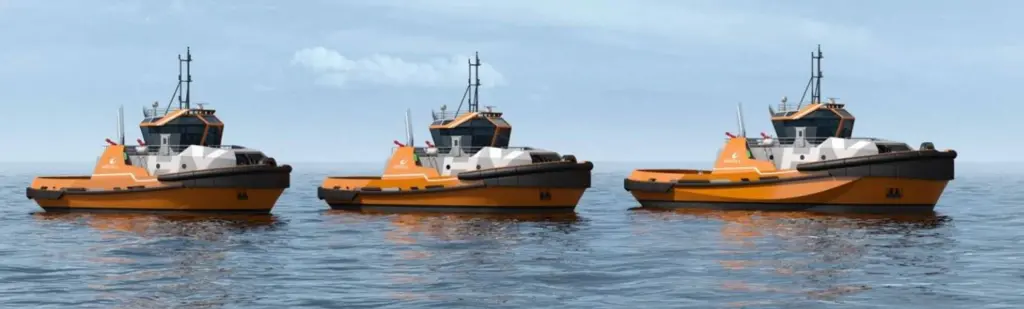
A growing sense of momentum is accompanying the development of ‘green tugs’ as operators, clients and regulators alike grapple with the desire to present operations that are environmentally-friendly and just as importantly from the business angle delivering improved efficiencies from vessels that by their nature have a wide range of power requirements which in some situations could be somewhat inefficient.
These latest designs, based around the Wärtsilä HY hybrid propulsion solution are claimed to offer flexibility and efficiency, addressing the problem of providing propulsion over a wide range of power from low speed light load transits to occasions when the full power capability of the tug is required virtually instantly. Providing such arrangements in an efficient and environmentally-friendly manner, particularly when close to residential areas is a subject increasingly occupying the attention of designers and builders.
The thinking behind the HY concept involves hybrid modules combining engines, energy storage system, and power electronics optimised to work together through a newly developed energy management system. Wärtsilä state it is the marine sector’s first hybrid power module of this particular type, establishing a new industry benchmark in marine hybrid systems. The energy management system allows the arrangement to be optimised for both individual market segments and specific vessel operating profiles.
Wärtsilä claims the total installed main engine power of the new designs is less than with conventional hybrid tugs, while maximum bollard pull is achieved via power boosting from batteries. The ability to use less engine power will lead to reduced emissions, reduced fuel costs and improved engine maintenance requirements it is stated.
Turning to the vessel designs themselves, three versions are proposed, two harbour tugs of 50tbp and 75tbp and an escort tug of 75tbp. The propulsion configuration is such that each design has the option to operate in either diesel-mechanical, hybrid or diesel-electric hybrid mode. Selecting the appropriate Wärtsilä equipment modules widens the range of potential bollard pulls available from 40t to 90t.
The HY Tug is capable of the normal range of duties including: berthing and unberthing; towing and shiphandling within ports and terminals; escorting at high speed (escort tug version) and the option of fire-fighting capabilities. The design has a distinctive appearance and is optimised for low hull resistance and high towing and escort performance while at the same time retaining good seakeeping, high manoeuvrability and safety and comfort for the crew. The variants include the adoption of the modular engine and hybrid propulsion concept and have received approval in principle from classification societies BV, ABS and LR.
Comparing the general specification of the three versions (50tbp harbour, 75tbp harbour and 75tbp escort) they have a LOA respectively of 28m, 29.5m and 35.4m on beams of 10.8m, 11.6m and 14m (all excluding fenders). Design draughts are 3.5m, 4m and 4.6m respectively with crew complement of eight, 10 and 12 persons. The two harbour versions have a speed of 12 knots, the escort version offering a slightly higher speed of 13 knots.
Wärtsilä provides an interesting comparison of the mid-range 75tbp version with conventional tug arrangements. A number of propulsion configurations are considered including medium speed vs high speed engines and fixed-pitch vs controllable-pitch propellers. The results indicate that best efficiency is achieved by Wärtsilä HY diesel-mechanical with controllable-pitch propellers and diesel-electric with fixed-pitch propellers.
Up to 26.4% less total installed mechanical power is claimed compared with conventional designs with an additional 1,500kW power boost also available. Maximum power availability is instant with zero smoke in certain modes and a duration of 25 to 55 minutes possible in Eco Transit mode along with a reduction of main engine running hours up to 58.3%. The diesel-mechanical configuration utilises two W8L20E main engines each rated 1,760kW at 1,200rpm while the diesel-electric version adopts W8L20 engines rated 1,600kW at 1,000rpm.
By Peter Barker
Related Articles
 SPECIAL REPORTS
 TUGS & SALVAGE
 EQUIPMENT