



No need to pick tomorrow’s fuel – just prepare for it: Damen
For tug operators, the most difficult question about decarbonisation may not be which alternative fuel to choose, but when to choose it.
A harbour tug ordered today should still be working three decades from now. During that time, fuel availability, bunkering infrastructure, emissions regulation and the economics of diesel, HVO, methanol and shore power are likely to change substantially.
Damen Shipyards Group is responding with its Fuel Flexible (FF) tug range: vessels designed to operate commercially today while being prepared for conversion as the business case for alternative fuels develops.
The concept is to build around a conventional diesel operating profile while incorporating the structural arrangements, tanks, spaces, machinery preparation and class notation needed to make future conversion easier. Damen believes the range comprises vessels prepared for conversion to various fuel solutions later in their lifecycles – and it hasn’t necessarily affected their weight or size.
Preparing for the fuel that comes next
“The idea,” says Damen’s Product Manager Tugs Erik van Schaik, “is that when making an investment in a tug today, you need something that is going to be able to compete in today’s market conditions.
“However, this is an asset that is going to operate probably for the coming three decades, and those conditions are liable to change in that time. The Fuel Flexible Tug is built to operate on diesel, but can be adapted once we have gained more clarity.”
As well as operating on 100% carbon-neutral HVO, the tugs provide space for a battery and switchboard or a methanol propulsion system. They also have future-proof methanol-prepared class notation and are ready for Damen’s Ultra Low Emission Vessel (ULEV) system, which is anticipated to combine a diesel particulate filter with Damen’s IMO Tier III-compliant SCR system.
The physical preparation for methanol includes tanks, preparation rooms and prepared main engines.
“The vessel is provided with methanol tanks, methanol preparation rooms and methanol prepared main engines,” says Van Schaik. “As a result, the ASD Tug 2713 FF can be easily retrofitted as a dual fuel diesel-methanol version during the lifetime of the vessel.”
Damen says the FF designs incorporate additional space for future installations, different welding procedures and tank constructions, and insulation in different locations.
ASD 2713 FF and methanol endurance
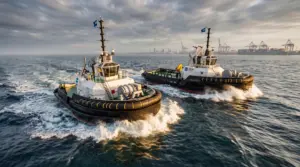
The ASD Tug 2713 FF is a 397gt, 27m by 13m tug offering 90 tonnes of bollard pull. It is intended for port and terminal operations, including handling large vessels such as LNG carriers. Its diesel tank capacity is approximately 126m³, compared with approximately 115m³ for methanol.
The lower energy density of methanol has a direct impact on endurance.
“The ASD Tug 2713 FF is designed to operate on single fuel diesel or on dual-fuel diesel-methanol,” Van Schaik says. “This can both be carbon neutral on HVO and green methanol. The operational range and endurance on single fuel diesel/HVO is approximately twice that of dual-fuel diesel-methanol. The ASD Tug 2713 FF still offers sufficient range on dual-fuel diesel-methanol for harbour and terminal operations.”
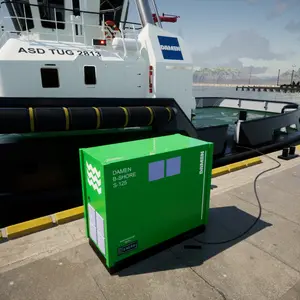
Damen’s propulsion strategy is based on different operating profiles. It identifies battery and shore connectivity as a potential solution for predictable, short-distance port or terminal work, while methanol is more relevant to less predictable duties or operations further from shore.
Keeping vessels compact
The additional structural requirements associated with methanol have not resulted in a major increase in vessel size or weight – two of the barriers to new fuels.
“Because we use an alternative design solution for cofferdams around the methanol tanks we can keep the fuel flexible tugs light and compact like our original diesel tugs,” van Schaik says.
The larger ASD Tug 3313 FF is 33m by 13m and 497gt, with 100 tonnes of bollard pull. It has approximately 240m³ of diesel capacity or 200m³ of methanol capacity, and a 110m² aft deck strengthened for loads of up to 5 tonnes/m².
Damen identifies long-distance towage, buoy and anchor handling, hose handling, oil pollution control, salvage, standby and rescue and firefighting among its intended duties.
“The aft deck construction is prepared for offshore and anchor-handling operations and not affected by the installation of the optional methanol package,” he says.
Methanol safety and bunkering
Van Schaik says a complete hazard study has been conducted with Bureau Veritas and the Dutch flag administration for the ASD Tug 2713 FF in both single-fuel diesel and dual-fuel diesel-methanol configurations.

“A complete hazard study has been successfully executed by Damen together with Bureau Veritas and Dutch flag for the ASD Tug 2713 FF in single-fuel diesel and dual-fuel diesel-methanol execution,” he says.
“There is only a toxicity, fire or explosion risk when methanol comes into contact with oxygen. The methanol tanks and methanol preparation rooms are fully closed compartments filled with nitrogen and A60 insulated. They are connected to the bunker station and the main engines by nitrogen-filled double-walled piping.
“In the design, contact between methanol and oxygen is prevented to prevent toxicity, fire or explosion risk. Besides this there are no hazardous zones on the vessel during normal operation. Only during methanol bunkering and maintenance in the fuel preparation spaces are there hazardous zones and special procedures have to be followed by the crew.”
Another barrier to new fuels is availability and bunkering, but van Schaik says methanol is already getting established.
“Fossil methanol is, in order of the biggest volume shipped around the world by chemical tankers, the fourth chemical,” he says. 2This means that there are methanol-bunkering stations in operation in a lot of ports. A lot of container vessels are also shifting towards methanol and ethanol as a fuel to provide carbon neutral transport of goods over so-called green shipping lanes.
“Big ports want to support this and already have to provide methanol bunkering for the cargo vessels. This means tugs can also use the green methanol and/or ethanol infrastructure provided to assist cargo vessels.”
Performance in different configurations
The 3313 FF can be fitted with FiFi 1 at 2,400m³/h or FiFi 2 at 7,200m³/h. However, installing the optional methanol package reduces maximum main-engine power from 3,200kW at 2,000rpm to 2,480kW at 1,800rpm.
“The ASD Tug 3313 FF can be provided with two optional fire-fighting systems.” Van Schaik says. “The FiFi 1 system at 2400 m3 per hour, which is mostly sold, and the FiFi 2 system at 7200m3 per hour. The maximum power of the main engines drops from 3,200kW at 2,000rpm to 2480kW at 1,800rpm after installing the optional methanol package.
“The FiFi 1 system can be operated at single-fuel diesel and on a dual-fuel diesel-methanol. Due to the power reduction of the main engines, the FiFi 2 system can only be operated at single-fuel diesel in the methanol-prepared execution of the ASD Tug 3313 FF.”
Cost of flexibility
Damen says the FF vessels are designed to be cost-comparable per tonne of bollard pull with standard models, with the conversion cost occurring later, when there is greater clarity and a return on investment can be expected.
“At a ‘cost-comparable sales price level per tonne of bollard pull’, the methanol-prepared ASD Tug 2713 FF with 90 tons BP is ±10% more expensive than the diesel ASD Tug 2813 with 80 tons BP,” he says.
“After the conversion with the optional methanol package the sales price of the dual-fuel diesel-methanol ASD Tug 2713 FF with 80 tons BP will be ±25% more expensive than the sale price of the diesel ASD Tug 2813 with 80 tons BP.
“So for an ASD Tug 2713 FF, the conversion with the optional methanol package will lower the bollard pull performance by ±10% and raise the sales price by ±15%.”
The decision to install the optional methanol equipment is linked to the economics of operating the vessel.
“Installing the optional methanol equipment package makes sense the moment it becomes a business case, because operating a tug on single-fuel fossil diesel or on single-fuel HVO is no longer allowed, or much more expensive than operating a tug on dual-fuel diesel/HVO-green methanol,” he says.
A 30-year view
Damen expects the economics of green methanol to change over the coming decades.
“At the moment, availability and demand for green methanol are both growing at approximately the same speed, which doesn’t lower the cost price a lot,” says Van Schaik. “I think it will take between 10 and 20 years before fossil fuels are made too expensive or are no longer allowed and green methanol is available at a competitive cost price level compared to HVO and other carbon neutral fuels.
“Because the lifetime of tugs in general is approximately 30 years, it is very important to already take methanol into account in our new vessel designs.”
The FF strategy also allows vessels to be adapted to different regulatory environments.
“In areas of the world where there are not so many rules and regulations, the Fuel Flexible tug range can operate very competitively on diesel or HVO in the basic version without any optional systems,” he says.
“The advantage is that the Fuel Flexible tug range can be easily upgraded and made suitable for the use of methanol or shore electricity and/or provided with IMO Tier 3 or ULEV exhaust gas after-treatment systems. This makes it possible for tug operators to also in the future mobilise tugs over the world during their lifetime and adapt these tugs to changing rules and regulations.”
Damen is also investigating the feasibility of an optional battery PTI/PTO hybrid retrofit system, he says.
Meanwhile, the ULEV system has already been delivered by Damen for other engines, although its application to the main engines of the 2713 FF and 3313 FF remains under development.
The third vessel in the range, the ASD Tug 2512 FF, is intended to be smaller and cheaper than the 2713 FF.
“The 70-ton bollard pull ASD Tug 2512 FF is below 300 tons GT and below 24 metres load line length,” van Schaik says. “This tug is significantly smaller and cheaper than the 90-ton bollard pull ASD Tug 2713 FF, which is just below 400 tons gross tonnage.
“The first ASD Tugs 2512 FF will be available in 2028. The ASD Tugs 2512 FF is a compact multi-purpose tug meant for the same customers that currently also buy our ASD Tugs 2312, 2811 and RSD Tugs 2513.”
For tug operators, the FF proposition is therefore less about selecting a single future fuel than retaining the ability to make that decision later.
The vessels are designed to operate on today’s fuels while incorporating the preparation needed for methanol, shore electricity and emissions-treatment options as operating conditions change over their lifetimes.
Related Articles
 SPECIAL REPORTS
 SPECIAL REPORTS
 SPECIAL REPORTS