

Alternative fuels lose momentum for now: Rolls-Royce
Rolls-Royce Power Systems believes the maritime industry’s enthusiasm for alternative fuels has peaked – at least for now.
Lukas Köhler, the company’s Senior Vice President Global Marine & Mining, says the industry has lost some of the momentum it built around decarbonisation five years ago, as shipowners confront questions over fuel availability, infrastructure, economics and which technologies will ultimately prevail.
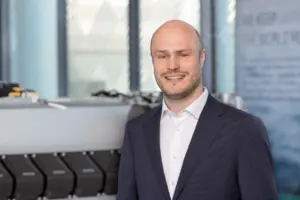
“I think five years ago we had huge momentum, we had huge belief in net-zero targets, in new fuels like methanol, in transferring technologies like fuel cells, et cetera, to vessels,” Köhler says. “I think if we look at the mirror right now, we have lost some of that momentum. I think there are question marks on where we should go, different perspectives. Batteries are a trend, methanol is certainly still something that can be considered, and as a scientist, I can tell you climate change will not go away. I’m convinced the conversation will come back and in the next five years’ time, we will have a deep discussion again about methanol and future fuels and technologies, et cetera.
“But in the short to medium term, we’ve come to the realisation it’s diesel. And that is why we as a company invest heavily into our diesel and internal combustion engine technologies.”
For operators ordering vessels now, it’s a difficult balancing act.
Phil Kordic, Senior Expert Commercial Marine Business, says customers still want new ships to be future proof, but they are struggling to decide which technology should provide that future.
“The conversations are still there,” he says. “But from what I see at the moment, clear solutions exist today in terms of being able to use biofuels and HVO. This is a technology that people can use today with their combustion engines and it is definitely a very practical measure in the short to medium term.
“But many customers are also thinking about how to best utilise a flexible architecture. They want to be able to design a ship that they can retrofit in the future with concepts such as methanol readiness and these kinds of things. I don’t think it’s gone away, I just think that people are struggling a little bit at the moment to find, to agree on what the solution is.”
Options
For now, HVO and other biofuels offer a comparatively straightforward option because they can be used in existing combustion-engine technology.
Methanol, meanwhile, remains a fuel in which Rolls-Royce has confidence, with the company recently securing DNV certification for methanol readiness on its mtu Series 4000 marine engines.
The problem is increasingly less about whether the engine can handle the fuel and more about whether the fuel will be available where ships need it.
“The key hurdle I think is on the supply side,” Köhler says. “We don’t see the production of green methanol, we don’t see the availability in ports, etc.”
That uncertainty is encouraging a more pragmatic approach to vessel design. Kordic says owners should create space and flexibility for future conversion without necessarily installing equipment before it is needed.
“Probably the best thing they can do is at least have some space allocated, for example, for a few of these things, but not necessarily carry around any of the equipment,” he says.
Hydrogen presents a more difficult proposition because of its storage and handling requirements, while methanol has the advantage of being a liquid fuel that can be stored in tanks.
Electrification, meanwhile, is increasingly established – but neither executive sees battery power as a universal answer for commercial shipping.
“For commercial vessels, pure battery ships are OK if it’s something like a short distance ferry ride or something like this,” says Kordic. “But then you’re limited and you can’t of course cross a big ocean with battery ships.”
“I think the use cases for batteries in the maritime context are limited, even 2-3 generations down the road of new battery tech,” says Köhler.
The result, in Rolls-Royce’s view, is not a choice between diesel and electrification, but an increasing overlap between the two. Battery-electric propulsion can handle part of a vessel’s operating profile while combustion engines provide back-up, additional range or peak power.
That is where the company’s new variable-speed generator sets come in.
Variable speed: making the genset part of the electric architecture
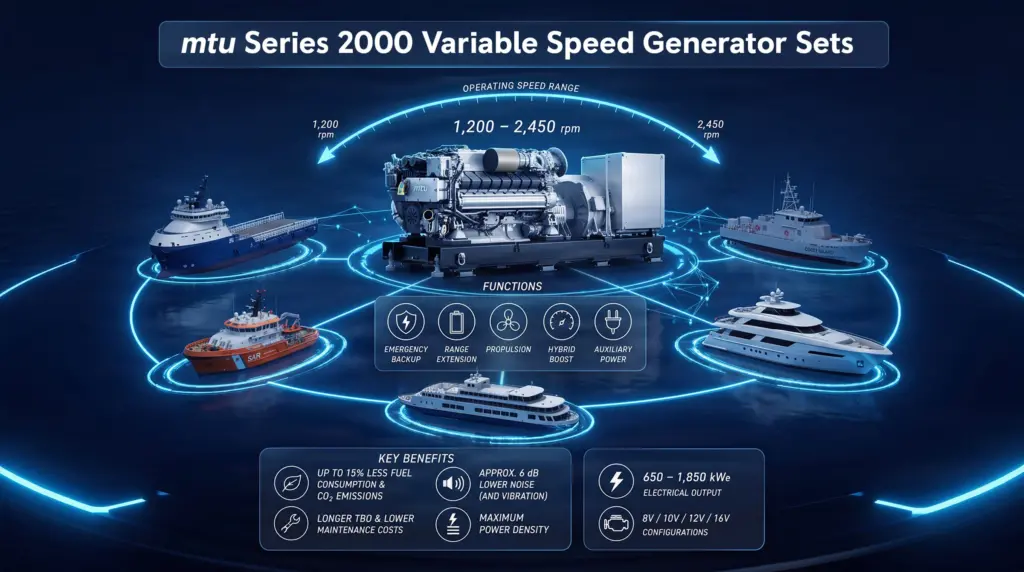
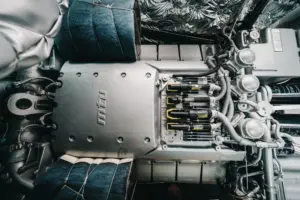
Rolls-Royce used SMM 2026 to showcase its expansion of its variable-speed mtu generator-set range into the Series 2000 power band.
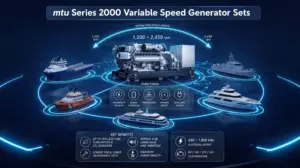
The new 8V, 10V, 12V and 16V units cover approximately 650 to 1,850 kWe, with engine speeds ranging from about 1,200 to 2,450 rpm depending on the model. Rolls-Royce says the units can reduce fuel consumption and CO₂ emissions by up to 15% compared with fixed-speed gensets, while also reducing operating noise by about 6 dB.
The underlying idea is straightforward: rather than forcing the engine to operate at one speed regardless of demand, the genset can adjust its speed to the electrical load.
Kordic says the concept is not new to Rolls-Royce. While variable-speed gensets have long been supplied on the larger Series 4000 engines and have also been deployed on Series 2000-powered yacht projects, the company is now launching a standard Series 2000 variable-speed genset range tailored to commercial marine applications.
“We are able to cover a power range from about 650 kilowatt electrical through to about 1,850 kilowatt electrical, but with a lightweight compact genset,” he says
The benefit is particularly relevant to vessels using batteries or other forms of electrical architecture. At low loads, the engine can slow down and operate more efficiently; when demand rises, it can increase speed and deliver its maximum power.
“You can have the engine when there’s periods of low power demand, you can have the engine operating at low speed, which is a lot more efficient,” Kordic says.
“And then on the other side, when you have periods of peak demand, you can allow the engine to spin, rotate in some cases even up to 2,450 rpm and really get the maximum power density out of the engine.”
Power density is central to the proposition. Rolls-Royce says a 16V2000-based genset can produce up to about 1.8MW for some vessel applications, while weighing as little as seven tonnes – potentially less than half the weight of a conventional constant-speed unit in the same power range.
That matters because electrification brings its own weight penalty. Because batteries do not become lighter as they are discharged, the vessel carries the full battery mass throughout its operating cycle.
“If you can offset that as much as you can with the lightest possible genset, you can always compromise as best you can,” says Kordic.
The new gensets therefore fit into a broader shift in the role of the marine engine. Rather than being the primary source of propulsion power at all times, the combustion engine becomes one component of an electrical system.
On a battery-powered vessel it can provide emergency propulsion power. On a hybrid vessel it can act as a range extender or booster.
Rolls-Royce has already supplied Series 4000 variable-speed gensets to workboats, while the Series 2000 has a longer history in diesel-electric yacht applications.
From bridge to propeller
Köhler describes three pillars for the commercial marine business, where Rolls-Royce is concerned.
The first is the core engine and propulsion system; the second is everything surrounding it – generator sets, SCR, automation, bridges and related systems; and the third is service.
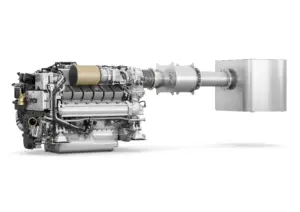
Rolls-Royce continues to invest in its Series 2000 and Series 4000 platforms, with power density remaining a defining characteristic.
“We always got that much more power out of a piece of iron than our competition,” says Köhler. “And that’s something that I firmly believe we need to continue in coming years, we need to build fantastic engines.”
The second pillar is becoming increasingly important as Rolls-Royce seeks to move beyond selling engines as standalone products.
“The next layer is everything around the engine: variable speed gensets, SCR, automation software, bridges.”
The company’s bridge strategy stems partly from its position in the yacht market. In 2023, Rolls-Royce bought Italian bridge manufacturer Team Italia/Onyx Marine and is now bringing its bridge, automation and propulsion technologies together under a broader ‘bridge to propeller’ concept.
Köhler says Rolls-Royce has historically sold around 700 bridges into the yacht sector and now wants to test whether the technology can gain traction in commercial vessels.
The target is not every vessel; the company sees potential in smaller commercial craft including tugs, ferries and crew transfer vessels rather than large merchant ships .
The attraction is integration. When the bridge is combined with mtu propulsion, operators can access engine information, maintenance menus, troubleshooting guidance and other functions through the bridge interface.
The commercial proposition will ultimately have to stand up against cost, however. Köhler acknowledges that the company is only beginning to test the market.
“We understand the commercial space is cost competitive and we do believe we can offer a cost competitive solution,” he says.
The other part of the second pillar is automation software.
Rolls-Royce bought UK marine automation specialist Servowatch in 2020 and is now building its automation portfolio around the mtu NautIQ platform. One of its applications, NautIQ Foresight, uses operational data to help optimise vessel performance, including taking factors such as tides into account.
Köhler sees digital optimisation as one of the most immediate ways operators can cut fuel consumption while the industry’s longer-term fuel strategy remains uncertain.
“I think this is in the short term the best solution to cutting carbon dioxide emissions, that is really looking at the operational profile and optimising,” Köhler says.
Kordic says artificial intelligence is increasingly being incorporated into this process, combining information on wind, water depth, tides, speed and previous vessel performance to advise crews on how to operate more efficiently.
The third pillar: service and the connected fleet
The third part of the strategy is less visible at a trade show but potentially just as important: service.
Rolls-Royce is investing in its global service network and examining where vessels operate and where local support is needed. Köhler points to growing activity around Egypt and the Suez Canal as an example of where the company is strengthening its presence with partners.
But service is also becoming digital.
The company has opened a remote monitoring centre in Italy, initially with a strong focus on yachts and commercial marine but with the intention of extending the capability to other applications of mtu engines. The longer-term objective is to move from preventive maintenance, based largely around known service intervals and historical failure patterns, towards predictive maintenance based on live engine data.
“We are striving to have basically every marine engine that we sell connected digitally,” Kordic says. “This is really important. This is something we firmly believe in, to have all our engine population connected to help the customer, to help us and to learn from the data.”
Köhler says the company currently uses accumulated field data to model when components are likely to require attention. Remote monitoring should allow those models to become more responsive to actual operating conditions.
That is another reason the three pillars increasingly overlap. The engine produces the data; automation and bridge systems make it usable; and the service organisation acts on it.
Rolls-Royce sees the immediate future of commercial marine looking less like a single replacement for the diesel engine and more like an increasingly integrated propulsion system.
Alternative fuels may have lost some of their momentum; battery-electric propulsion will remain limited by vessel type, route and energy density; methanol still faces a supply and infrastructure challenge – but Köhler reiterates that the wider decarbonisation debate will return.
“It’s very clear. I believe it’s going to come back in a couple of years,” he says.
And while the industry waits for the next wave, Rolls-Royce is positioning itself around technologies it believes can deliver value now: more efficient engines, variable-speed electrical systems, automation, integrated bridges, digital optimisation and a more connected global service network.
“Do the things today that we can do,” says Kordic. “We can optimise propulsion efficiency. Use biofuels. What we can do today, we should focus on that.”