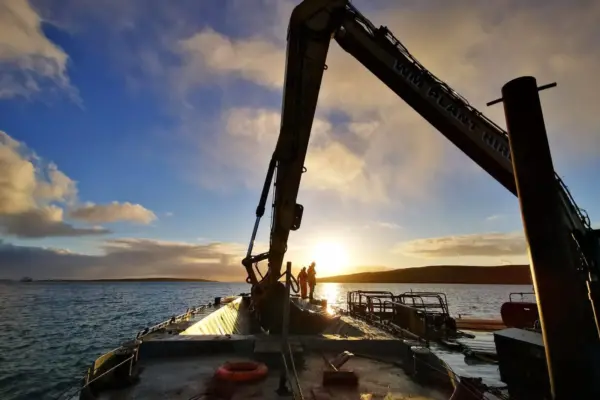
Stillstrom steps up to the offshore charging plate
Maersk firm Stillstrom has finished what it says is the world’s first offshore wind farm connection for service operation vessels (SOVs).
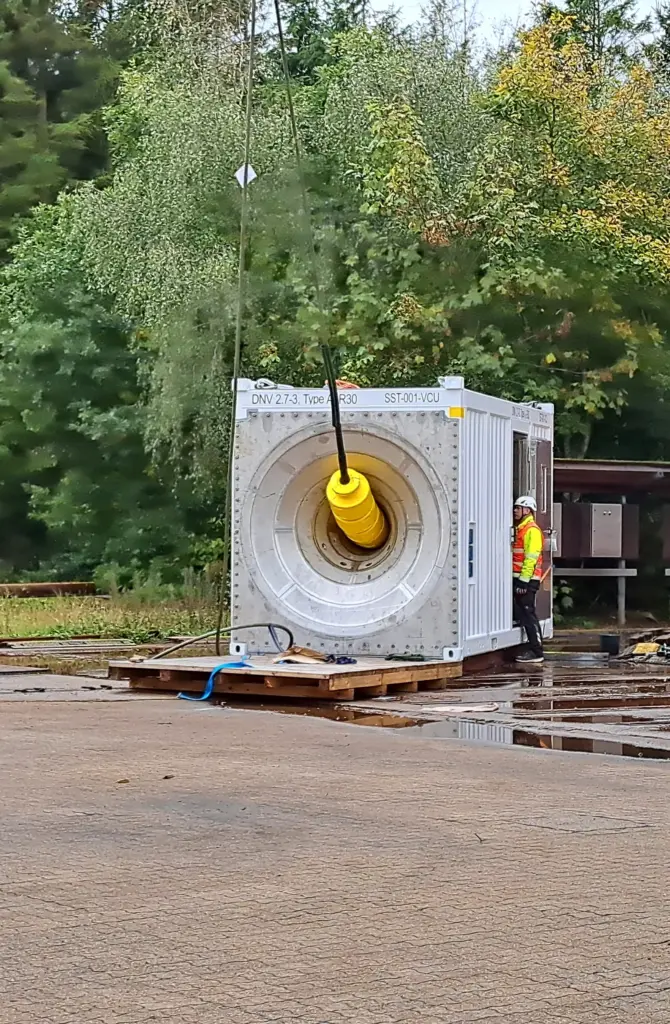
The Vessel Container Unit (VCU) allows battery-powered SOVs to charge directly from wind farms and has been testified to by classification company DNV. It provides a flexible 11kV charging interface with automated cable handling designed to accommodate dynamic positioning operations and different vessel charging layouts.
“Its modular construction allows bow, stern or under-deck connection and is designed to provide a seamless charging and control interface with the vessel,” says Stillstrom. “Housed in its own container, the unit can be integrated on newbuild and retrofitted vessels alike and moved from one vessel to another where onboard cabling permits.
“Once connected, the VCU integrated funnel enables the vessel to charge at an optimum heading, providing the dynamic positioning operator with total control over charging and disponnection operations.”
“For vessel operators, charging at sea is no longer a concept,” said Graeme Wood, Stillstrom UK MD. “In simple terms, the VCU has been built and tested, and we are good to go.
“High-voltage power has never been transferred to a vessel offshore in this way, and the connector package inside our VCU represents several years of careful development and testing. The control system and integrated safety interlocks significantly de-risk offshore charging for both vessel owners and wind farm operators.”
The system can be installed on a wind turbine, offshore substation or a dedicated offshore structure and vessel-side equipment is a central part of the design. It is also designed to avoid requiring the vessel to maintain a fixed heading directly alongside the offshore structure: the charging connection can instead be made while the vessel remains at a controlled distance from the turbine or substation.
The system can use a hang-off arrangement on a wind turbine or offshore substation. Where installation on existing infrastructure is not practical, a separate charging buoy or dedicated foundation can be connected to the wind farm through a subsea cable.
Stillstrom’s offshore charging system uses a modular approach, with transformer, cable reel and winch, boom crane, umbilical cable and local equipment room. The equipment room contains the electrical components required to transfer power from the wind farm’s electrical network to the vessel.
The company has also developed a standalone charging concept for offshore wind farms where charging infrastructure is not incorporated into the original design.
Managing the charging connection
One of the main technical challenges is managing the charging cable while the vessel is operating on dynamic positioning (DP).
A service vessel will move continuously within its DP operating envelope, even when holding a nominally fixed position. The charging cable must accommodate these movements without excessive slack, tension or loads being transferred to the connector and supporting structure.
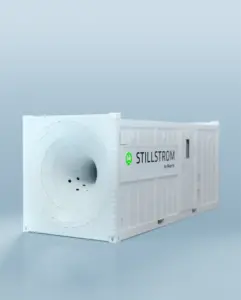
Stillstrom demonstrated automated cable control during a trial with ESVAGT and Semco Maritime at Esbjerg, Denmark, in August 2026. The DNV-witnessed trial used a 125-metre cable deployed from a height of 15.5 metres, emulating a turbine or offshore substation installation.
The system used RTK GPS positioning data to coordinate a tower-mounted cable reel with an electric pull-in winch on the vessel. As the vessel moved away from the charging point, the system automatically paid out cable; as it returned, the cable was retrieved.
The test demonstrated automated cable management while the vessel was operating on DP. Further integrated vessel testing and sea trials are required before the system completes its qualification programme.
Stillstrom UK managing director Graeme Wood said the company’s approach is intended to fit existing offshore wind operations.
“The UK is leading the way in offshore wind and maritime decarbonisation,” he said. “Having a permanent presence in Aberdeen allows us to build on the momentum we’ve generated in the North Sea, working directly with operators to deliver a commercially viable offshore charging solution that keeps vessels on station longer without relying on fossil fuels.”
Offshore charging rivals
Stillstrom is one of several companies developing offshore charging infrastructure for electric and hybrid wind farm service vessels. The alternatives include fixed charging equipment on offshore substations, turbine-mounted systems, floating buoys and dedicated offshore structures.
MJR Power & Automation has demonstrated offshore charging at Parkwind’s Nobelwind wind farm in Belgium.
The system uses charging equipment installed on an offshore substation and was tested with a CTV in July 2024. It is designed to supply up to 2MW for CTVs and up to 8MW for SOVs.
The demonstration showed that electricity could be transferred from an operational offshore wind farm to a service vessel. The system is designed to reduce the need for vessels to return to port to recharge, although commercial deployment will depend on integration with the wind farm’s electrical system.
Norwegian company Seaonics has developed the Ocean Charger, designed to charge at a wind turbine using turbine infrastructure as the charging point rather than requiring a dedicated offshore substation installation. The system has undergone prototype testing with the hybrid vessel REM Power.
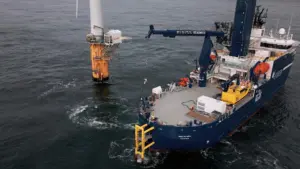
Seaonics has announced plans to commercialise the system following its prototype work.
Oasis Marine has been developing a floating offshore charging buoy with Turbo Power Systems, Verlume and the Offshore Renewable Energy Catapult.
The buoy concept uses battery storage and power management equipment to transfer electricity to hybrid and electric CTVs and is designed to provide a charging point independent of the turbine or offshore substation, although it requires a mooring arrangement and subsea electrical connection.
Charge Offshore is developing a dedicated monopile charging system through the Dutch Power2Tow project, which is investigating electric emergency response towing vessels.
The structure would provide charging independently of a turbine or offshore substation and is being developed as part of a wider effort to establish the vessel and infrastructure requirements for electric offshore towing operations.
The system remains in the preliminary design phase.