
AYK Energy: Awaiting the marine batteries revolution
 Part of our special report
Batteries, boats and the power problem · November 2026
All 2 features
Marine battery specialist AYK Energy is building its business around the electrification of tugs, ferries and workboats. It is also trying to address one of the key obstacles to electrification: the lack of shore power.
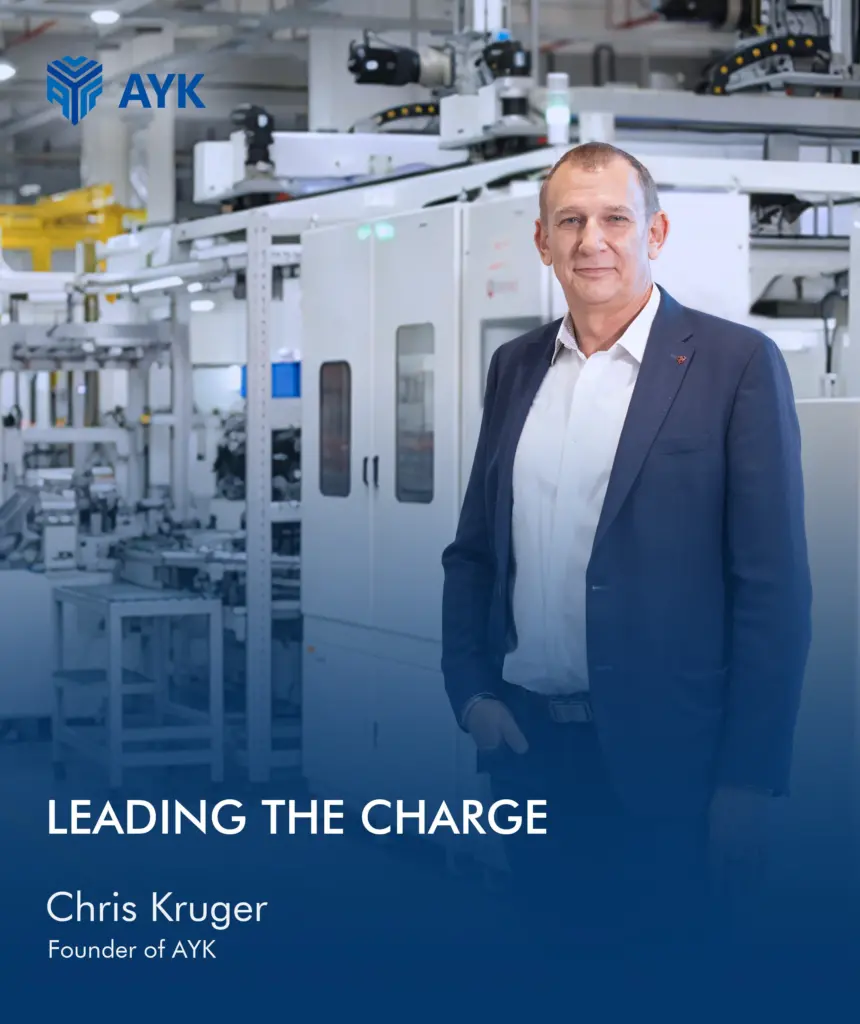
Founder and CEO Chris Kruger speaks to Maritime Journal editor Debbie Mason.
Batteries were supposed to be the key to maritime electrification, but despite the enthusiasm surrounding them, adoption has been much slower than many anticipated.
For Chris Kruger, founder and CEO of marine battery manufacturer AYK Energy, the explanation is straightforward: shore power – or lack of it.
While major ports are beginning to invest in shore-side electricity, there is no coordinated approach to ensuring that vessels can actually access the power they need.
“This is where China has the advantage. They decide we’re going to do this and simply get it done,” says Kruger. “They supply the power and this is a national project. National money goes into this.”
Europe, he says, has been much less decisive: the EU has set a 2030 deadline for cold-ironing capability, but Kruger believes the ambition is not being matched by sufficient financial support or a clear allocation of responsibility.
“There are maybe a few initiatives, but there’s not a concerted effort to make this happen,” he says. “So nobody takes responsibility. If the port is big enough, they say okay we will do it – but it’s not the port’s responsibility.”
The problem is particularly acute for vessel owners. Why should one operator invest in expensive charging infrastructure if competitors can continue using conventional fuel without having to make the same investment?
“The vessel owner says, ‘I’m not going to pay for that. If not everybody has this, then I’m the only one that’s financed this infrastructure. And I get penalised for going electric, so I’m not doing that.’”
Cost of batteries cost of power
Infrastructure is not the only obstacle. The initial investment in battery-powered vessels remains higher than for conventional diesel alternatives, with a battery vessel usually costing around a third more because of the batteries.
Yet Kruger believes the additional cost can be recovered through lower operating costs, provided electricity is competitively priced. This is not always the case. In the UK, for example, the eye-watering electricity costs were a big shock to him, and completely undermine the business case for batteries – which doesn’t make sense in a country that has set itself stiff ‘net-zero’ targets and believes batteries are one way of achieving them.
The economics therefore depend heavily on the local energy market, as well as the vessel’s operating profile and charging requirements.
Kruger also sees a bigger question around electricity generation itself. Wind and solar have a role, but their intermittent output means energy storage will be essential. That is less true of tidal energy, which he also advocates.
“For all of those you need batteries because they’re not continuous,” he says, adding that he believes nuclear power will need to form part of the future energy mix.
Setting the safety standard
AYK Energy only manufactures lithium iron phosphate (LFP) batteries, but Kruger is keen to stress that chemistry is just one part of the safety equation.
“We take safety to a completely different level,” he says. “We are setting the standard.”
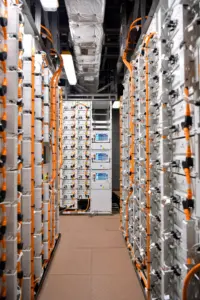
The company’s approach involves multiple layers of protection, both at battery-module level and within its containerised energy storage system.
The container is designed around A60 fire protection, with the structure intended to withstand an external fire reaching 1,000°C for an hour while keeping the interior below 100°C.
Rather than using a conventional container construction, AYK has adopted a deckhouse-style design, with substantially thicker steel. The half-height unit weighs six tonnes in steel alone, compared with approximately three tonnes for a standard full-height container.
It is also designed to IP67, providing protection against dust and water ingress, with dehumidifiers used to control moisture.
The individual battery modules are IP67-rated too, and incorporate their own fire-suppression provision, including water mist that can be introduced if a failure occurs.
A particularly important part of the design is preventing thermal runaway from spreading between modules.
Kruger describes testing a 117kWh battery module measuring 2.2 metres by 0.7 metres, using the UL 9540A test method to assess thermal runaway and fire propagation.
“We had to do a test which says you need to put the battery module into some runaway in between other modules that’s alive with live cells and show that it does not propagate,” he says.
AYK went further, deliberately triggering thermal runaway in six cells simultaneously using heating pads.
“We only got two more cells beyond those to go into thermal runaway. It self-extinguished without us doing anything with this design.”
The system also incorporates gas extraction to prevent gases from a failing module entering the container space, alongside conventional battery management system protections against overvoltage, overtemperature and overcurrent.
Kruger says the company has worked with classification societies but deliberately gone beyond their minimum requirements.
Batteries on board and on shore
Rather than permanently tying a battery installation to one particular vessel, AYK has developed a containerised battery concept as a transportable energy asset that can be deployed wherever it is needed and used to charge a tug, feeder vessel, workboat or ferry, and moved elsewhere if operational requirements change.
The concept also offers a potential way of addressing the shore-power problem, although Kruger acknowledges that the electricity still has to come from somewhere to charge the container.
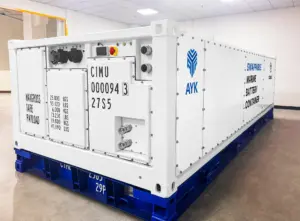
The units are not yet commercially deployed: AYK has built several for testing to demonstrate their robustness, but at approximately US$1 million each, they’re a substantial investment.
When it comes to propulsion, AYK’s batteries are already powering a diverse range of vessels.
Kruger estimates that around 50 vessels are using the company’s technology, spanning tugs, ropax ferries, workboats, harbour-cleaning vessels, superyachts and ro-ro ships.
Some vessels retain a small emergency diesel generator as back-up, but the ultimate aim is full-electric operation.
Tougher penalties
Chris Kruger believes punishment is one of the only ways to see battery use expand. The
consequences of failing to provide charging infrastructure, or continuing to pollute in port, should be much harsher, he says.
Governments should introduce meaningful financial penalties for vessels operating diesel generators in harbour, reflecting the health and environmental costs imposed on surrounding communities.
“If you run a diesel generator in harbour, they have to say, you are polluting, you are creating health issues for the population in this area,” he says.
He believes the same principle should apply to ports that fail to provide the necessary infrastructure.
“The EU could enforce this kind of law and say by 2030, if you don’t have the capability of receiving shore power, you will get penalised by X amount per kilowatt hour of pollution,” he says. “They have to make it extremely expensive when you come to shore.”
Unless governments create a financial incentive to change, he fears vessel owners will continue to postpone investment, regardless of the environmental and operational benefits of electrification.
AYK, meanwhile, is expanding. The company has doubled its manufacturing space to 10,000m3 and increased annual production capability from 300MWh to 600MWh, with both air-cooled and liquid-cooled battery production lines.
It has also developed a new, more energy-dense liquid-cooled battery range, including a system for a major ferry project, and established a facility in Liverpool, UK to develop service and research facilities, with manufacturing potentially following.
Kruger says the business has achieved positive EBITDA in 2024 and 2025 and is targeting a third consecutive positive year.
How to achieve longevity
For operators considering a new installation or retrofit, Kruger says the starting point should always be understanding what the battery is expected to do.
“
What is the load profile? What do they want the battery to do for them? The most important thing is to know what job this battery needs to do and how much energy it will need,” he says.
Charging speed, available space and the amount of shore power are also important considerations. Vessel owners typically establish how much energy is required per trip and how quickly it needs to be replenished, before working backwards to determine the battery capacity and charging infrastructure.
Battery longevity is another consideration. AYK generally designs its systems around a 10-year life, but Kruger says some have lasted considerably longer.
He cites the Princess Benedicta, which underwent a battery retrofit in 2012. The original financial calculation was influenced by the simultaneous switch from conventional fuel to low-sulphur fuel, but the operator achieved a return on investment in approximately one year.
The battery subsequently remained in service for more than 14 years, mainly thanks to the captains impeccable care, he says, charging and discharging it according to the manufacturer’s recommendations for optimum longevity.
Kruger recalls another installation designed for five years that lasted only three because it was repeatedly operated above its voltage limits.
And before operation even begins, operators must ensure they pick experienced, reputable suppliers and installers.
“There are a lot of scammers out there and many people have burned their fingers,” he says.