



Alumarine ‘SNS 277’ for S.N.S.M.’s Golfe Du Morbihan station
The Alumarine shipyard has just launched the new ‘SNS 277’ heading for the SNSM station in the Golfe Du Morbihan, located at Port Blanc. The first seatrials on the Loire are said to have gone perfectly.
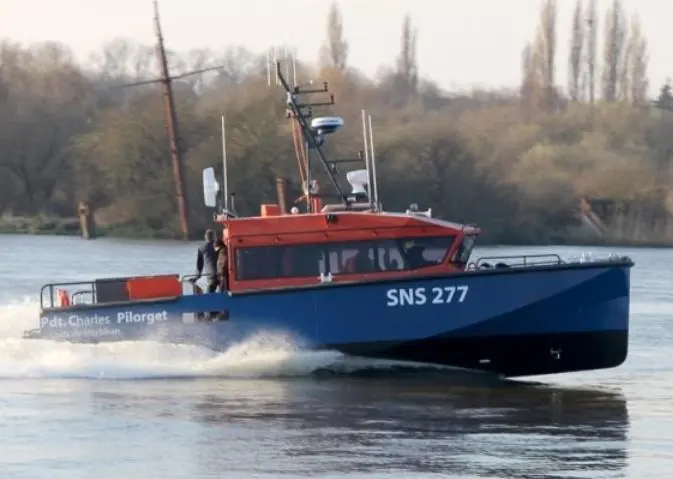
This compact and lightweight latest-generation vessel will provide rescue missions including the deployment of a swimmer, medical evacuation missions and towing ships in difficulty. Alumarine claims it will allow rapid intervention, in optimal safety conditions for both rescuers and rescued people, with a moderate fuel consumption.
The deck is entirely surrounded by handrails, and the vessel has a flat and unobstructed rear deck to facilitate the handling of people rescued by stretcher and facilitate the hoist. The wheelhouse is off-center on the starboard side to provide a wide gangway on the port side and a maximum shelter width. It accommodates 2 separate spaces, the cockpit and the space dedicated to the care of rescued persons, complete with separate lighting, intended to be very useful during night navigation.
The double door at the rear of the wheelhouse and the side cut doors allow easy passage of a stretcher and relief workers, which facilitates health transfers. A second elevated outdoor driving position provides an extended view of the water and facilitates the approach to casualties.
The gallows on the port side and the cleared gangway enable the quick recovery of casualties using lifting nets. A boarding ladder which can be deployed to port or starboard, allows the quick launching of a rescue swimmer.
With its planing hull and a propulsive power of 2x330hp, the vessel will reach casulaties quickly. Its operational speed is between 15 and 25 knots with a possibility of rapid transit at more than 30 knots.
The SNS 277 will be one of the first SNSM boats equipped with Internet access on board, allowing better dialogue with the base station to facilitate exchanges of search patterns, access to permanent weather services, exchanges of photos , opportunities for emergency telemedicine and tele-diagnostics.
By Jake Frith
Related Articles
 ACCESSORIES & EQUIPMENT
 OTHER NEWS
 ACCESSORIES & EQUIPMENT