

Autonomous surveillance from Harbour Wing
There is growing interest on Unmanned Surface Vessels (USVs) to perform both routine and dangerous tasks, with their ability to operate autonomously at sea.
The fuel capacity is a limiting factor in most of the powered operations but now a US company has developed a sailing USV that can operate un-manned for extended periods offshore for as long as the wind blows.
The designers of this USV claim that it will be able to operate in ocean conditions for extended periods and this will allow it to monitor shipping lanes and fishing operations without any humans on board. This ability will be valuable for security operations such as anti-piracy, drug smuggling patrols and it can also provide remote security and monitoring for offshore oil installations. It would be a good vessel to monitor the recent platform gas leak in the North Sea.
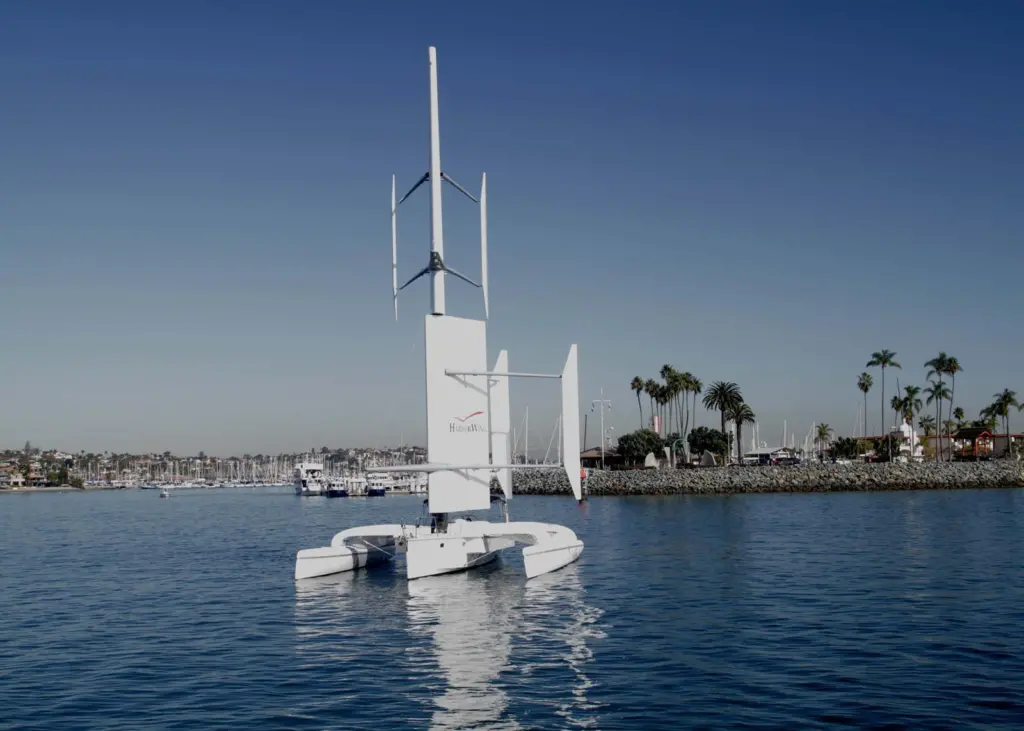
The technology for this sailing USV is based on both trimaran and catamaran vessels. These mount a semi-rigid wing sail that has small fin sails extending rearwards from the main sail that can sense wind changes and which automatically adjust the sail to changing conditions to maintain the desired course. To adapt to different wind strengths the wing sail is divided into two sections so that in strong winds the upper section can be left to feather into the wind with only the lower section providing propulsion. The wing sail can be rotated through 360° for accurate station keeping and manoeuvrability.
A prototype USV of the Harbor Wing was built on a 30 foot catamaran with a mast height of 40 feet. The basic hull is very simple and sealed against water ingress and there are mounting points for monitoring and surveillance equipment. The masthead provides another mounting point for remote cameras and radar if required.
From this prototype, which was partly funded by federal research funding in the US, Harbor Wing has developed a 50 foot trimaran version for extended operations. This is designed to spend up to three months at sea at one time and the hulls are fitted with foils that lift them in the water and which can then allow a speed of up to 25 knots in the right wind conditions. The 60 foot mast height allows for sensors to look over the horizon without revealing the host craft and communications can be by radio and satellite. Electrical power requirements can be supplied by wind generators and/or solar panels connected to battery banks and the vessel has a payload capacity of 1,500 pounds.
Highly developed guidance systems have been developed to control these USVs. In addition to their monitoring and surveillance capabilities these USVs are being promoted as vessels for remote ocean sensing and survey work. Harbor Wing is working closely with the US Navy on developing versions of this concept with military applications.
Harbor Wing is also developing their wind propulsion system to act as an auxiliary power system for ships and ferries to provide a system that would reduce fuel consumption and they claim that its automatic control and setting capability would allow it to work virtually automatically.
By Dag Pike
Further information: www.harborwingtech.com