![MaritimeJournal[Seawork]](https://www.maritimejournal.com/wp-content/uploads/2026/09/MaritimeJournalSeawork.svg)



Into the DEEP: Fincantieri enters subsea robotics sector
 Part of our special report
Autonomy at Sea · January 2026
All 10 features
Part of our special report
Autonomy at Sea · January 2026
All 10 features
When Fincantieri, one of the world’s largest and oldest shipbuilding groups, announced three years ago that it was entering the subsea robotics sector, many in the maritime world assumed it would be a gradual move – perhaps the development of an underwater vehicle here, a defence research project there.

What has emerged is something far more expansive: a full underwater ecosystem of drones, sensors, motherships and AI-driven command-and-control systems that Fincantieri believes will redefine the way nations and industries protect, monitor, maintain, and develop critical underwater infrastructures, such as telecommunication cables, pipelines, offshore energy assets, ports and other strategic installations.
This new business area, referred to internally as the Underwater Hub is led by executive vice president Underwater Gabriele Maria Cafaro, who is overseeing its growth and implementation.
Speaking to Maritime Journal, Cafaro described the project not as a product launch but as the foundation of an entirely new strategic pillar for the company.
“This journey started something like three years ago,” he says. “And it started a process, a strategic path in order to be ready to capture some early-stage interest regarding the underwater dimension.”
This ‘dimension’ is the vast, shifting, increasingly contested space beneath the world’s oceans: where everything from global data flows to energy transmission to military security is affected.
And for Fincantieri, a company whose legacy spans cruise ships, naval vessels and submarines, it represents both an urgent challenge and a once-in-a-generation opportunity.
Unseen underwater utilities
Modern civilisation depends on underwater infrastructure far more than most people realise, Cafaro believes.
“A very big portion of human being wellness is somehow passing through underwater infrastructures,” he says.
Indeed – this is an understatement when we consider that about 98% of global data traffic, from
financial transactions to video calls, travels through subsea fibre-optic cables.
Power interconnectors, oil and gas pipelines also snake across or under seabeds worldwide. And as offshore wind continues to scale up, thousands of kilometres of new cables are being laid every year.
All of these assets are vulnerable. The 2022 explosions that crippled the Nord Stream pipeline system thrust subsea infrastructure security into geopolitical view, and even simple accidents, from dragging anchors to fishing gear, are capable of inflicting millions of euros of damage. According to Cafaro, the failure of a major telecommunications cable can cost hundreds of million per day. And unlike pipelines and power grids on land, the underwater network is extremely difficult to patrol, let alone protect.
Historically, operators have relied on large, crewed vessels for inspections and mapping, making the process slow, costly and reactive. Fincantieri’s bet is that a new generation of autonomous drones, paired with persistent underwater sensors and a coordinating ‘brain’, can fundamentally change that model.
The DEEP system: a network built for the seabed
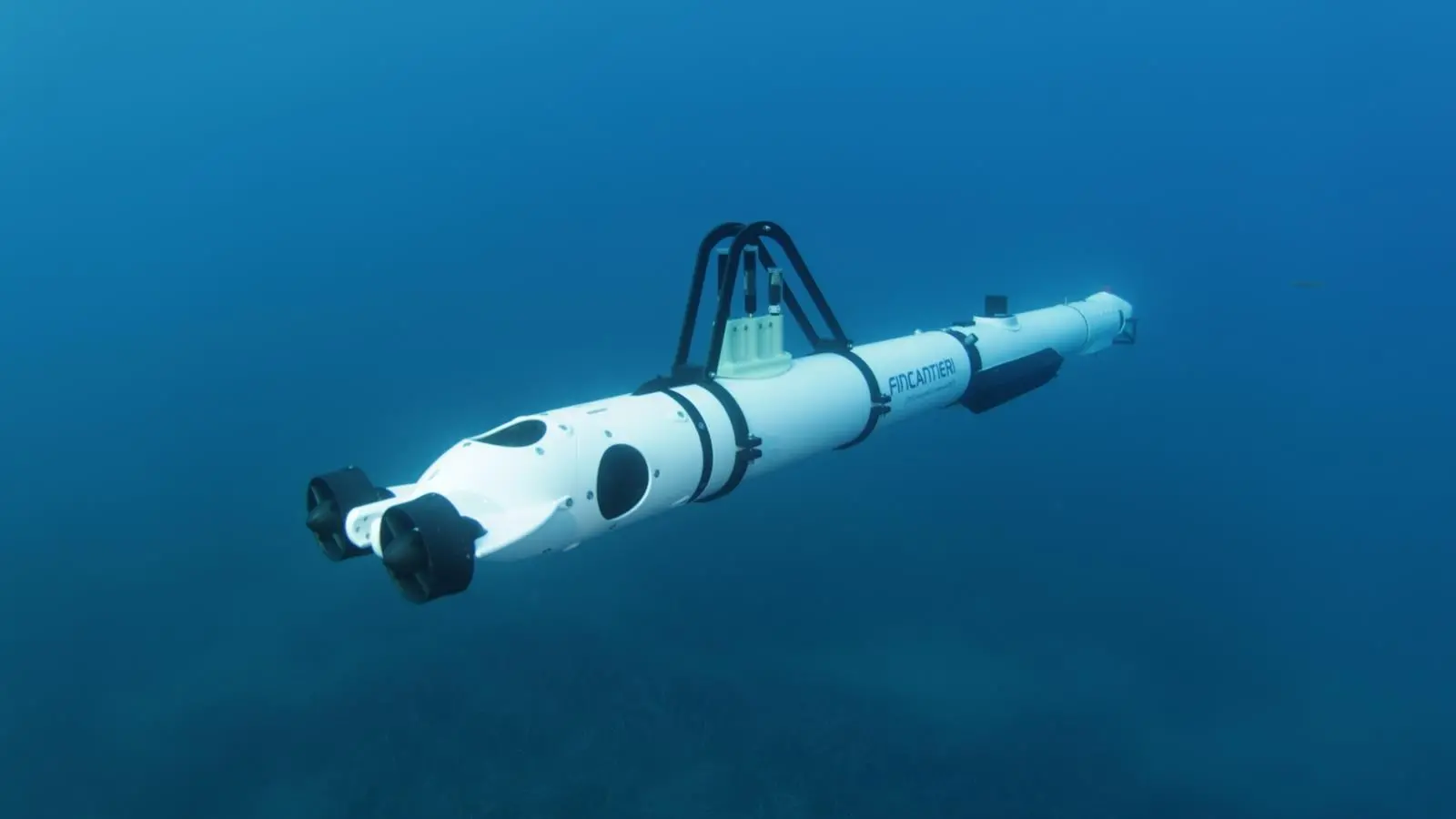
At the centre of Fincantieri’s subsea push is DEEP. Unlike traditional subsea inspection tools – standalone, remotely operated vehicles (ROVs), AUVs or single-mission drones – DEEP has been conceived as a full ecosystem, combining early-warning electro-acoustic seabed sensors; an Underwater Management System command-and-control platform; swarms of autonomous underwater drones; purpose-built surface drones acting as communication hubs; launch-and-recovery gear, docking stations and long-endurance motherships.
“What is really new is the system that we call DEEP,” says Cafaro. “The DEEP system is something that we have orchestrated as a whole, as an entire system, that has been developed to protect, maintain and develop the infrastructure.”
Early-warning sensors: Underwater ‘alarm system’
The process begins on the seabed, where Fincantieri places arrays of electro-acoustic sensors capable of detecting anomalies such as movement, intrusion, or unexpected noise patterns near critical infrastructure.
“First of all, we have an early warning system,” Cafaro says. “Down in the seabed, you position some electro-acoustic sonars to understand if there is an intrusion or if something is happening in a specific area. When something happens, these sensors communicate and report the information to a central underwater management system (UMS) that has been developed internally by our company, IDS (Ingegneria dei Sistemi).”
When triggered, these sensors beam alerts to the UMS, a software platform built by a Fincantieri-owned engineering specialist. IDS, bought by Fincantieri in 2021, has a long pedigree in naval and defence systems, including sensor integration for submarine and mine-countermeasure operations.
The company’s experience provides the interface and analytics backbone that makes DEEP possible.
Once the UMS assesses the anomaly, it automatically deploys the appropriate response – either a drone swarm or, if needed, a manned vessel.
“This software launches a reaction,” Cafaro says. “Our swarm of drones is in action, our drones are deployed and they go and recognise the threat with the payload they are carrying.”
The drones carry side-scan sonar and forward-looking sonar, along with proprietary AI-based automatic target recognition, allowing them to classify objects on the seabed, which could be anything from a lost anchor to a suspicious, intentionally placed device.
While DEEP is designed to be autonomous first, it is not, strictly speaking, fully autonomous.
A human pilot, trained at Fincantieri’s facilities in La Spezia (defence) and on Italy’s Adriatic coast (energy sector), oversees operations.
“This system was born to be unmanned,” Cafaro says. “But it requires on shore a sort of pilot for the entire system. We are training pilots on the west and east coasts of Italy, one for defence, the other for offshore energy.
“The drones operate by themselves, and that’s why the UMS is crucial because you need to have a brain that coordinates everything and guarantees the pilot constant and rapid information.”
For defence operations the drones could even be weaponised, Cafaro says.
“First of all, identifying the threat is itself very important because you have also a deterrence,” he says. “So, if someone is going to enter that space and he knows that you have this system, this is a deterrent, which is very, very important.
“Second, the action that you can take is another, an additional mission profile that you can add to the system, weaponizing the drones, which is something that we can easily do. We have a very small torpedo as a countermeasure. It’s 50cm long and it’s more than enough to counterattack a drone.”
The drones: A growing fleet for multiple depths
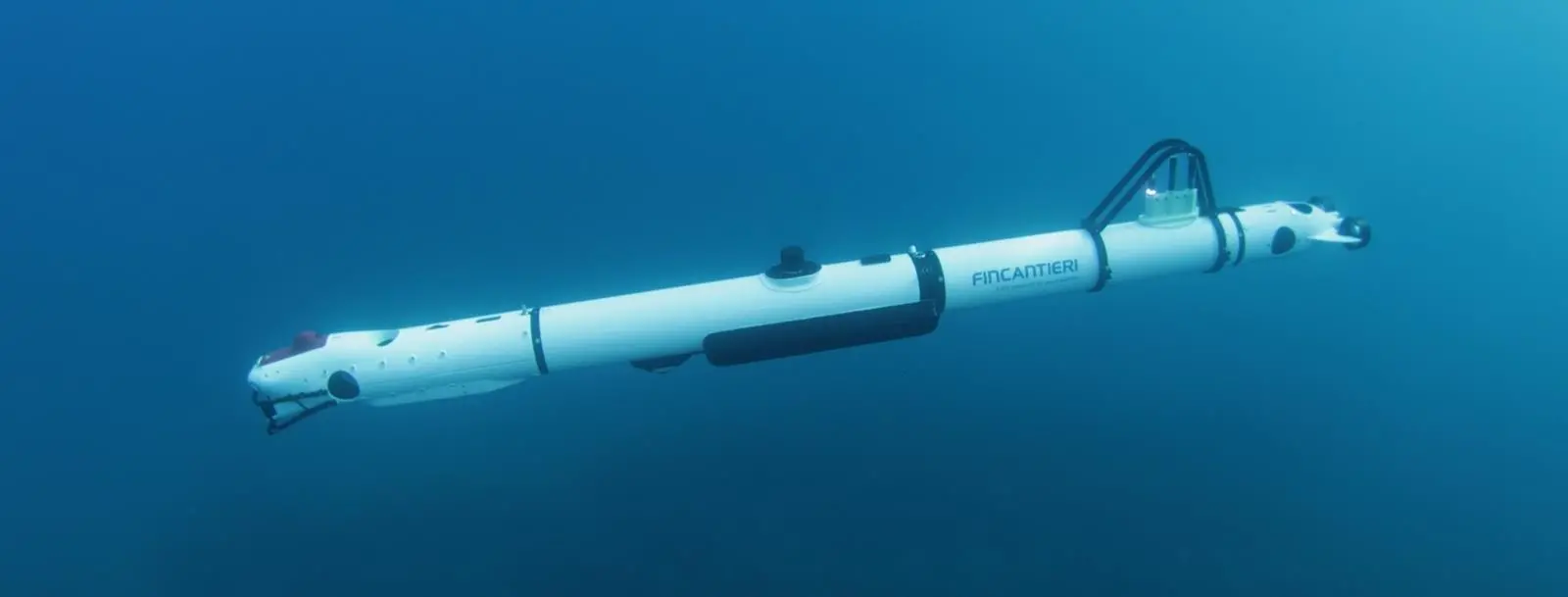
The company builds USVs (Uncrewed Surface Vessels), while for subsea it uses drones from Graal Tech, a Genoa-based SME with more than two decades in underwater robotics.
The drones range in size but essentially break into three classes:
- A 4-metre-long AUV rated to 300 metres
- A similar-sized model rated to 500 metres
- A large-deepwater drone, under development, rated to 3,000 metres and equipped with real-time 3D imaging
One of the biggest obstacles in underwater robotics is communication, which is extremely limited below the surface.
Radio waves attenuate almost immediately; acoustic signals are slow and unreliable. Fincantieri approaches the challenge in layers:
- Short-range cooperative communication between drones
- Collaboration with W-Sense, a deep-tech Italian company specialised in underwater wireless communication
- Mission profiles requiring drones to surface periodically to transmit data
- Use of a surface drone or vessel as an intermediate hub
In the future, drones may even recharge and upload data directly from undersea cable repeaters, which Fincantieri believes can be repurposed as docking stations.
From security to surveying: Dual-use technology
Although much of the early interest in DEEP comes from national defence organisations, the company insists its relevance is far broader.
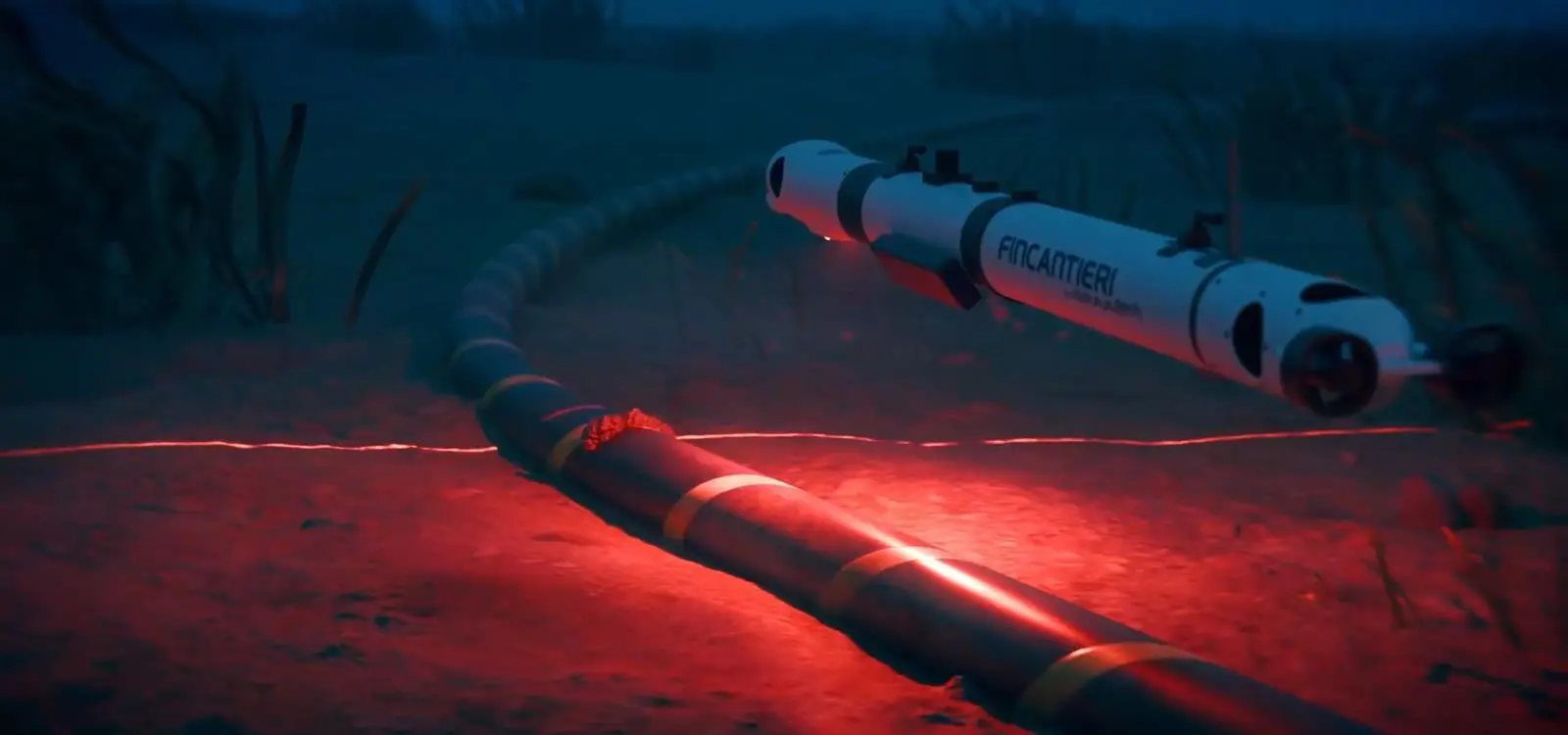
The same tools that can detect tampering with a pipeline can inspect a wind turbine’s cable conduit or survey the seabed for a new cable route. The company is moving aggressively into offshore renewables support, seabed mapping and pipeline inspection markets.
This dual-use approach reflects a broader shift in the maritime sector, where unmanned systems are becoming indispensable across civil, commercial and defence missions.
Today, laying a new subsea cable requires a crewed geophysical survey vessel to chart the seabed, identify obstacles, and determine a safe route. Fincantieri believes that soon a small, unmanned surface platform, accompanied by a swarm of drones, will take over this role faster, more cheaply and with higher resolution.
“Tomorrow you can use unmanned surface vessels or a smaller surface vessel as a mothership, then coordinate a swarm of underwater drones to map and get images from the seabed and perform real time data processing,” Cafaro says. “The key words are protection, maintenance and repair, and development.”
Fincantieri’s expanding industrial base
The move into the underwater domain has also reshaped Fincantieri’s corporate footprint. In recent years it has acquired, consolidated and repositioned several companies to build its subsea competencies:
- Leonardo’s Underwater Armaments & Systems (WASS): Bringing electro-acoustic and defence expertise
- Remazel Engineering: Specialising in deep-sea launch-and-recovery systems, seabed and top-side equipment and offshore engineering
- IDS: Providing the UMS command-and-control system and surface drone production
Remazel is especially critical. It designs and manufactures heavy subsea structures including docking stations, deep-sea mining components, and sophisticated launch-and-recovery systems for drones and autonomous vessels. These are essential for scaling DEEP into a global, industrial product.
Commercial momentum
Fincantieri points to concrete operational references. The Italian Navy was the first partner to implement the UMS, along with several surface drones and, more recently, a mothership. An unnamed major Italian EPCI in energy and TLC segments is co-developing and preparing to acquire a complete system.
“At the end of the co-development, which will last several months, the underwater management system, the underwater drones and the surface drone will be fully operating,” Cafaro says.
Given the growing importance of subsea monitoring for offshore energy, telecommunications and national security, demand is likely to accelerate.
The future: an autonomous underwater network
For Fincantieri, the long-term vision is a permanent, semi-autonomous underwater surveillance network, a subsea equivalent of an air-defence radar shield.
As geopolitical tensions rise and seabed infrastructure proliferates, the company expects countries to deploy such systems around critical assets. The implications reach beyond security. If drones can recharge from cable repeaters, operate for months, and cooperatively map or inspect the seabed, industries like offshore wind and subsea telecoms could see enormous reductions in downtime and cost.
For a 240-year-old shipbuilder, the transition from cruise ships and frigates to AI-driven subsea swarms may seem radical. But to Cafaro, it is a natural evolution rooted in the company’s maritime DNA.
“Fincantieri wants to be the orchestrator of these technologies,” he says. “To provide integrated solutions to protect, maintain and develop underwater infrastructure.”
And as global reliance on seabed infrastructure only grows, the shipbuilder’s bold foray into the deep may prove not just ambitious, but essential.
For more features and interviews on Autonomy, see our Special Report here.
Related Articles
 OTHER NEWS
 MARINE CIVILS
 MARINE CIVILS