





Bids for new Polarstern under scrutiny
Bids are now being examined in Germany prior to the award of a multi-million Euro Government contract to build another sophisticated research ship – part of a programme to replace ships retiring over the next few years.
Authorities are evaluating yard bids in an invitation to tender for the “construction and turnkey delivery” of the new Polar ice-breaking research and supply newbuilding Polarstern 11. The invitation closed on March 23rd .
When evaluation is complete, selected yards will be invited to make firm offers, a spokesman for the Alfred Wegener Institute (AWI) told Maritime Journal. The AWI operates the existing 33 year old Polarstern and will also operate Polarstern 11 for the Ministry of Research (BMBF). When construction of the replacement was approved in 2012 reports put the cost at around €450 million.
A BMBF spokesman told MJ it would be about August before chosen yards would be invited to firm up their bids. Observers said the contract award would then be possible next year after a winning yard had been chosen.
No details of shipyards interested in the work, German or foreign, are being revealed but it is already known that one of Germany’s leading facilities Russian-owned Nordic Yards is bidding.
It said group yards had already built 118 ships with ice-breaking capability. “There aren’t many world shipyards that can claim such a record” a spokesman was quoted as saying.
The BMBF spokesman said it was planned to complete Polarstern 11 at the end of 2019 and to hand it over to the scientists in 2020.
The existing 118m long and 26m wide Polarstern is of 12,600gt and currently Germany’s biggest research ship. There are no details of a successor as yet but she will also be required to sail through ice 1.5m thick with optimised hull ice-breaking and ramming characteristics. Researchers also want a new ship to be very reliable in remote regions. Manoeuverability, stability and space are also being called for.
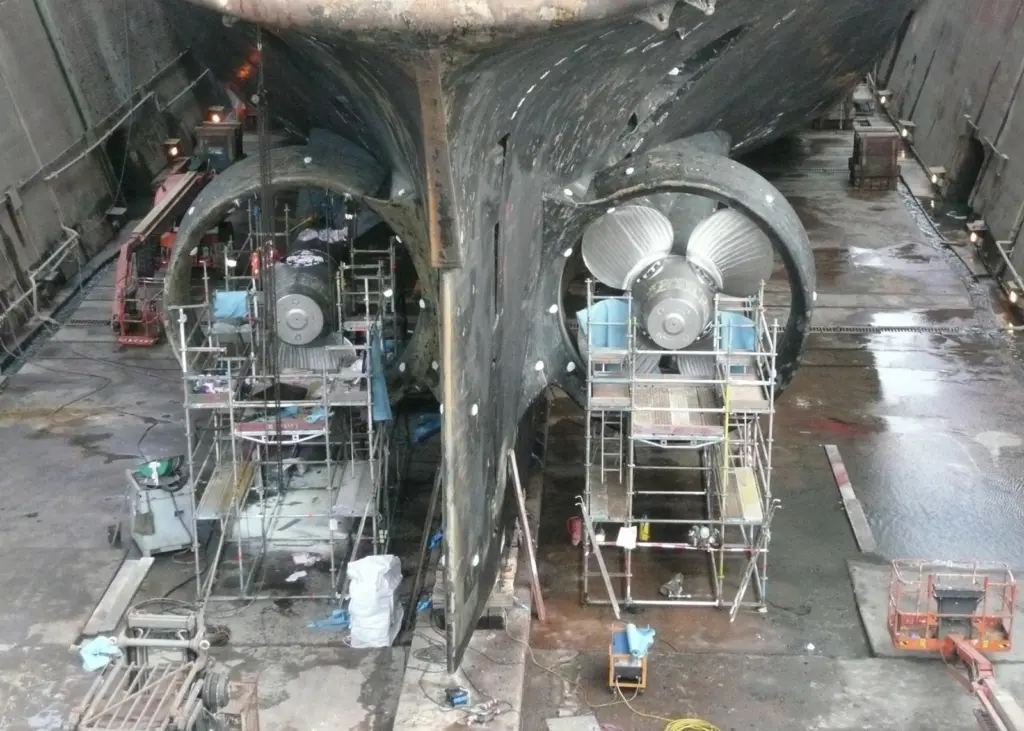
Polarstern docked at Lloyd Werft Bremerhaven in March for propeller repairs after a breakdown in the Antarctic and was still there late April. A senior official said her repair was “a timely reminder” that many German research ships are ageing and in need of replacement.
Berlin acknowledged that several years ago when it approved the building of Polarstern 11 as one of four new research vessels planned for service by about the end of the decade and reportedly costing a total of about €850 million.
The others are a €160 million replacement for the 97.5m research workhorse Meteor, a €110 million replacement for one of Germany’s best-known multi-purpose research ships – the 60.8m Poseidon – and the new €125 million,116m Sonne which entered service this year.
By Tom Todd
Related Articles
 ACCESSORIES & EQUIPMENT
 ELECTRICAL SYSTEMS
 VESSELS