




Canals and rivers can overcome contractor access challenges
UK urban centres are increasingly overcrowded, presenting challenges to contractors completing construction projects in these locations.
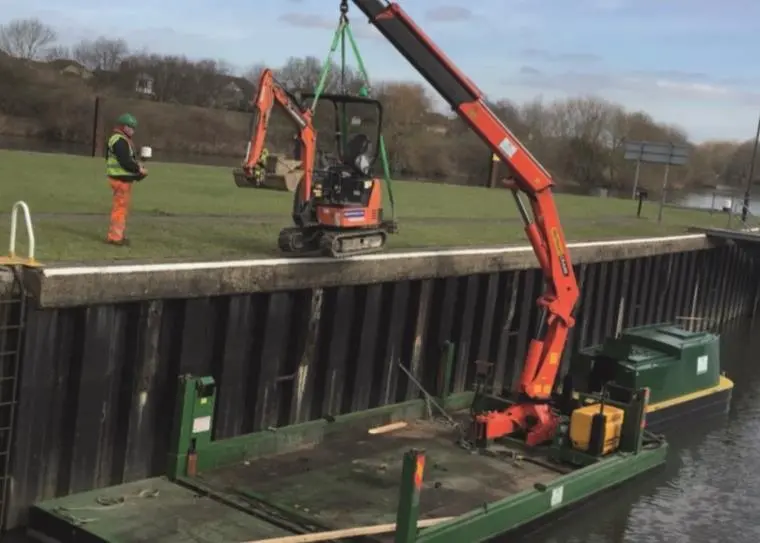
With many of these works situated along waterfronts, floating plant – boats and boat-based construction equipment – may offer a unique solution to this issue. With this in mind, Ian Rothen, founder of The Rothen Group, discusses the benefits of utilising Britain’s waterway system in construction.
It is widely accepted that space in London and many other UK cities is increasingly at a premium, yet construction continues unabated. Combined with the ongoing trend towards waterfront living, shopping, and dining, contractors face a unique challenge.
Construction companies can find themselves undertaking work in crowded urban areas, with at least one side of the building works taking place adjacent to water. Many rarely work in close proximity to water meaning many of the processes they take for granted, such as transporting materials to and from the site, become significantly harder.
Additionally, waterside locations pose unique challenges for restoration and maintenance work. This is especially true for buildings with an exterior wall directly along the banks of a waterway, which may require a unique approach.
Aside from practical building and maintenance considerations, there are several waterway-specific restrictions that contractors need to be aware of. Many UK canal towpaths are very old, and were originally designed to bear the weight of horses. As such, construction teams must be careful navigating these paths – something which may prove unfamiliar.
USING THE WATERWAYS
Although building alongside waterways can be challenging, incorporating them into construction processes can bring benefits. Indeed, Britain’s waterways were once the arteries of UK industry, and they can still be very useful to construction companies.
For example, site material transportation can be solved using the UK’s historic canal network. It can serve as a convenient line of transport for specialised marine vessels, allowing construction equipment to reach awkwardly-located sites.
Floating plant positioned in site-adjacent water can prove ideal when moving materials or waste, or acting as a platform to undertake works from. Oftentimes, floating plant can reach sites inaccessible by road, offering tremendous versatility to contractors operating in remote or difficult-to-reach locations.
Similarly, using the waterways to their full potential can help construction teams to complete maintenance and restoration projects more quickly and easily. A range of equipment exists to assist in multiple applications – for example, contractors can use floating pontoons as platforms for scaffolding, from which they can undertake repairs on brickwork or windows, or use survey boats to provide a unique vantage point for site surveyance.
ENGAGING EXPERTS
There are exciting opportunities around using Britain’s waterways in construction, but it is crucial that contractors engage experts to maximise their potential. This is key for locations close to historic towpaths where there are numerous restrictions, ranging from machinery use to pedestrian access. Aside from potential damage heavy equipment and debris can cause, pedestrian access must often remain open if construction occurs in busy towns and cities. Naturally, this can present issues when carrying out works.
Experienced marine contractors like The Rothen Group can help to navigate the various waterway regulations and restrictions. For construction teams coming into contact with towpaths for the first time, this advice can prove invaluable, opening up new avenues to complete waterside building works.
It is also worth highlighting the range of marine construction equipment that exists to parallel its land counterparts. For almost every aspect of a construction project, there is a marine equivalent, including diggers, cranes, scaffolding, and laying cables – all of these are possible by using floating plant.
By viewing the UK’s waterways as a solution, not an obstacle, contractors can quite literally approach waterside construction from an entirely new angle. The breadth of marine equipment that is able to complement and mirror its land equivalent ensures that construction teams can continue to work on projects in crowded urban areas.
Related Articles
 ACCESSORIES & EQUIPMENT
 MARINE CIVILS
 MARINE CIVILS