




Corrosion protection for wind farm installation ship
Chesterfield UK based hull corrosion protection systems manufacturer Cathelco is supplying an ICCP hull corrosion protection system for a new type of jack-up vessel which can bring fully commissioned topsides to offshore energy sites, handling everything from loading to positioning.
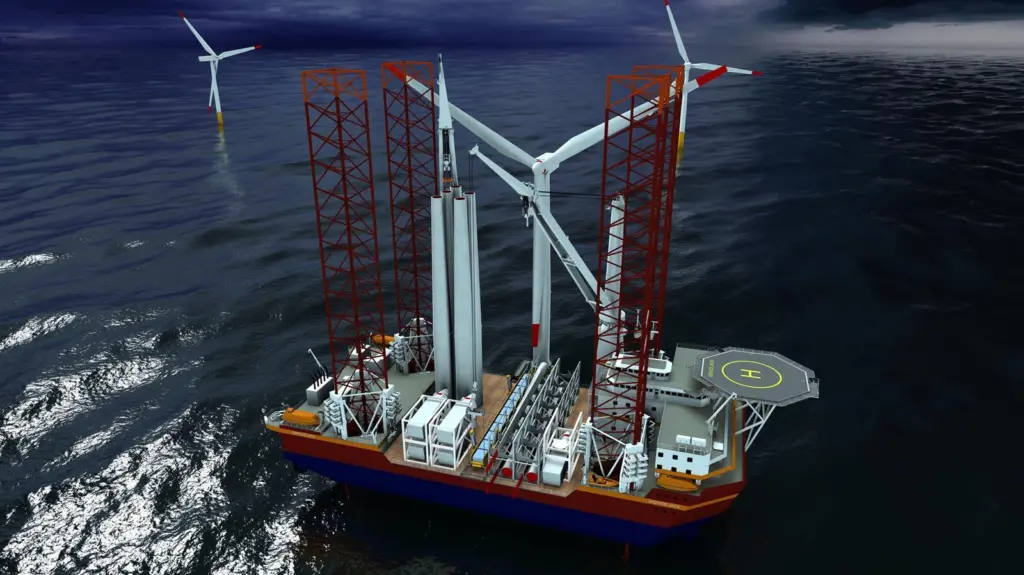
However, corrosion protection for a vessel like this is somewhat different to applications for the more usual kinds of hull construction. Aneel Mumtaz of Cathelco told MJ that the vessel, Service Jack 2, is particularly complex.
He said, ‘It is really two separate structures in one but you have to integrate the whole structure, as the key to effective corrosion protection is to polarise the entire area by ensuring an even current distribution.’
The retractable legs are located within ‘moon pools’ which could affect the performance of the ICCP system by creating a current drain and lowering the level of protection. ‘To eliminate this possibility, we took particular care in positioning the reference electrodes’, said Mr Mumtaz.
The trusses and braces can create other problems. ‘There is often an associated shadow effect on certain parts of the structure, Mr Mumtaz added. ‘This means we look carefully at where we can place sacrificial anodes to reduce the effect.’
The system supplied by Cathelco consists of a control panel which feeds an impressed electrical current to elliptical anodes mounted on the hull surface. In operation, the current from the anodes ‘neutralises’ electro-chemical activity on the surface of the hull and prevents corrosion from occurring.
Yet another consideration is where the vessel is going to operate. Seawater salinity varies and temperature can affect conductivity, highly resistive waters require more anodes.
Positioning the reference electrodes to achieve accurate monitoring is an important aspect of the system design, as the electrodes measure the electrical potential at the hull/seawater interface and send a signal back to the control panel which raises or lowers the anode output. In this way, the correct level of corrosion protection is constantly maintained throughout the life of the vessel.
The 117m Sea Jack 2 is being constructed for Master Marine of Norway and will initially be used to install wind turbines at the UK’s Sheringham Shoal Offshore Wind Farm.
Related Articles
 ACCESSORIES & EQUIPMENT
 ELECTRICAL SYSTEMS
 VESSELS