




Coulam: a new door on design
The Coulam series, originally developed as a way to get disabled people out on the water, sprang into the commercial design presented at Seawork 2016. This year, developments have moved on with a new 8.8m version.
The initial Coulam Wheelyboat V20 was the first of its kind to be constructed from hand layered, heavy duty GRP. Having gone to the trouble of making the moulds it seemed sensible to ensure the effort bought the most bang for its buck; therefore, Jim Coulam, the yard’s owner, started to market the vessel as a general purpose vessel suitable for an easy-loading workboat or short hop foot-passenger ferry. After all, getting a wheelchair user onboard comfortably meant the design had already met the most difficult criteria: access and stability.
The new model has a 2.9m beam, wide enough to take two crew and 16 passengers seated on four rows of forward facing seats: even with a raised helm position there is still enough room to move around the deck comfortably. Mr Coulam added that it is able to carry 2.5 tonnes onboard and it’s also big enough to transport an amphibious all-terrain vehicle like the ArgoCat 8×8 along with 10 passengers, making it possible to use the boat for trips into undeveloped territory.
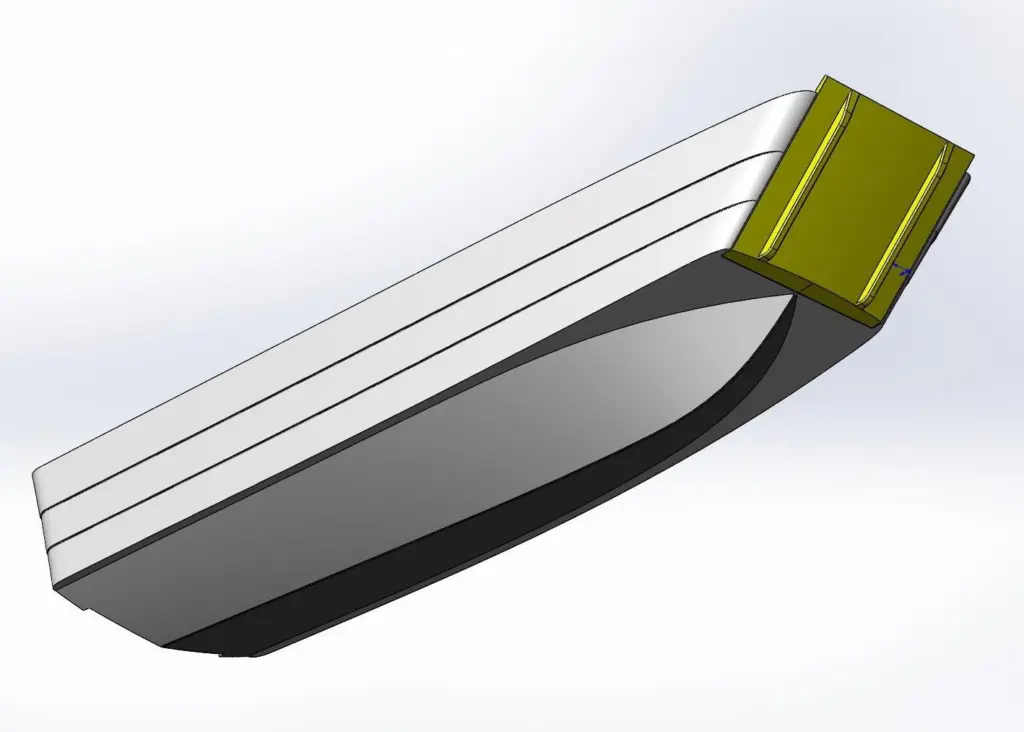
The propulsion is provided by twin 250hp Suzuki outboards (with an option for a diesel outdrive version coming later), fed from below-deck stainless steel fuel tanks. To make the most of the power, the hull pulls off quite a tricky balancing act: below there’s a fine entry, fully planing form which means the boat can reach an impressive 40 knots, but this has to swell to accommodate a square-nosed bow door, so two hefty chines help step up the volume above the water line. These chines also help to yield a stable ride even in fairly choppy conditions and careful attention to buoyancy “makes it virtually unsinkable” said Mr Coulam: both these characteristics were originally developed to support wheelchair users but they are also useful attributes for workboat operations.
However, central to the design is the bow door. It takes up most of the flat, forward end of the V29, a 1.75m section which winds down and can butt up against a pontoon to give the boat step-less ‘ro-ro’ access. It can also be dropped further to provide a ramp onto the shore, this latest version being reinforced with a stainless steel band to protect it when landing on rougher surfaces.
Importantly, the bow ramp is kept suspended by the Goliath stainless steel winch “which we chose because we needed something that would be corrosion resistant in salt water” explained Jim Coulam. The 900kg brake winch, which can be either manually or electrically operated, has a failsafe operation: “It can’t freewheel, if you let go of the button or the handle, the automatic brake kicks in,” he added.
The closing mechanism has also needed development “and the door is actually a bit overbuilt” admits Mr Coulam: although the boat’s shape keeps the door just above the waterline, it still needs to be tight enough to keep the deck dry and there were a number of challenges to the design. The hinges were the first issue: these needed to be placed forward, allowing the section to pivot off-centre, lifting smoothly away on opening and coming back to close perpendicular to the hull – a little like the action of an aeroplane door. However, nothing on the market fitted the bill, so both pins and hinge bodies were fabricated at the yard out of 15mm 316 stainless steel, and there is also a catch for extra safety. Seals were next. “We started with foam seals to begin with, but now we have a composite, sandwich construction with a nitrile outer,” Mr Coulam explains.
However, the hull and door have also been developed to open while afloat: this results in a horizontal surface pretty much level with the water giving the boat a platform for a range of operations. This could include anything from launching and recovering small marine devices to emergency casualty response.
There’s also a potential for adapting the design to integrate steps into the ramp. The idea is that dropping these steps till they fall almost perpendicular to the boat would provide an easy entry for divers.
There are other versions: there’s a 7.3m construction coming along soon and another, 11m model, “big enough to fit a Landrover 110 onboard” is on the drawing board, said Mr Coulam.
It’s interesting that the first Wheelyboat designs went from alloy to plastic, and it’s worth adding that Mr Coulam remains a fan of GRP – though he points out to make a vessel rugged enough for workboat operations, it won’t be any lighter than aluminium. However, he explained: “Plastic has an enormous advantage: it’s pretty difficult to get totally watertight welds on aluminium and if you get a hole then you need to bring in a specialist to carry out repairs. If you put a hole in a GRP hull, you can just patch it up.”
By Stevie Knight