




Custom workboat will perform multiple roles
A UK-based specialist marine operator has expanded its fleet of workboats and harbour launches with a newbuild 15m Multicat workboat/barge, writes Graeme Ewens.
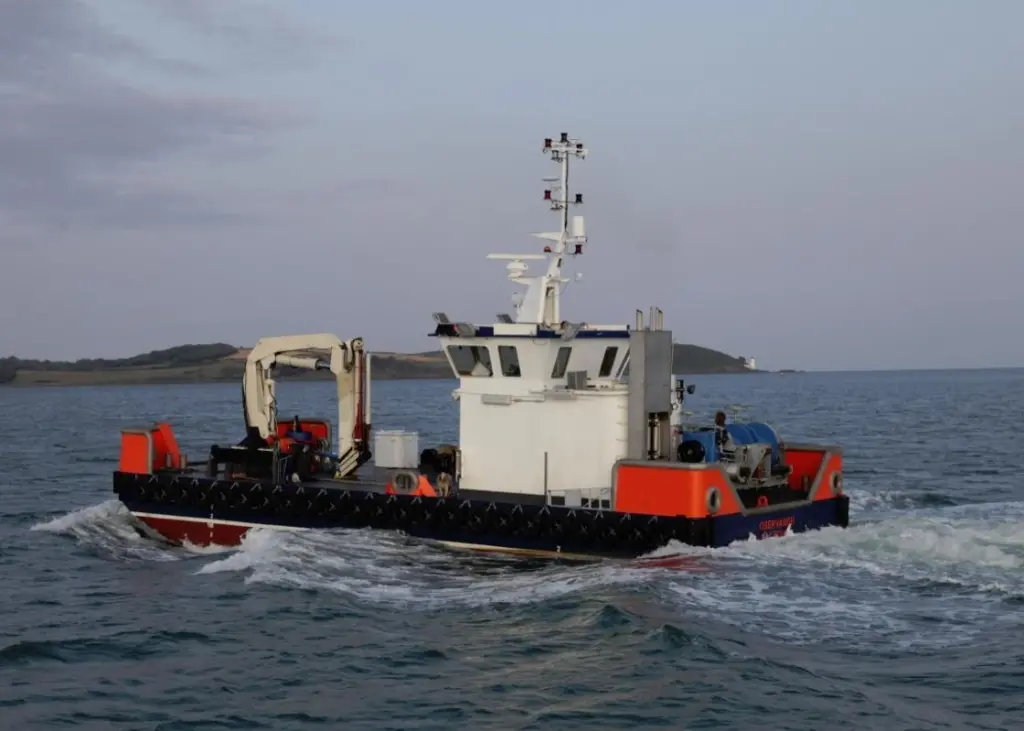
Sea Wide Services (SWS) recently launched the Obervargh (Cornish for Workhorse). The vessel was constructed over 18 months in the firm’s riverside warehouse at Falmouth Wharves, Cornwall, and was lifted into the Penryn River in June utilising their landlord KML’s heavy-lift crane barge, which then placed the deckhouse on board the flat-topped hull. The hull and deckhouse had been fitted out separately and were connected once afloat.
SWS is a well-established business that specialises in diving and salvage operations, underwater survey and repair, and work in the renewable energy sector. They also carry out mooring maintenance, hydro and environmental survey and towage for a range of clients around the coast of the UK, the Isles of Scilly and Northern Ireland, as well as supplying goods and services to vessels calling at the Cornwall port for fresh water, waste removal, crew change, etc. The new vessel is designed to cover any of these requirements, augmenting their existing fleet of six vessels.
Designed by naval architect Jack Gifford to DNV class regulations MCA workboat code Class 2, and fabricated by local shipwrights Mark & Loz, this versatile and compact 15 metre lOA multi-purpose vessel has a beam of 6m, maximum draught 1.6m and moulded depth of 2m. It is equipped with a deck-mounted 28 T/M knuckle boom crane on the port side forward and 2 x 400mm spud legs to starboard, and a 2.5m bow roller. The pusher bow is fendered and the main deck is hardwood covered. The lightship weight is 59.2t and the vessel can carry 35 tonnes of potable water in two tanks, separated by a coffer dam from two tanks holding 12 tonnes of fuel oil to supply the company’s own vessels, and 1.13t of ballast water.
The vessel is powered by twin Doosan MD196TI, 320hp (235kW) engines driving five-bladed props in Kort nozzles, giving a calculated bollard pull of 7 tons and a design speed of 10 knots. A 50hp bow thruster is also fitted. Auxiliary engines are 2 x 60KVA 3-phase generators, with one driving a hydraulic pump. There is a 15t drum winch and 2t tugger winch mounted aft and two 300 kg AC 14 anchors in hawsepipes with anchor windlasses forward port and starboard.
The offset deckhouse located on the port side aft was purchased as a skeleton from a foreign supplier. It is heated throughout and features a bridge deck with a single pilot seat, enjoying 360deg visibility, with a mess room with seating and a galley area. There is direct access from the deck to the wetroom and toilet and another entrance leading down to the engine space. A workshop, hold and day room is located below decks between the main tanks and the forepeak.
The construction and supply of equipment and fitting out were all locally sourced in Cornwall, apart from the sterngear and nozzles supplied by Kort Propulsion. Electronic equipment, supplied by BT Marine Electronics, includes: Furuno APAR radar; Simrad side scan sonar; Hemisphere GNSS survey grade GPS with true heading; Sailor VHF x2; SeaPro Plus chart plotter. Winches were supplied by Spencer Carte; Electrical engineering by MES; Mechanical engineering by Hearn Engineering; Steering gear by Wills Ridley; blasting and painting by Kernick Metal Finishing, and machinist T Pellow. Marine surveyors were R Pearce & Co and project manager was Mark Cann.
As the hull was constructed inside KML’s warehouse, the launch required removal of a brick wall to slide the boat on to the quay. The hull was mounted on rails and pushed out by forklift at high water to be lifted on strops by KML’s floating crane, followed by the wheelhouse. Installing deck machinery and fitting out was completed in July, before the workhorse headed for its first assignment, Vibro-core drilling on the River Clyde for CMS Geotech.
Related Articles
 ELECTRICAL SYSTEMS
 VESSELS
 INDUSTRY NEWS