![MaritimeJournal[Seawork]](https://www.maritimejournal.com/wp-content/uploads/2026/09/MaritimeJournalSeawork.svg)


From hybrid pioneer to HVO workhorse: Why the PLA removed Leader’s batteries
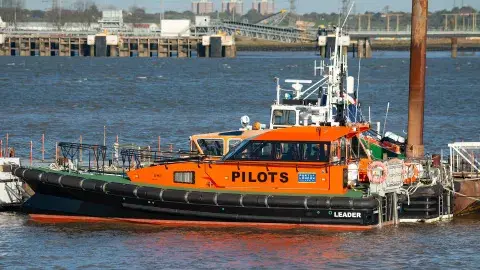
When the Port of London Authority took delivery of Leader in 2019, the 14.4m pilot cutter was an early experiment in low-emission marine propulsion.
Built by Norfolk boatbuilder Goodchild Marine, Leader was the UK’s first hybrid pilot boat: a parallel diesel-electric design intended to demonstrate that a high-performance pilot cutter could undertake much of its work under electric power.
Four years later, the experiment took an unexpected turn: the vessel was retrofitted to run solely on renewable hydrotreated vegetable oil (HVO), and the battery system was removed altogether.
The reason, the PLA says, was not one single failure of hybrid technology, but a mismatch between the vessel’s original design assumptions and the operational reality of a busy Thames pilot boat.
“As one of the UK’s early hybrid pilot boat projects, Leader provided valuable operational and engineering insights into the use of alternative propulsion technologies in a real-world commercial setting,” a spokesman told Maritime Journal. “Those lessons have helped to inform subsequent fleet and sustainability decisions.”
The Leader project demonstrated the importance of operational performance requirements – particularly for vessels undertaking high-frequency pilotage operations – requirements which evolved over the life of the project, including longer transits and a greater requirement for higher-speed operations than originally envisaged. And because the duty cycle is 24/7, the vessel needed more time to charge than was available.
In principle, the battery element of the hybrid system worked well at low (displacement) speeds with the energy consumed at mid and high speeds being significant, but that led to very fast battery discharge which, coupled with limited power available, meant long charging times.
Battery weight
Goodchild’s original ORC 136 HY was designed around a 400hp Yanmar diesel and a Transfluid parallel hybrid system, with lithium-ion batteries supplying electric motors.
Goodchild specified around 15 knots on battery power and 19 knots on diesel, with the two systems capable of working together for additional performance. Batteries could be recharged either from the diesel engines or through shore power.
Efficiency was improved with an ORC hull design developed by French naval architects Pantocarene and incorporating Goodchild’s distinctive forward ‘beak’ and a double-chine hull intended to combine seakeeping, manoeuvrability and low resistance, however the weight of the batteries was a negative factor.
The project, says the PLA, demonstrated the importance of balancing battery weight with operational performance requirements, and was most efficient when running at slow displacement speeds or when on the plane running at high speeds. Leader was heavy for its size due to the batteries so required more energy pro-rata to plane.
The result was a propulsion system that made considerable sense in one part of the duty cycle but was less well suited to another, and although the PLA admits HVO is expensive, that is what Leader now runs on, having been converted in 2023.
Commander
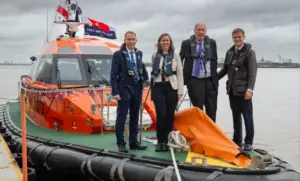
The experience also influenced the design of Leader‘s much larger fleet-mate, Commander. Also built by Goodchild, the 17.8m ORC 171 was launched in 2025, is licensed for 12 people and has a sea speed of 26 knots.
It has twin 600hp Scania engines driving through V-drives and was configured for HVO from the outset, rather than relying on battery-electric propulsion.
The PLA says the vessel’s high pilot capacity – 10 pilot seats – is intended to reduce the number of journeys.
Commander is not just a bigger Leader: the PLA says rapid response and high-speed transits were important considerations when specifying subsequent pilot vessels. Its Humphree stability system and ORC 171 hull are intended to provide stable transfers, while the larger hull allows more personnel to be carried per trip.
Both vessels were officially christened at the same time: the new Commander, and the not-so-new but retrofitted Leader.
Next fuels
Despite not being a suitable propulsion option for Leader or Commander, batteries have not been entirely ruled out by the PLA, which says it is still chasing greener solutions.
“There is no single solution to maritime decarbonisation, and the right technology depends on operational requirements, infrastructure availability and technological maturity,” the PLA spokesman said. “Alongside the use of HVO across our pilot boat fleet, we continue to explore a range of emerging technologies to identify practical, safe and reliable pathways to reducing emissions on the Thames.”
Battery-electric has a place where vessel speeds are lower, and sufficient charging infrastructure exists, the PLA says, which is seen as part of its strategy in the longer term where possible.
Any vessel needs to be reliable, particularly those used in pilot transfer, and this is a factor in selection, says the PLA. Currently, albeit expensive, HVO ticks a lot of boxes and was an easy move as a drop-in fuel.
“The PLA operates in a uniquely demanding environment, responsible for the safe navigation of 95 miles of the tidal Thames, one of the UK’s busiest inland waterways, including through a team of more than 130 expert marine and river pilots,” said the spokesman. “Strong tides, fast-flowing currents and round-the-clock operations mean vessel reliability and operational performance are always key considerations.”
Related Articles
 OTHER NEWS
 FEATURES & VIDEOS
 FEATURES & VIDEOS