



Deep Green: the low current tidal generator
As reported in December’s ‘Maritime Journal’ the renewable energy industry was excited late last year when Swedish marine energy technology company Minesto announced that it had successfully managed to produce electricity from low velocity currents off Northern Ireland, the first in the marine energy era.
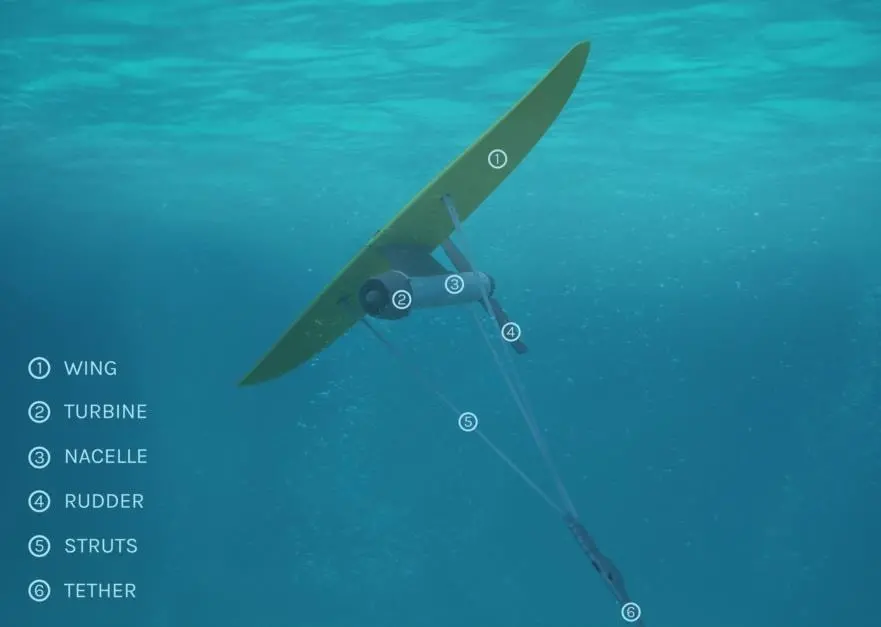
The marine power plant Deep Green has now been producing electricity for more than a year, and we felt it was time to find out more about this somewhat unconventional looking technology.
The Deep Green technology was invented by the inquisitive engineer – Magnus Landberg, in 2001. Each kite is anchored to a point on the seabed or a fixed surface platform and it ‘sails’ a figure of eight course with the long straight legs taken obliquely into the stream to provide 10 times more flow through the turbine than the same tidal flow would put through a static conventional tubine. The outcome was a compact, efficient, tidal power plant able to sweep large areas, much more efficient than rotors on static structures. The design offered a decrease in electricity generating cost
Magnus was project manager for a wind turbine project at Swedish aircraft manufacturer Saab and Minesto was spun-off from Saab, and has since then pushed Deep Green towards commercialisation with great focus on prototype testing in combination with business development on literally all continents.
As expected, deployment of the power plant in Autumn 2013 turned out to be a great challenge. From the desk top, it is almost impossible to foresee how the power plant could be handled in the unpredictable offshore environment with winds, waves and tidal currents causing forces and havoc in all directions.
The team took time out and gathered to develop a plan. This all resulted in a test set-up physically being turned upside down – with the power plant attached to a floating platform instead of to the seabed. The new set-up gave more control, and it was easier to access all subsystems. In addition to that, all mechanical and electrical components were thoroughly examined with great care. When the kite was re-launched and submerged in Strangford Lough, the pulse was high on all 25 Minesto employees watching as it disappeared beneath the surface. As soon as the kite started to make its first figure 8 – steered by a person in the offshore control room– they all knew that a successful launch was in hand.
The team now knew that they had taken a giant step closer to unlock the low velocity tidal and ocean currents as a source for renewable energy production. In October 2013, just a few weeks after the successful first flight, the initial use of an automatic control system took place. Since then, the quarter scale Deep Green has been operational and has produced electricity. The Minesto Deep Green power plant has now achieved performance comparable to producing electricity at the same cost as offshore wind. Furthermore, multiple improvements are targeted, without any significant design changes, with the power output expected to be doubled.
All of the power plant’s functions have been verified, including the full control in all tidal velocities. An important milestone was reached the first time the power plant was automatically controlled and positioned in the middle of the water column during slack water and the turning of the tide. The quarter scale test platform has many times proven to be a cost efficient development environment. For example, when testing a new turbine design, 3D printing was used to produce a polymeric prototype at 1/5th of the cost and 1/10th of the time for an aluminium turbine.
Now the kite is mostly operated from the seabed foundation, and the possibility to connect it to the floating platform is still used when deploying new upgraded sub-systems. In the end, the challenges Minesto faces surprisingly continue to unlock opportunities. The solution of an upside down anchoring to a platform has doubled the market potential since it has turned out to enable full scale installations at larger depths than originally thought, such as in ocean currents. It is in fact ocean currents, which enable constant renewable electricity production, can be used as base load on the grid.
Anders Jansson, co-founder and CEO of Minesto told Maritime Journal; “Scepticism has been expressed against marine energy for its long and costly development, but that should be set in relation to other technologies that we today depend on. Offshore wind hadn’t been heard of in the mid 1990s whereas the growth during the 20th century has been phenomenal. Between 2010 and 2014, the market grew with 600% and is expected to grow with 2,300% until 2020.
“Today we depend on wind power which supplied electricity to more than 25% of the UK’s households in 2014. The next industry to experience the same breakthrough is tidal and ocean current energy. Thanks to many enabling technologies, like sensors, materials and computer simulations, tidal energy technologies have made great advancements in few years’ time. The tidal energy industry has done its homework to pass the early stages of technology development, and now it’s time for politicians and investors to act to ensure the future European backbone industry to grow.”
The next step for Deep Green is the installation of the first commercial scale, 0.5MW power plant off the coast of Wales in 2017. The installation in Wales will be successively extended to a 10MW array, which could have the potential to deliver power to over 8,000 Welsh households.
By Jake Frith
Related Articles
 MARINE CIVILS NEWS
 OTHER NEWS
 MARINE CONSTRUCTION