

Dew Piles It On for Rosyth Ro-Ro Port
The Port of Rosyth already had much of the required infrastructure in place when it received the go-ahead early this year to become Scotlands first ferry link to mainland Europe via a Superfast ro-ro service to Zeebrugge.
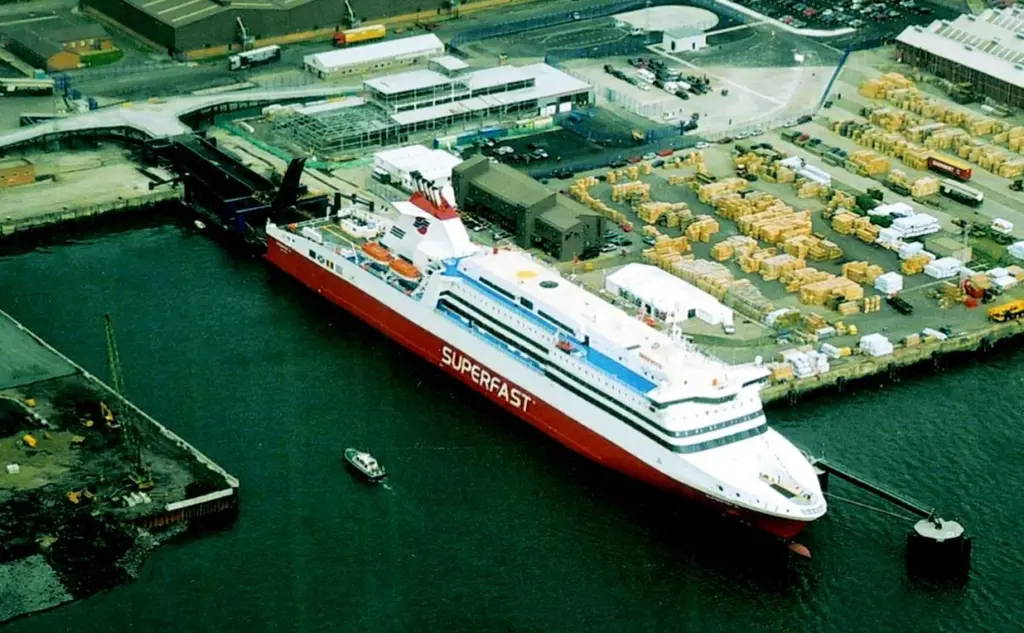
However, some £10.8m worth of additional works were required, including lengthening the mooring berth and major dredging works to deepen the harbour basin.
Major marine construction works at Rosyth necessary to facilitate ferry operations included three major piling projects. The six month delay in confirmation of Government funding meant the 44 weeks originally scheduled for main contractor Dew Construction to complete these jobs was compressed to just 18 weeks.
The works comprised the construction of a 162m new quay wall to create a deepwater berth hewed out of the existing bedrock.
Before work began, imported fill was used to reclaim land and to form access benches and haul roads across the site. A 200t barge mounted excavator operated by subcontractor Westminster Dredging was then used to win 40,000 tonnes of bedrock, forming the seabed 8m deep and siecasting the valuable material to land for recycling. The 24 hour a day operation was concluded within three weeks.
The piling works progressed at the brisk rate of 6m per day, installation being followed immediately by cutting and trimming, removal of overburden in the piles, drilling 600mm diameter holes 7m into bedrock followed by the placing and grouting of heavy spigot piles.
In conjunction with the main wall a parallel anchor wall was constructed, tied to the main wall with 90mm high tensile bars.
To finish the works, fair faced reinforced concrete capping beams were pre-cast on site for rapid fitment upon final completion of the wall.
The second project was to construct two marine dolphins, the outer being a canting dolphin to help the 23,000t ferries moor safely while the inner acts as an extension of the berthing face to the existing quay. The dolphins had to be large and robust to absorb the berthing energies of large ferries and were helped by 15t parallel motion fenders.
To speed installation, the dolphins were of modular fabrication incorporating 75t pile jackets that doubled as temporary works piling gates when initially placed onto the seabed and then for piling the main legs. Modular construction provided massive time savings, with each dolphin completed in just seven days.
Despite the six month delay in starting works, Rosyth was ready to receive its first ferry from Zeebrugge by the target date and was fully functional shortly thereafter. Rosyth is looking to become an even bigger player as a ferry port and work on a second mooring berth has been running seven weeks ahead of schedule.
MJ Information No: 17527
Related Articles
 MARINE CONSTRUCTION
 EQUIPMENT
 MARINE CONSTRUCTION