![MaritimeJournal[Seawork]](https://www.maritimejournal.com/wp-content/uploads/2026/09/MaritimeJournalSeawork.svg)


Easier electrification for small ferries
Torqeedo and Poseidon have cooperatively announced a fully electric, steerable thruster system providing up to 65kW.
Poseidon’s thruster is integrated into Torqeedo’s award-winning and highly efficient Deep Blue drive. The thruster delivers continuous power of 50kW and peak power of 65kW and can rotate up to 360 degrees. Two drives are a typical configuration for the average 80 to 200-passenger vessel, but up to four may be installed. With service intervals of as long as 25,000 hours and the optimized efficiency of a pulling propeller, the Poseidon thruster integration for Deep Blue will further lower the total cost of ownership for climate-friendly ferries and water taxis.
The system is powered by Deep Blue lithium-ion batteries with a battery bank capacity of 80kWh to 1MWh. These high-capacity batteries with technology by BMWi meet IEC 62619 and IEC 62620 requirements, making them suitable for use in inland vessels according to ES-TRIN (European Standard laying down Technical Requirements for Inland Navigation vessels) requirements. A DNV-GL type-approved battery variant is also available for offshore applications.
The electro-hydraulic steering system was developed by FS-Schiffstechnik in Duisburg, Germany, an established supplier of electrical and hydraulic systems for commercial shipping for over 25 years.
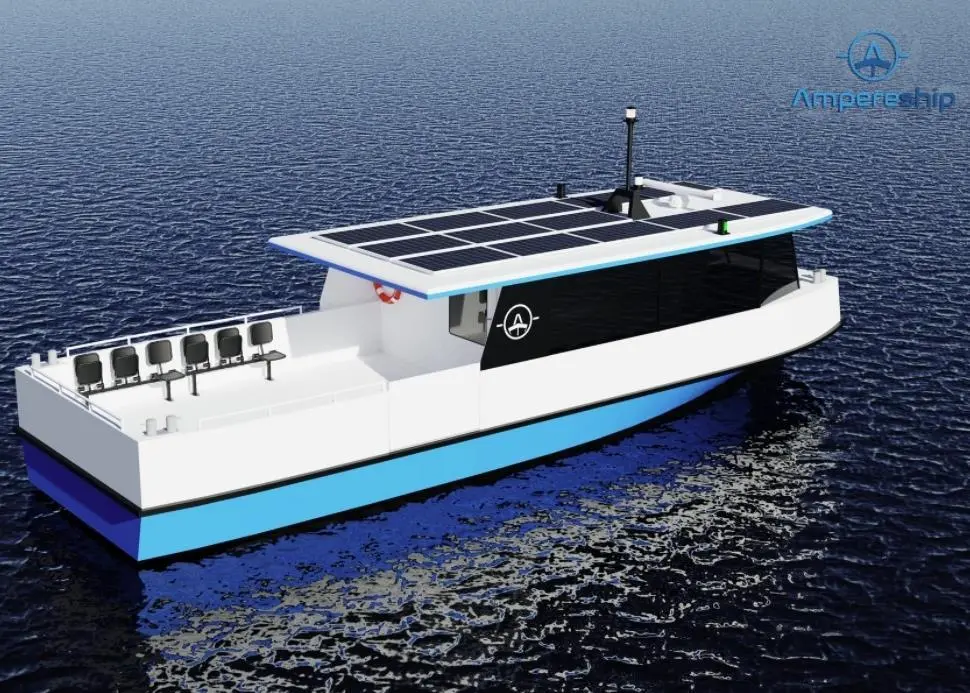
The first project with the new Deep Blue thruster is already well underway. Ostseestaal subsidiary Ampereship is building an ES-TRIN certified solar-electric passenger ferry that will travel between the mainland town of Kamp and the island of Usedom in Northern Germany. The solar-powered 14.65 metre-long ferry can transport up to 20 people and 15 bicycles per trip at a cruising speed of 8km/h, with a max speed of 14km/h. The new ferry is scheduled to start operations in August 2021.
“There are many commercial applications that can be electrified very economically. Our focus is to keep the total cost of ownership low by offering a solution on a system level, including design-in, service, maintenance and remote diagnostics. This makes electrification as easy and safe as possible for the shipyard and the fleet operator,” explains Phillip Goethe, director project sales.
Torqeedo says that electrification of vessels in inner-city waterways with Deep Blue can be accomplished very cost-effectively because speeds are often limited and the vessels are typically in use for 8-14 hours per day, which leaves plenty of time for overnight charging. That reduces infrastructure and battery bank costs and makes the entire investment even more economically and ecologically beneficial. The new thruster drive option adds unbeatable manoeuvrability to the proven Deep Blue system – a critical advantage for inland and urban waterways.
Axel Büchling, manager project sales for Torqeedo, has 24 years of experience in marine electrification and has converted many ferries in Europe to electric drives.
“The technology is ready. Up to 200kW propulsive power is enough to operate most inland passenger vessels. The modular system design allows the operator to use the same parts and components in different vessels and all components can be monitored and serviced remotely. That is a big advantage,” Büchling said.
Büchling also noted that Torqeedo’s global service network, supported by parent company DEUTZ, can provide optimal support to its customers no matter where they are. To make the transition as easy as possible, Torqeedo also may offer advice regarding current funding opportunities or subsidies, depending on the project.
Visit Torqeedo at Seawork 2021 on stand PO143