![MaritimeJournal[Seawork]](https://www.maritimejournal.com/wp-content/uploads/2026/09/MaritimeJournalSeawork.svg)






Ørsted scraps massive North Sea wind farm
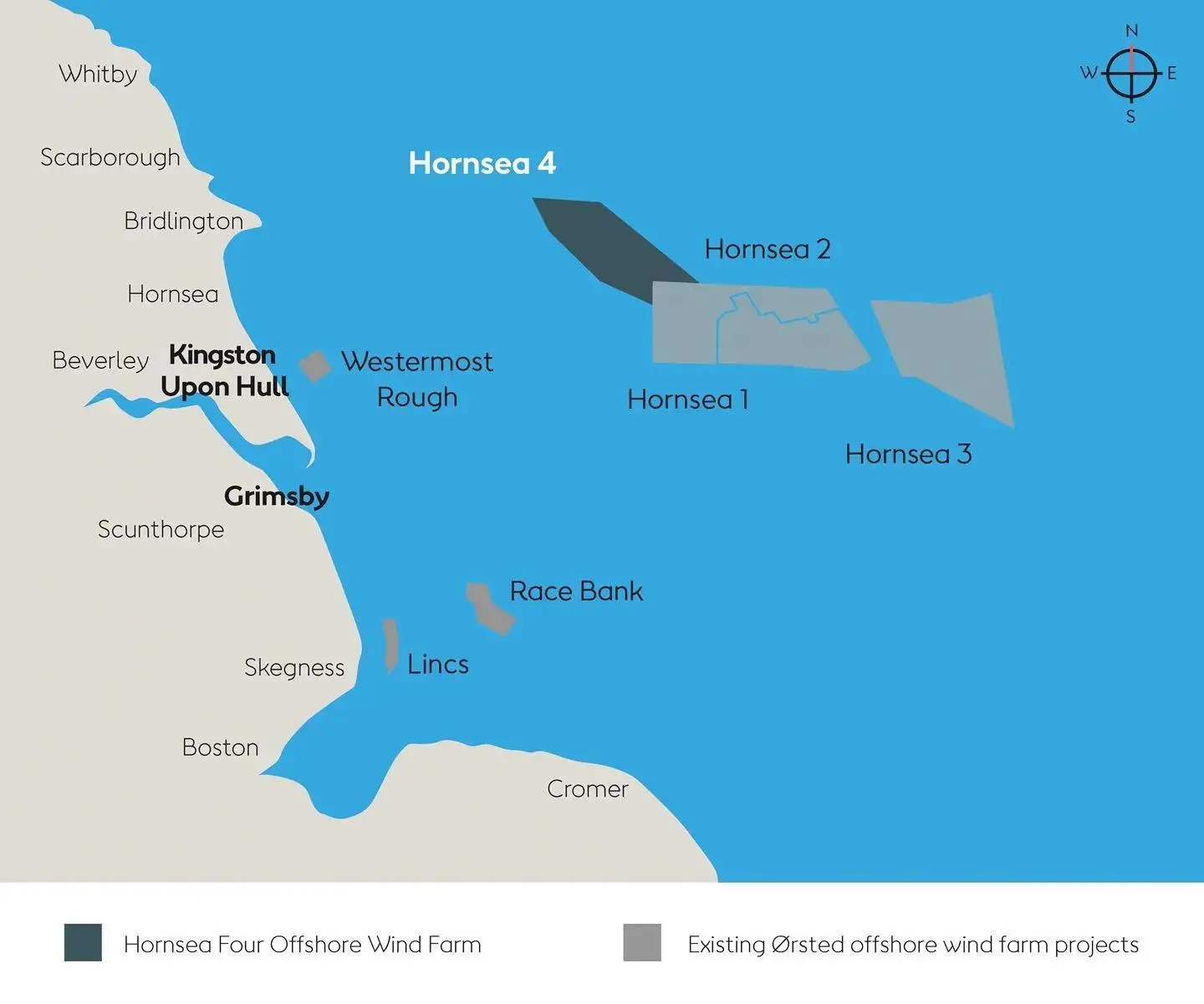
Energy giant Ørsted has pulled the plug on Hornsea 4, the fourth offshore wind farm of a total 8GW of potential offshore wind off the east coast of northern England.

In a statement that should send shock waves across the industry, Ørsted blamed economic forces for the discontinuation of Hornsea 4, which would have seen 180 wind turbines installed over an area of 492km2. Generation capacity was 2.6GW.
“Since the Contract for Difference (CfD) award in allocation round 6 in September 2024, the 2,400MW Hornsea 4 project has seen several adverse developments relating to continued increase of supply chain costs, higher interest rates and an increase in the risk to construct and operate Hornsea 4 on the planned time-line for a project of this scale,” it said.
Group president and CEO Rasmus Errboe, who only took the reins at Ørsted earlier this year, said the company ‘remained fully committed to being an important partner to the UK government to help them achieve their ambitious target for offshore wind build-out’.
“However, our capital allocation is based on a strict and value-focused approach, and after careful consideration, we’ve decided to discontinue the development of the Hornsea 4 project in its current form, well ahead of the planned Final Investment Decision later this year.
“We’ve been maturing the project over the past nine months and have been working relentlessly with stakeholders and suppliers to manage the different project risks for a project of this scale. Throughout the development phase we’ve been very diligent in our approach to capital commitment to our suppliers, and our committed capital is well below our threshold. The adverse macroeconomic developments, continued supply chain challenges, and increased execution, market and operational risks have eroded the value creation.”
Ørsted said breakaway costs for 2025 could be up to €600 million, with impact on Earnings Before Interest, Taxes, Depreciation and Amortisation (EBITDA) likely to be up to €470 million.
“In addition, capitalised construction costs of approx DKK 0.5 to 1 billion (€134 million) will be written down,” Ørsted said.
The company did offer a glimpse of hope, saying that it would keep the project rights in its development portfolio and seek to develop it at a later day ’in a way that is more value creating for us and our shareholders’.
The UK government has not given up on the project, insisting ‘we want this project to happen by 2030, and will work with the business to make this happen’.
A reply from the Department of Energy Security and Net Zero said: “We recognise the effect that globally high inflation and supply chain constraints are having on industry in Europe, and we will work with Ørsted to get Hornsea 4 back on track. We have a strong pipeline of projects to deliver clean power by 2030 and our mission-led approach ensures we can steer our way through global pressures and individual commercial decisions to reach our targets.”
Commenting on today’s announcement by Ørsted that it is putting its Hornsea 4 offshore wind farm project on hold, RenewableUK’s Deputy Chief Executive Jane Cooper said:
”The unique cost pressures faced by Hornsea 4 have led to a rethink on this particular project, and we need to do everything we can to keep a stable market for all other projects going forward.
”The fact that supply chain constraints have been cited as one of the reasons for this decision highlights the importance of investing to support the UK companies across the wind value chain as a central part of the UK’s industrial strategy. We urge the Government to remove uncertainty for investors in this year’s auction for new clean power projects by ensuring auction parameters reflect the cost increases we’re seeing in the supply chain and inflationary pressures. Additionally, Government should rule out the introduction of zonal pricing which would drive the cost of investment up even further.”
To date, Hornsea 1 and 2, which in total can generate 2.4GW, are operating and Hornsea 3, which will have up to 231 turbines installed over an area of 700km2, is under construction.
Related Articles
 FEATURES & VIDEOS
 ENVIRONMENT
 OTHER NEWS