




All foundations installed at world’s largest offshore wind farm
All of the foundations and transition pieces for the world’s largest wind farm have now been installed in the North Sea.
Seaway Alfa-Lift, the heavy-lift vessel owned by Seaway7, has installed the final transition piece on to its monopile foundation at Dogger Bank C, the third phase of the Dogger Bank Wind Farm.
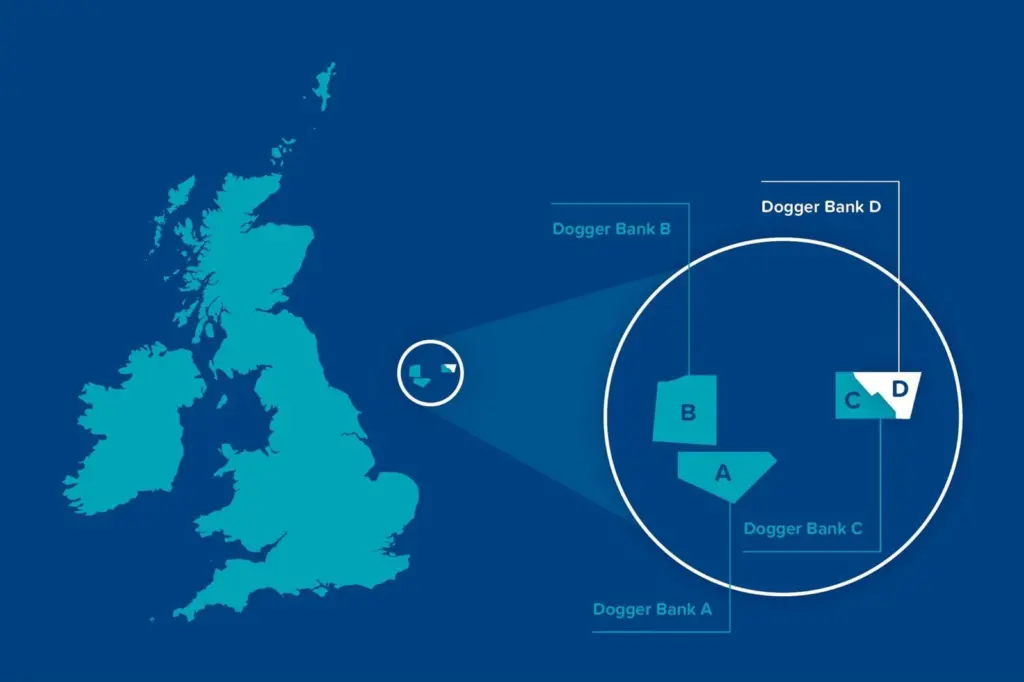
Dogger Bank has a total power generation potential of 3.6GW, split equally among the three phases. Phase D is already in the planning pipeline, adding another 1.5GW.
In total, 277 monopiles and 277 transition pieces have been installed, making a total of 554 foundation assets. The farm is owned by a joint venture of three, namely SSE Renewables and Equinor with 40% each, and Vårgrønn with 20%.
Seaway7 used its 183m vessel Seaway Strashnov to install the monopiles. The vessel is powered by six 4,500kW main engines, two 5,500kW main thrusters, two 3,500kW DP thrusters, two 1,150kW bow thrusters and a transit speed of 12 knots.
Seaway Alfa-Lift is even larger, 244.6 metres in length and with 11 engines in total, including four 6,875kW main engines, three 3,200kW tunnel thrusters, three 5,500kW stern thrusters, and one 3,200kW bow azimuth thruster.
Dogger Bank is an isolated sandbank in the central and southern North Sea, spanning Dutch, UK, German and Danish waters.
After the last ice age, the area became an island before being covered by sea level rises about 6,000 years ago. The sandbank now accommodates the three phases of Dogger Bank between 125km and 290km off the east coast of Yorkshire, extending over an area of about 8,660km2 and in water depths of between 18m and 63m.
In February, the UK had an installed power generation capacity from offshore wind of 15.7GW, according to Renewable UK. It has the second largest industry in the world next to China, which has almost three times as much, according to Statista.
Related Articles
 ELECTRICAL SYSTEMS
 ENVIRONMENT
 ENVIRONMENT