![MaritimeJournal[Seawork]](https://www.maritimejournal.com/wp-content/uploads/2026/09/MaritimeJournalSeawork.svg)






Could the courts save the US offshore wind industry?
Federal judges have over-turned all five offshore wind stop-work orders or lease suspensions issued by the American president since December.
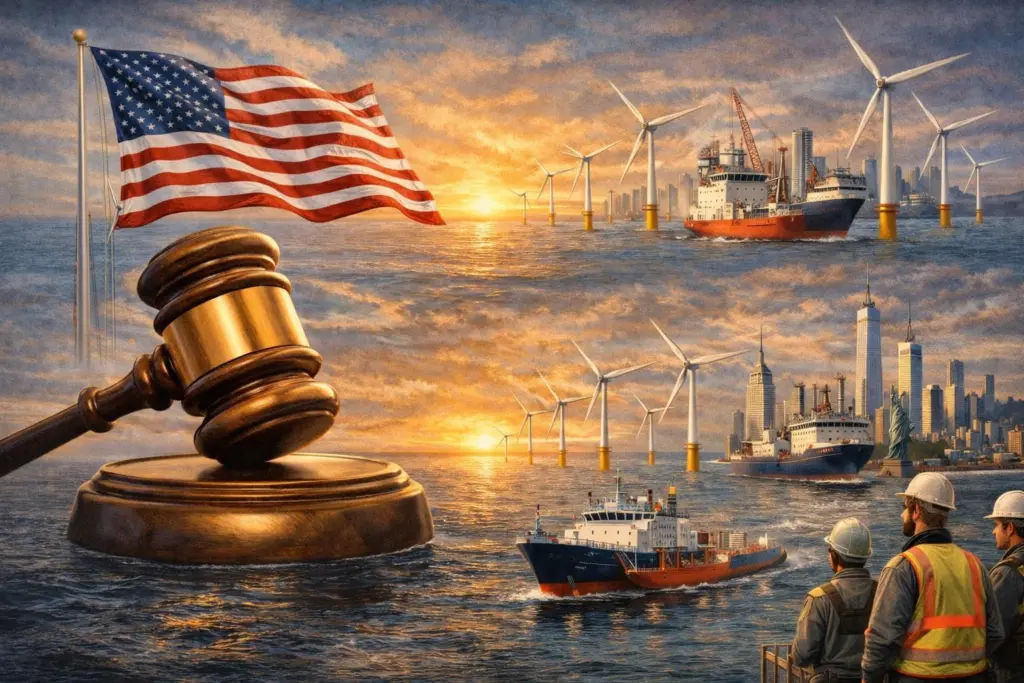
The five projects given the go-ahead after being stopped by Donald Trump will generate almost 6GW of electricity, which is estimated to be enough to power 3.5 million households.
Billions of dollars’ worth of port and vessel building have potentially been saved, along with thousands of jobs and domestic manufacturing.
The most advanced of the projects, Vineyard Wind, was allowed to restart after a Boston District Court judge ruled the administration’s action was ‘likely arbitrary and capricious’.
The project is 95% complete and already sending 572MW of electricity to Massachusetts through installed export cables. More than 30 vessels are supporting the construction, many of them built or retrofitted in US shipyards from Louisiana to Rhode Island.
The project’s supply chain spans 37 states and has driven more than $1.6 billion in investment, while employing more than 3,700 workers.
“Vineyard Wind is critical to securing not only Massachusetts’ electric grid, but the regional grid serving millions of residents,” said Oceantic Network CEO Liz Burdock, adding that offshore wind ‘performs well during these cold winter months’.
Revolution Wind, serving Rhode Island and Connecticut, also returned to work after the courts intervened for a second time.
The 700-plus-MW project is 87% complete, with all offshore foundations installed and 58 of 65 turbines already standing.
But the developers had braced for disruption after receiving the stop-work order just before Christmas.
“When we received the suspension order shortly before the holidays without any notice, we were ready and activated our action plans,” the company said. “Now our focus is on safely resuming construction work as soon as possible.”
Like Vineyard Wind, Revolution Wind relies on a specialised US-flagged vessel fleet and upgraded port infrastructure, including heavy-lift quays and marshalling areas purpose built for offshore wind components.
The sun rises again
In Washington, DC, Judge Royce Lamberth cleared Sunrise Wind to resume construction after reviewing classified material cited by the administration as justification for the stop order.
He echoed the Boston judge’s comments that it was ‘arbitrary and capricious’, and warned that losing access to specialised installation vessels would trigger a ‘cascade of delays’.
Sunrise Wind is 45% complete and will deliver 924MW to New York once operational.
Its supply chain spans 34 states, supports more than 4,290 jobs, and includes more than 16 vessels built or retrofitted at 10 US shipyards. Among them is the Acadia, the first US-built subsea rock installation vessel, built at Hanwha Philly.
“Sunrise Wind represents a vital investment in strengthening both Long Island’s power system and the broader regional grid,” Burdock said, calling the ruling a step towards ‘reliable, affordable clean energy’.
Another federal judge over-turned a stop-work order that had halted construction on Coastal Virginia Offshore Wind, allowing the project to resume work while legal challenges proceed.
The decision came in mid-January 2026 when the U.S. District Court for the Eastern District of Virginia granted developer Dominion Energy a preliminary injunction, which means construction can continue even as the broader lawsuit against the order moves through the courts.
Empire re-launched
The court decisions culminated with Empire Wind, developed by Equinor, where Judge Carl Nichols of the US District Court for the District of Columbia granted a preliminary injunction allowing construction to resume.
Nichols found that the government’s action would cause ‘irreparable harm’ and that the developers were likely to succeed in showing the order lacked adequate justification.
Empire Wind, roughly 60% complete, is a multi-billion-dollar project heavily dependent on US port facilities and Jones Act-compliant vessels.
“Today’s ruling marks the fifth time in a row that a federal court has allowed one of the five offshore wind projects suspended in December to move forward,” said Hillary Bright, executive director of Turn Forward.
“After five rulings and five clear outcomes, it is time to move past litigation-driven uncertainty and allow these projects to finish the job they were approved to do.”
With courts repeatedly rejecting the administration’s attempt to halt construction, developers are once again mobilising vessels, ports, and workers – and it could be that the courts will save the US’s offshore wind industry.
Related Articles
 FEATURES & VIDEOS
 ENVIRONMENT
 OTHER NEWS