![MaritimeJournal[Seawork]](https://www.maritimejournal.com/wp-content/uploads/2026/09/MaritimeJournalSeawork.svg)



Developers pull back from floating wind
Research has shown that developers are backing out of floating wind projects because of investment hurdles and slow progress.
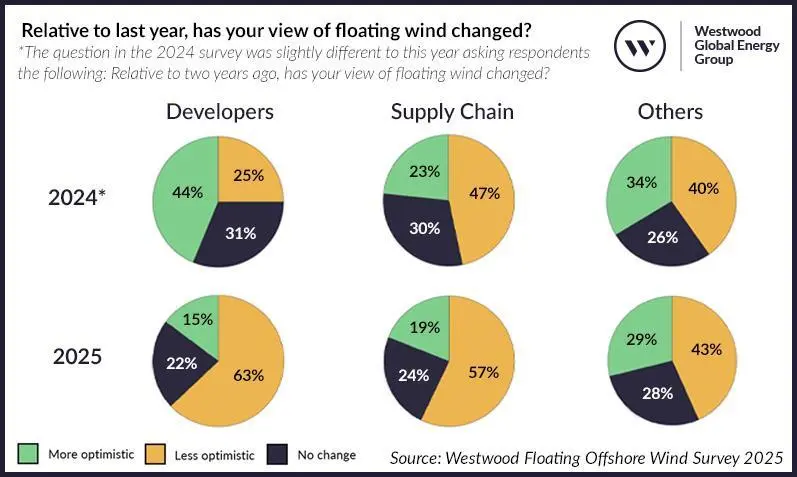
A survey led by the Westwood Global Energy Group with World Forum Offshore Wind, Norwegian Offshore Wind, Oceantic Network and WindEurope said delivery delays, investment risk and sluggish policy were causing industry to be more cautious.
Westwood says it polled 166 stakeholders ‘across the global floating wind value chain’, including engineers, product developers, investors and government organisations, and discovered 63% of them were feeling ’less optimistic’ than last year.
It said 72% anticipated there would be less than 3GW of floating wind operational globally by 2030.
The biggest downturn in optimism was from the developers themselves, it said, who were previously ‘the most optimistic group’.
“Among the reasons cited for the lack of optimism, the most prominent financial barriers were high upfront capital costs and limited investor confidence in technology,” Westwood says. “Among non-financial hurdles, port infrastructure, lack of standardisation of technologies and low government support levels continue to dominate.”
There was a strong correlation, the survey revealed, between perceived market leadership and recent government initiatives, and the top three floating wind countries identified – the UK, South Korea and France – had the most subsidies and most pronounced ‘policy signals’.
“Progress is happening, but too slowly,” said Bahzad Ayoub, Manager – Offshore Wind at Westwood. “The frustration across the sector stems from knowing that momentum exists – but the pace is out of sync with expectations. Optimism hasn’t disappeared, but it’s now paired with a grounded mindset. Floating wind must be treated as a distinct sector, not simply an extension of fixed-bottom wind and a majority of respondents think this way. The technology, timelines and investment requirements are different – and government and industry action needs to reflect that.”
Among the concerns was the cost and lack of grid connection and infrastructure, such as at ports, and a lack of standardisation of floating technologies.
A lack of manufacturing capacity and capability was also a concern.
Related Articles
 FEATURES & VIDEOS
 ENVIRONMENT
 OTHER NEWS