



Green and digital corridor deal reached
The Maritime and Port Authority of Singapore (MPA) and the Port of Rotterdam are joining forces to create the world’s longest green and digital corridor to enable low and zero carbon shipping.
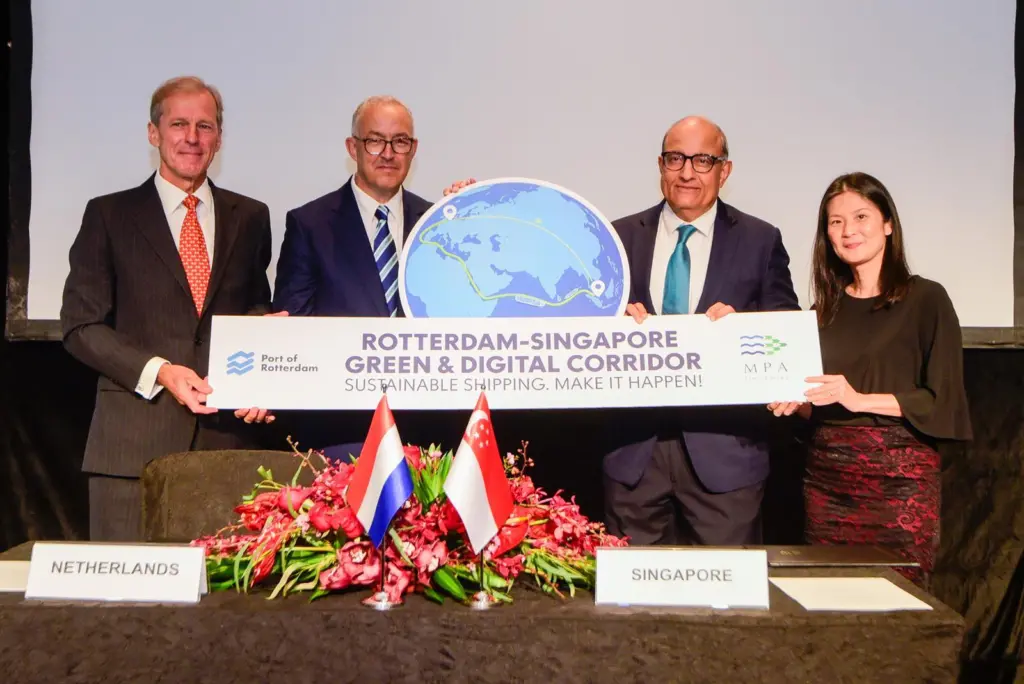
The memorandum of understanding will explore alternative fuels, optimising efficiency, safety and the transparent flow of goods, and aims to have the first sustainable vessels sailing on the route by 2027.
“Shipping is among the most important industries to decarbonise, owing to its large international reach and volume, which continues to grow,” commented Allard Castelein, chief executive of the Port of Rotterdam.
“By bringing together parties across the supply chain along one of the world’s biggest trade lanes, we can enable carriers to switch to zero-carbon fuels and speed up the transition to more sustainable shipping.”
Singapore has committed towards a low carbon future with its Maritime Singapore Decarbonisation Blueprint 2050. “This MoU reaffirms Singapore’s commitment towards facilitating a multi-fuel bunkering transition and accelerates our digitalisation efforts to optimise maritime efficiency and improve supply chain resilience,” said Quah Ley Hoon, chief executive of MPA.
The port authorities will work with the Global Centre for Maritime Decarbonisation and the Mærsk Mc-Kinney Møller Center for Zero-Carbon Shipping, as well as other industry partners across the supply chain, including bp, CMA CGM, Digital Container Shipping Association, Maersk, MSC, Ocean Network Express, PSA International, and Shell.
Related Articles
 OTHER NEWS
 ELECTRICAL SYSTEMS
 ENVIRONMENT