





Half of fishermen claim OSW is bad for business
An ongoing survey by the Plymouth Marine Laboratory (PML) has so far found that more than half of respondents in the fishing industry see offshore wind farms as having a negative impact on their businesses.
All of the proposed wind farms currently in the pipeline in UK waters are expected to have in impact on fishermen in the future, survey project lead Claire Szostek said.
Fishermen’s concerns include the squeeze on areas they can operate in because they can no longer use some of their gear – which means they have to travel further afield, adding costs.
“Additional concerns highlighted by respondents include sea floor cables, decommissioning, damage to the seabed, particular impacts on inshore fishermen, disproportionate coverage of scallop and whelk fishing grounds, impacts on commercial vessel traffic patterns, electromagnetic effects from cables and impacts on specific fisheries and/or locations,” Szostek said.
“80% of the 43 wind farms that are currently operational or under construction are viewed as impacting fishing activity,” said Szostek. “The majority of fishers have had to use different fishing grounds due to wind farms, with a few choosing to change gear and one fisher leaving the industry as a result.
“So far, 57% of respondents have cited a negative outcome on catches and profitability, and just one person has experienced a positive outcome on catches and profitability.”
There may be some benefits for pot fishermen, she said, citing one lobster fisherman who said lobster fishing had improved around turbines.
“This is currently being investigated by researchers at Aberystwyth University,” she said.
Boost to marine life
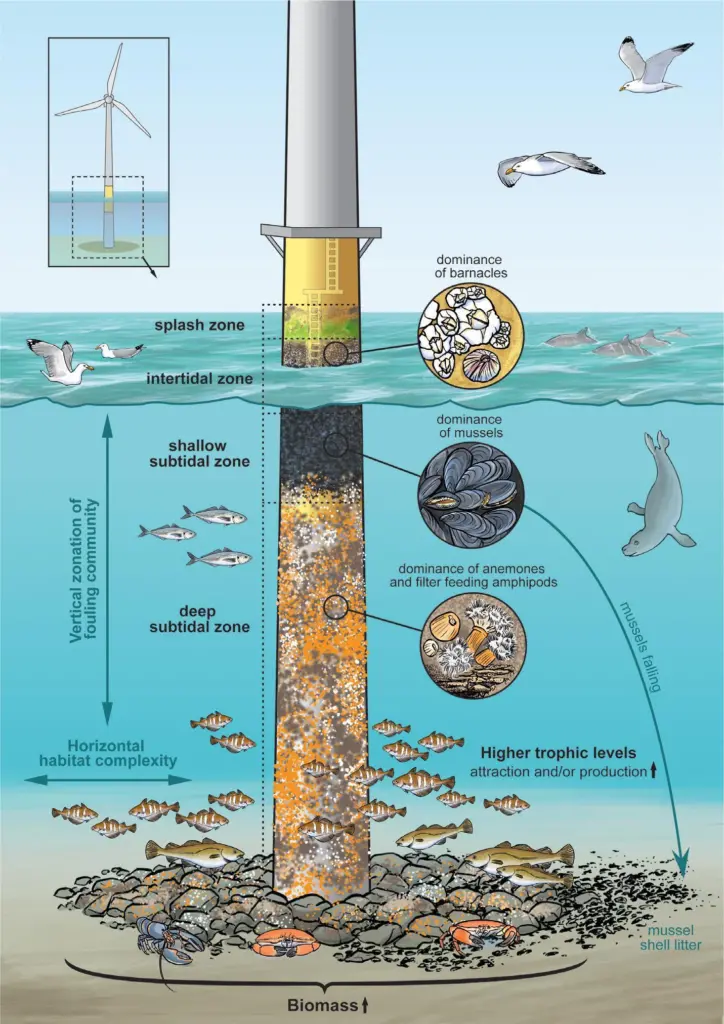
While the impact of wind farms may have a negative effect on commercial fishermen because of space issues, many scientific papers have been written about the increase in marine life their so-called artificial reef effect has.
“It is now widely accepted that one of the most important effects of OWFs is the provision of new habitat that can be colonized by hard substrate species,” says the report Offshore Wind Farm Artificial Reefs Affect Ecosystem Structure and Functioning: A Synthesis by Oceanography, a publication by the Oceanography Society.
“Setting aside the loss of soft sediment habitat due to the OWF footprint, OWF structures generally provide two distinct artificial habitats: hard vertical substrates and a complex range of horizontal habitats, depending on the type of foundation and the degree of scour protection used.
“In addition, the novel surfaces occur throughout the full water column, from the splash zone to the sea floor, often in areas where comparable natural hard surfaces are absent. These attributes are largely unique to offshore energy infrastructure. The introduction of coarse rock affects seabed habitat complexity, particularly in mobile sediments, expanding the habitats available to serve as refuges and to support food sources for biota.”
Responses to the PML survey have so far come from fishermen all around the UK, on vessels ranging from 6-42m in length using multiple types of trawls, dredges, creels, pots, jigging machines, hand lines, trammel and gill nets.
Half of respondents so far fish within 6 NM and three-quarters fish >12 NM from shore.
Related Articles
 ELECTRICAL SYSTEMS
 ENVIRONMENT
 ENVIRONMENT