![MaritimeJournal[Seawork]](https://www.maritimejournal.com/wp-content/uploads/2026/09/MaritimeJournalSeawork.svg)






Heerema installs wind turbines with new floating method
A wind farm installation has been carried out using a new RNA floating method by marine contractor Heerema.
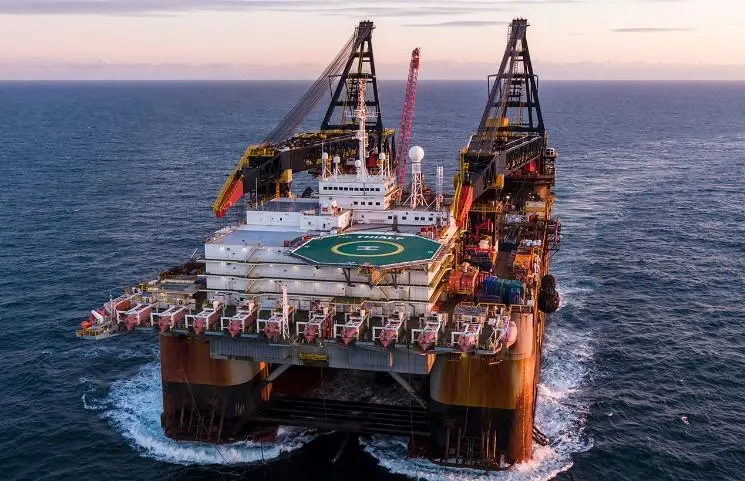
Twenty-four offshore wind turbines have been successfully installed at the Arcadis Ost 1 wind farm using a new floating method, a joint statement between owner and operator Parkwind and marine contractor Heerema has confirmed.
The turbines, in the federal state of Mecklenburg-Western Pomerania. cover 29km² and have 257MW generating capacity, enough to power about 300,000 households.
Heerema says the installation process was sped up by assembling and lifting the wind turbine generator (WTG) tower (using semi-submersible crane vessel Thialf) in parallel with a second main crane pre-assembling the WTG.
“For the latter, Heerema developed a method where the Rotor Nacelle Assembly (RNA) lift takes place on a so-called ‘support’ tower on board the crane vessel,” says Heerema. “The support tower provides a stable platform to allow a fast and secure assembly of the nacelle and the blades. Once pre-assembled the complete RNA is lifted as one piece onto the WTG tower in only one lift.
“The pre-assembly process on board Thialf ensures full control, thereby guaranteeing a safe and highly reliable installation environment. The reduced number of lifts between the vessel and the structure eliminates key risks of the floating installation. Vestas has delivered RNA lift-feasible components by developing new tools to support the offshore floating installation.”
“After almost three years of development and engineering, we have successfully executed the floating installation of the first Arcadis Ost 1 turbine,” a joint statement said. ”This innovative method has two main advantages. The first is zero seabed interaction, especially important in areas of significant water depth or challenging soil conditions. The second advantage is a shorter installation cycle.”
Parkwind owns and operates four wind farms in the Belgian North Sea as well as Arcadis Ost 1.
“As offshore wind energy targets grow, this kind of innovation is key if we want to move towards a sustainable future as fast as possible,” said Eric Antoons, co-CEO of Parkwind. “As zones go further offshore and turbines increase in size, we are certain to see a continued demand for substantial innovation in our industry. We are delighted to be a part of this journey.”
Related Articles
 FEATURES & VIDEOS
 ENVIRONMENT
 OTHER NEWS