

Jumbo Maritime has upgraded its heavy lift vessel Jumbo Jubilee with wind-assisted propulsion, boosting its capacity to support offshore renewable energy projects while reducing carbon emissions.
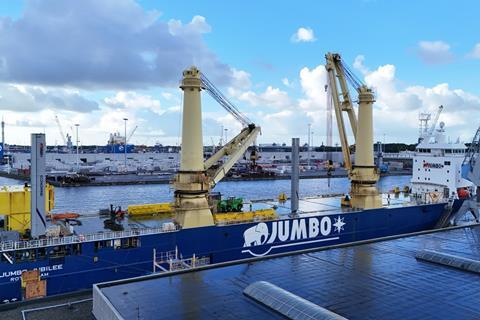
The installation of two Econowind mechanical sails on Jumbo Jubilee is part of Jumbo Maritime’s strategy to enhance its fleet’s sustainability.
“At Jumbo, sustainability is at the core of our operations,” said Daan Kornneef, CEO of Jumbo Maritime.
“The addition of these mechanical sails on Jumbo Jubilee represents a significant step forward in our mission to support the offshore renewables sector while minimising environmental impact. We are proud of our team’s efforts in making this possible.”
Fuel efficiency
This wind-assisted propulsion (WASP) system is expected to significantly improve fuel efficiency, making the vessel an ideal solution for offshore renewables and heavy lift operations. The initiative aligns with Jumbo’s commitment to innovative decarbonisation measures across its fleet.
The relatively small footprint of the sails makes them an ideal solution for installation on a heavy lift vessel, where space is required for project cargoes.
Additionally, the sails are flexibly mounted on a customised frame engineered in-house. With this, the sails can be moved, or even transferred to another vessel should additional space be required for cargo.
The installation of the ventofoils follows application of an anti-fouling coating on the ship’s propeller to maintain efficiency, as well as the introduction of an AI powered anti-fouling hull coating monitoring system.
This innovative system captures a wide range of date including vessel speed, geographical position, as well as sea water temperature and other environmental conditions and parameters. This allows the system to make predictions and provide notifications when there is a risk of accelerated fouling.
This means that Jumbo can perform an inspection and undertake maintenance in advance of a decrease in fuel efficiency. It also means the system can be maintained using less aggressive methods, ensuring its preservation for longer durations between dockings.