

Installation of the UK’s first CO₂ transport and storage infrastructure project has begun, with pipelay and subsea installation now being followed by rock protection work along the route.
The Northern Endurance Partnership (NEP) is developing infrastructure to pipe captured CO₂ from industrial facilities in Teesside to permanent storage beneath the North Sea as part of the East Coast Cluster being developed by bp, Equinor and TotalEnergies.
The initial system is designed to transport and permanently store up to 4 million tonnes of CO₂ a year.
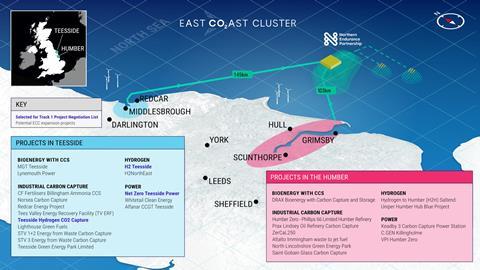
Saipem is responsible for engineering, procurement, construction and installation of the offshore pipeline and associated infrastructure. Its contract covers approximately 145km of offshore pipeline, together with associated facilities and inspection work. Saipem’s final award for the NEP and related Net Zero Teesside Power project was valued at about €650 million, with a 30-month execution period.
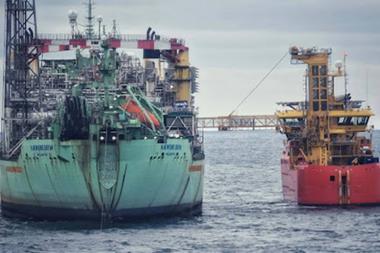
“We are laying a 149 km, 28-inch CO₂ pipeline connecting onshore outlet facilities to offshore CO₂ storage sites, plus cable ducts for subsea injection systems,” the company says. “Our Castoro 10 and Castorone vessels are leading this work alongside about 40 subcontracted vessels coordinated by Saipem.”
Castorone is a deep-water pipelay vessel and Castoro 10 will be deployed for shallow-water work, supported by a wider fleet of subcontracted vessels.
The pipeline will transport CO₂ in a dense phase to the Endurance storage site in the southern North Sea. The project’s onshore system gathers and compresses CO₂ before it enters the offshore pipeline.
Enter Jan De Nul and TechnipFMC
Jan De Nul is now carrying out rock installation and it is the first time it has worked on a carbon capture and storage project. Its 191.5m Simon Stevin is installing protective rock cover over sections of the CO₂ pipeline, where additional seabed protection is required. The vessel can carry more than 31,000 tonnes of rock and is designed for installation in water depths of up to 2,000m.
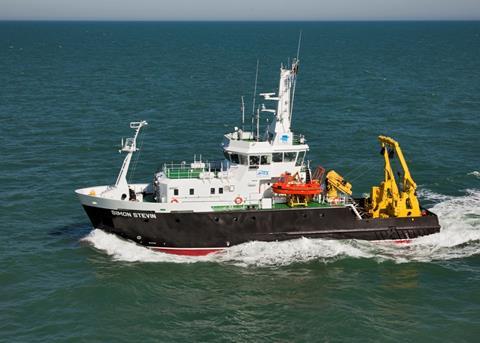
Controlled placement of rock and gravel will be carried out in areas where sufficient burial of the pipeline cannot be achieved, and is expected to be complete by the end of November.
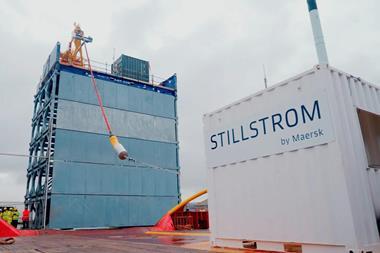
Subsea injection infrastructure is being supplied and installed by TechnipFMC under an integrated engineering, procurement, construction and installation contract. The scope includes an all-electric subsea system comprising manifolds, umbilicals and pipe.
TechnipFMC said the all-electric design removes hydraulic components and simplifies the umbilicals, reducing infrastructure and installation requirements.
The contract has been classified by TechnipFMC as a ‘large’ award, valued between $500 million and $1 billion.
Seabed landers
Northern Endurance has deployed three permanent CO₂ monitoring seabed landers around legacy wells and the Bunter Outcrop, a shallow geological feature. The landers carry monitoring equipment that will remain on the seabed throughout the NEP project, collecting data from the storage area. They will be serviced annually.
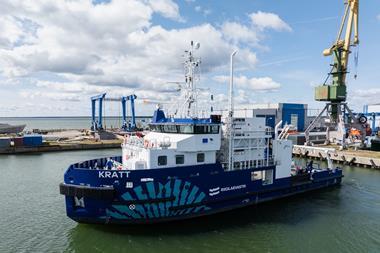
The landers have been designed to resist trawl loads and incorporate measures intended to reduce the risk of snagging by static fishing gear. They were deployed by Forth Constructor, a 40m maintenance support vessel operated by Briggs Marine, delivered in 2025 by Freire Shipyard in Spain. It has DP2 dynamic positioning, diesel-electric propulsion, an active heave-compensated crane, a 20-tonne removable A-frame, four-point mooring, a moonpool and ROV capability. Its shallow 2.5m draft allows it to work in relatively shallow water.
The vessel is designed for a range of offshore tasks including ROV operations, surveys, geotechnical work, diving, seabed investigations and preparation work.
Potential expansion
The subsea system will feed compressed CO₂ into the Endurance storage reservoir, a geological formation beneath the North Sea. DNV is providing certification covering the transport chain from the compression facility through CO₂ conditioning and the offshore pipeline to the injection system.
Equinor, one of the NEP partners, has described final investment approval for the project as a significant step in developing the UK’s carbon transport and storage infrastructure.
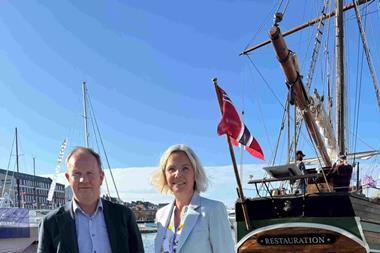
“It is a major milestone to have agreed Final Investment Decision and financial close on two of the UK’s first carbon capture, transport and storage infrastructure projects,” said Irene Rummelhoff, Equinor’s executive vice-president for Marketing, Midstream and Processing.
The NEP project is initially focused on Teesside, while infrastructure for the Humber is being developed separately as part of the planned expansion of the East Coast Cluster. NEP says the wider system could eventually connect additional carbon capture projects in the Humber and other industrial areas to offshore storage.
In 2024, the UK government committed up to £21.7 billion (€26 billion) over 25 years for carbon capture and storage clusters.