





Scottish tidal turbine sector powers up
Tidal energy firm Nova Innovation says it has doubled the size of its tidal array off the north coast of Scotland – the first tidal array in the world – to operate six turbines.
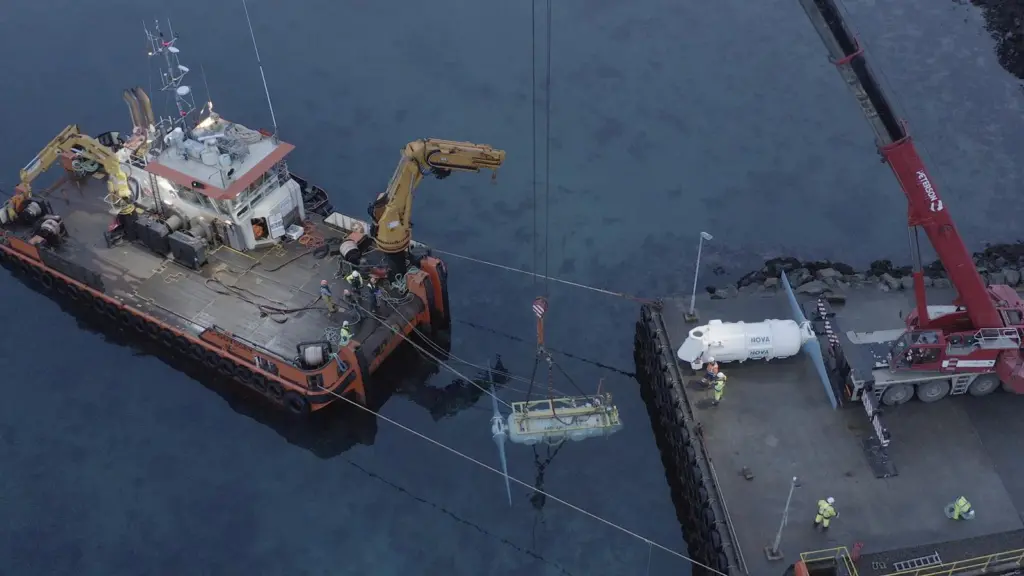
The company installed its first three tidal turbines in 2016 off the islands of Shetland in the North Sea, and added a fourth, Eunice, in 2020.
Now, it says, it has added a fifth and sixth – named Grace and Hali Hope – and connected them via a subsea hub to send power to shore through a single export cable.
The project has been funded by the EU’s Horizon 2020 programme via two funding streams: one is an ENFAIT (Enabling Future Arrays in Tidal) €20 million project, which Noval Innovation is leading; the other is the ELEMENT Effective Lifetime Extension in the Marine Environment for Tidal Energy), a €5 million fund.
Nova’s M100 devices are 100kW seabed mounted tidal turbines with two blade rotors, and have been designed so that the turbines can be easily removed and maintained. The rotor diameter is 9 metres and its speed is 15 to 25 rpm. The modular system also allows them to be easily installed and transported using local vessels and infrastructure.
They are powering homes and businesses.
Meygen project
Not so far away, between the northernmost coast of Scotland and the uninhabited island of Stroma, a 3.5km site operated by MeyGen received approval for a tidal stream project in 2014.
Split into four phases, the first has been operational since last October and comprises four 1.5MW turbines and since 2018, they have delivered 47GWh of electricity, MeyGen says.
Each turbine has three blades with a rotor diameter of 18m. The turbines also include a yaw module, which rotates the turbine at each slack tide to face into subsequent ebb or flood tide.
The 150t turbines are mounted on a 1450t gravity foundation that supports the turbines under its own weight in average flow speeds of up to 10 knots. Each turbine has a dedicated quad armoured subsea array cable laid directly on the exposed seabed and brought ashore via a horizontal directionally drilled borehole within the foreshore bedrock.
The turbines feed into the onshore power conversion unit building at the Ness of Quoys, where the 4kV supply passes through an ABB PCS6000 converter to be made grid code compliant at 33kV for export into the local distribution network. Based on average UK annual consumption of 3.1MWh per annum this phase of the tidal array generates sufficient electricity to supply circa 6,000 homes.
398MW
Related Articles
 ELECTRICAL SYSTEMS
 ENVIRONMENT
 ENVIRONMENT