![MaritimeJournal[Seawork]](https://www.maritimejournal.com/wp-content/uploads/2026/09/MaritimeJournalSeawork.svg)




Norway signs deal with China to ramp up maritime batteries
One of the top two world battery makers has signed a deal with Norwegian marine battery company Corvus Energy to work together on next-generation energy storage for maritime.
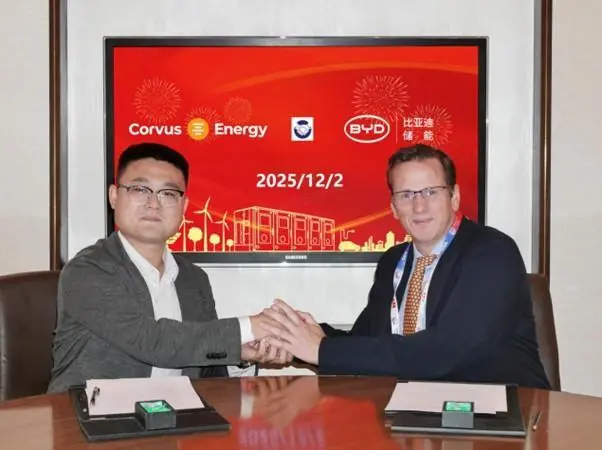
BYD Energy Storage, which began life 30 years ago making rechargeable mobile phone batteries, signed an MoU partly ‘to coordinate global market activities to accelerate the adoption of marine energy storage systems and support the shipping industry’s transition toward cleaner, more sustainable operations’.
The companies’ statement says they will combine BYD’s scale and knowhow in lithium iron phosphate (LFP) batteries with Corvus’ experience in marine energy storage applications.
It’s a big deal for Corvus Energy, which has just launched its Blue Whale NxtGen, a high-energy marine battery system, as it is likely to mean better supply chain access and a larger market.
“This MoU represents a significant step forward in our ambition to remain the market leader in high-quality marine battery systems,” said Ole Jacob Irgens, head of EMEA and Asia at Corvus Energy. “By combining Corvus’ deep maritime understanding and extensive experience in marine battery installations with BYD Energy Storage’s scalability, innovation in LFP technology, and strong global supply chain, we are well positioned to bring new products to market faster and meet the evolving needs of the shipping industry.”
Corvus says it has a track record of more than 1.300 projects across offshore, passenger, commercial and industrial marine segments, claiming that more than 50% of the world’s vessels that have zero-emissions technology on board rely on Corvus’ systems.
Build Your Dreams
With its mobile phone batteries, BYD (Build Your Dreams) quickly became one of the largest phones in the segment in the world, competing on low cost and strong in-house engineering rather than automation.
It entered the car industry in 2003 with the purchase of the struggling Xi’an Qinchuan Automobile, and with a 10% stake in it snapped up by entrepreneur Warren Buffet’s Berkshire Hathaway in 2008, the stage was set.
The company’s meteoric rise accelerated in 2010, when when it started producing electric vehicles as well as internal combustion engine cars, surpassing Tesla in terms of numbers of vehicles. It is especially known for its Blade Battery, an LFP design which, while less energy dense than other lithium options, is considered safer and more reliable.
When it comes to marine, BYD has so far not been particularly visible, although it does already supply ferries, tugs and workboats, many of them with hybrid battery systems.
The MoU is a sign that maritime batteries are a growing area of interest for BYD.