![MaritimeJournal[Seawork]](https://www.maritimejournal.com/wp-content/uploads/2026/09/MaritimeJournalSeawork.svg)


Trust gap threatens rapid rise of uncrewed vessels, industry warns
Industry leaders have warned that the rapid expansion of uncrewed and autonomous vessel operations risks outpacing standards and operational controls, potentially undermining trust in the technology unless clearer guidance and more robust systems are developed.
In some cases, makeshift Remote Operations Centres (ROCs) were even being set up in surveyors’ bedrooms to conduct surveys, the panel said.
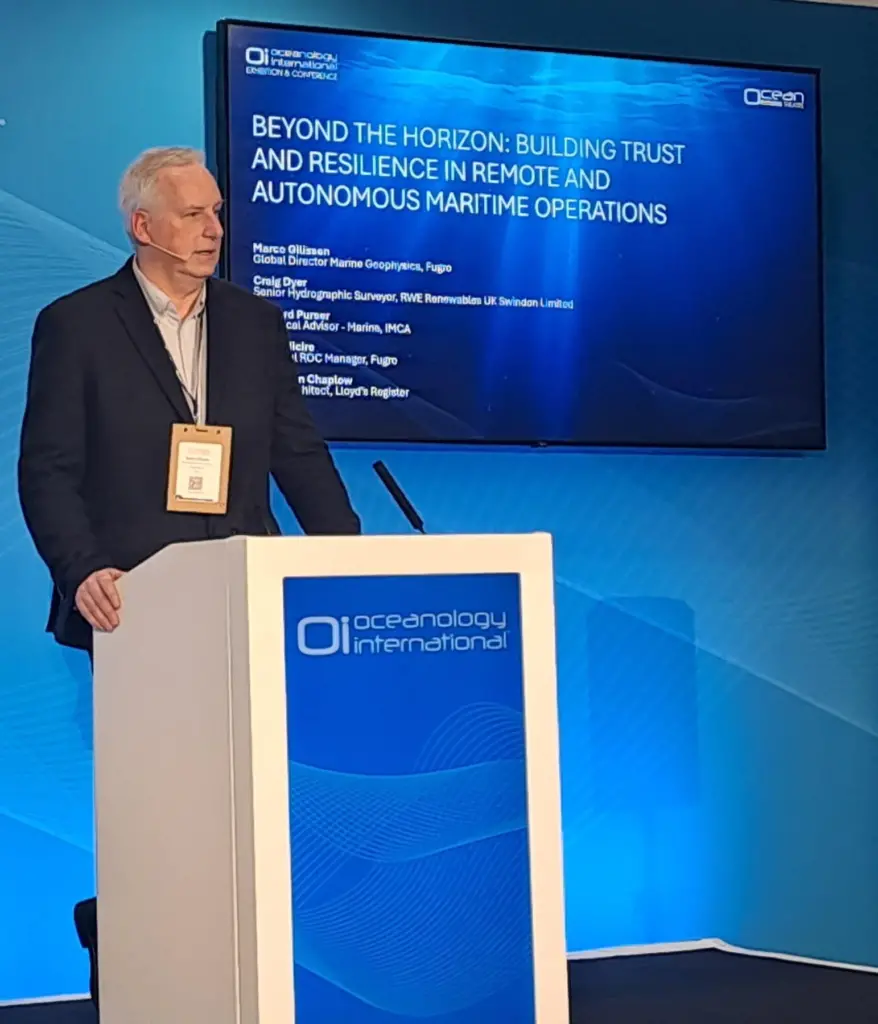
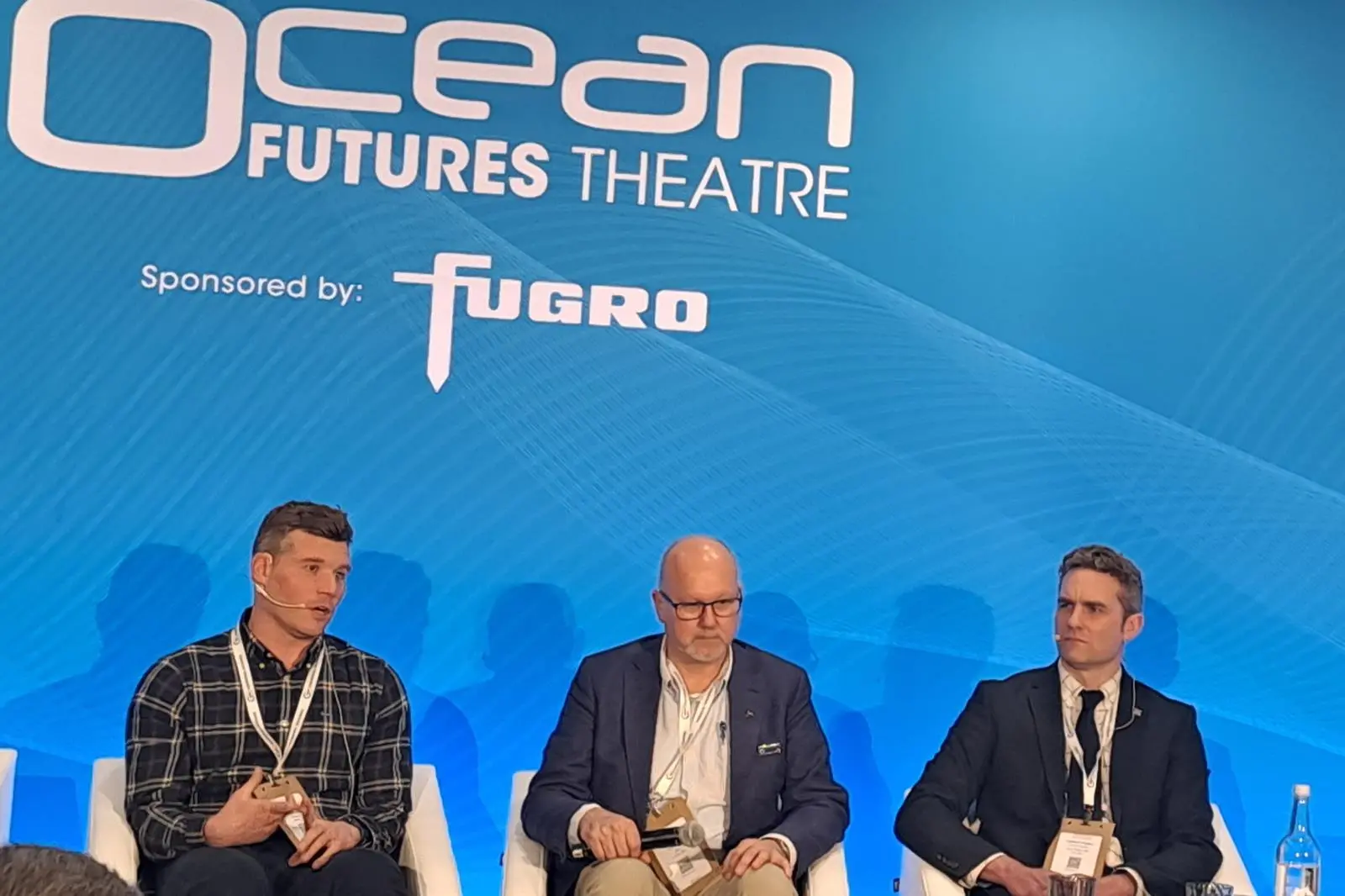
Speaking at a panel hosted by Fugro at Oceanology International 2026 in London this week, experts from across the offshore and maritime sectors highlighted safety, certification and operational oversight as critical issues the industry must address as vessels become larger and more capable.
“We are seeing the most profound change this industry has seen in recent history, and we need to start building trust in it,” said panel moderator Marco Gilissen, Fugro global director – Marine Geophysics.
A key concern raised during the discussion was the ability to maintain control of remotely operated vessels and safely manage failures in communications, sensors or onboard systems.
“My greatest fear is completely losing control of the vessel and it colliding with something,” said Chris Dyer, senior hydrographic surveyor at RWE Renewables. “To help mitigate that we need certain procedures in place and a foolproof way of stopping it from happening. We need to learn from collisions at sea.”
As the technology evolves, panellists said the vessels themselves are expected to increase significantly in size and complexity, bringing new engineering challenges.
“There’s a lot that can go wrong,” said Richard Purser, technical adviser with the International Marine Contractors Association (IMCA). “We will see these vessels getting larger and larger, as big as a DP vessel. We need to start guarding against that and build robustness into the design like we do on conventional vessels – redundancy and protection against signal failures.”
Purser added that system failures must be anticipated as part of the design process.
“We know sensors will fail. But what do we do when they fail? There needs to be a design for that.”
Certification and standardisation
Certification was also identified as a major hurdle, particularly as without a global standard, flag states are applying their own rules and frameworks.
“The IMO machine is going in the right direction, it’s working on a document, but it’s very slow and in the meantime different flag states around the world are applying different rules,” said Purser. “We need guidance.”
Anderson Chaplow, principal specialist at Lloyd’s Register, said the approach to certifying uncrewed vessels requires a different methodology from conventional ships.
“Certifying to the same standards as conventional vessels won’t have the same outcome,” he said. “We look at five things: risk to people on board, risk to people or assets nearby, environmental factors like speed and size, the value of the asset to the operation, and the survivability of the vessel.”
A recurring theme throughout the session was the lack of standardisation in remote operations centres (ROCs), which are used to monitor and control uncrewed vessels.
Dyer said inconsistent approaches risk damaging confidence in the technology.
“I’ve seen ROCs where everything is done very differently,” he said. “An ROC should be like the bridge of a vessel and the information should be relayed to the client. At the moment there are some being operated in surveyors’ bedrooms. I think we need more control on that.”
Likely acceleration
Despite the challenges, panellists agreed that the shift towards uncrewed and remotely operated vessels is likely to accelerate in the coming years, driven partly by operational efficiencies and environmental benefits.
“It’s an environmental benefit – taking people off vessels reduces hotel loads and there are knock-on effects like reduced emissions and fuel consumption,” Purser said.
But there is an emotional hurdle to get over.
“ASVs will be used more and more but the drawback is that operators on the base don’t trust them yet,” said Dyer. “They hear ‘autonomous’ and don’t know what it means. ‘Uncrewed’ might be a better term. A vessel with no people on board might put them off.”
“It’s gathering steam,” said Gilissen. “It started during Covid, a myriad of smallish USVs, a few key developers. Over the last two years we’ve jumped from small USVs to real ships, 17-18 metres or bigger, and I suspect in two or three years’ time there will be another step. But it’s a matter of trust.”
True autonomy?
Despite the noise around ‘autonomous vessels’, the reality is that full automation is still a way off.
“In the offshore industry we are going to see a slow graduation,” said Purser. “We know that certain drilling companies are looking to have the drill floor completely unmanned. Cranes on the backs of ships can be operated without an operator. It’s going to be gradual, and during that time we will get machine learning, etc. It will be an evolution.”
“There also has to be a benefit,” said Chaplow. “What we can achieve under remote control is maybe half what we can achieve with full autonomy. It will be more hands off than true autonomy. An autonomous vessel has to have someone responsible for it and able to intervene.”
“Sensors and systems will become autonomous first,” Gilissen said. “But the vessel itself will probably be the last thing to be truly autonomous. It may always remain aspirational, but we are getting closer to it all the time.”