




Fairplay 30 – The most powerful yet for its German owners
Among several recent news items emanating from the rapidly changing Fairplay Towage group of Hamburg is the delivery of the new tug Fairplay 30, the most powerful to date. The new vessel and a sister ship, Fairplay 31, due for delivery early in 2009, represent a new generation of powerful azimuth stern drive (ASD) tugs designed and equipped to operate effectively in the offshore market and also carry out shiphandling work if required.
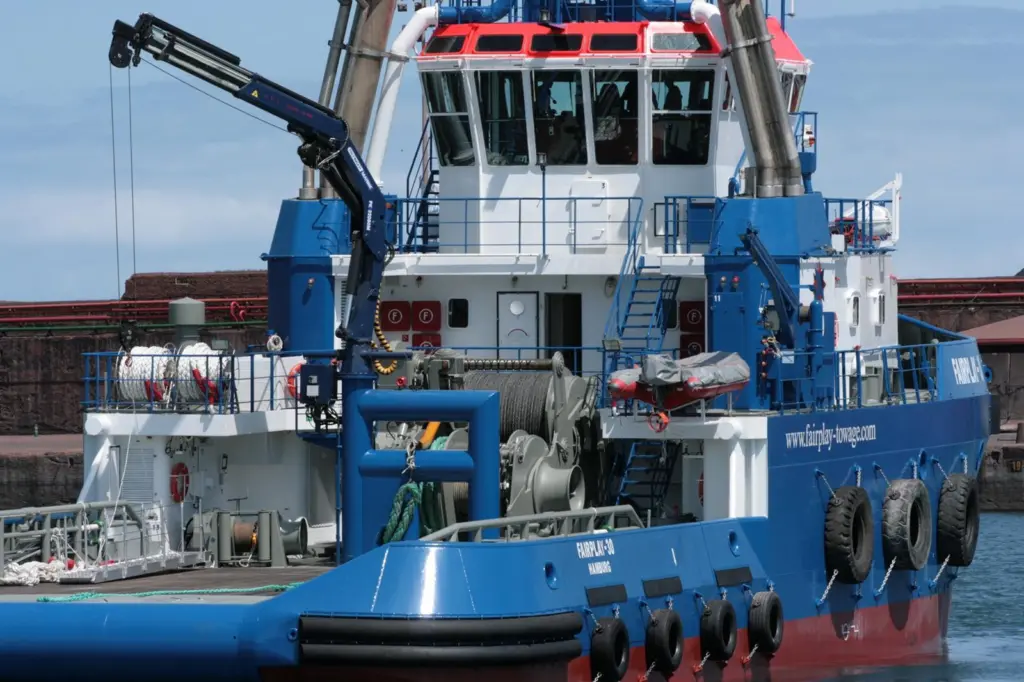
Built in Spain by Astilleros Armon in Navia,
Fairplay 30
and
Fairplay 31
are vessels of 39m in length overall, with a beam of 12.7m
and
a maximum draft of 5.8m. Fairplay intend to employ the tugs primarily in European waters but they are classed for worldwide service with the following Bureau Veritas notations: BV 1+Hull+Mach,Tug FiFi1 Waterspray, Unrestricted Navigation+AUT UMS, Ice 1C.
The hull design incorporates a substantial forecastle, one full deck in height, a deep vertical forefoot
and
a large central skeg aft. An ice class 1C hull notation enables the vessel to operate in Northern Europe during the winter months. A heavy, two stage bow fender, comprising moulded rubber blocks
and
cylindrical sections, is designed to enable the tug to carry out shiph
and
ling
operations in the push-pull mode. Large vehicle tyres are used to protect the forecastle sides during offshore operations. An open stern incorporates a 4.5m wide stern roller of 1.25m diameter with a safe working load of 200 tons. The after deck has approximately 120 sq/m of free space
and
is protected where necessary with the usual timber sheathing.
Fairplay 30 is a powerful vessel fitted with two ABC12VDZC four stroke main engines producing a total of 7,213 bhp at 1,000 rpm. Power is transmitted to a pair of Schottel SRP 2020 fully steerable propulsion units with fixed pitch 2.8m diameter propellers via MC-HD slipping clutch units. On trials this propulsion system gave the tug a bollard pull ahead of 85 tons, 80 tons towing astern,
and
a maximum free running speed of 14.1 knots
Manoeuvrability is enhanced with the installation of a Schottel STT 110LK transverse bowthruster capable of delivering 2.8 tons of thrust.
A bunker capacity of 438 cu/m for gasoil gives the tug a cruising range of about 24 days. Other dedicated internal tanks can accept 63 cu/m of fresh water
and
16 cu/m of fire fighting foam compound.
Electrical power is supplied by two main auxiliary generators rated at 368kVA, each powered by a six cylinder Volvo D12D-A MG diesel
and
a smaller Volvo D7A-A powered 130kVA harbour set. A further six cylinder Volvo diesel with a 600kW output is used to drive the bowthruster
and
the Kvaerner FiFi-1 fire pump.
An extensive array of deck machinery is necessary to ensure that the tugs can operate effectively in their anticipated roles. On the foredeck is mounted a Brusselle combined anchor windlass
and
towing winch designated type 21312. The single split drum is hydraulically powered
and
has a maximum line pull (on the first layer) of 800kN
and
a brake holding capacity of 2,000kN. This winch is used exclusively for shiph
and
ling
and
carries a 54mm diameter galvanised steel wire towline 400m in length
and
180m of Dyneema high performance manmade fibre rope. The noticeably raised bulwark in the bow incorporates a heavy fairlead to h
and
le the forward towline.
A Brusselle anchor h
and
ling
towing winch Model M 256 SLH250 is installed on the afterdeck. The waterfall style winch is hydraulically powered
and
incorporates full automatic control of towline tension
and
length. The top full width drum with spoo
ling
gear accommodates the main 54mm diameter galvanised steel wire towline of 1,200m in length. A second (lower) split drum carries two 54mm work wires 400m
and
800m long. Both drums have a maximum brake holding load of 207 tons. The winches fore
and
aft can be controlled remotely from the wheelhouse or locally via a h
and
held controller.
Also provided is a spare 54mm x 1,200m main towline stored on a Brusselle hydraulically powered reel
and
two smaller h
and
operated reels on the port side of the boat deck are used to store spare ropes
and
pennants. Brusselle also supplied a pair of tugger winches (model M257) with a line pull of 10 tons
and
a brake load of 50 tons. Line h
and
ling
equipment supplied by Karmoy comprises one set of hydraulically operated tow pins with a safe working load of 160 tons
and
a Shark Jaw of 200 tons. To aid the h
and
ling
of stores
and
equipment a Palfinger PK32080 deck crane is mounted on
and
above the towing fairlead aft of the main winch. The crane is capable of lifting 2.2 tons
and
has a maximum outreach of 12m.
Fairplay 30
and
its sister ship have air conditioned accommodation for a maximum of twelve persons in eight cabins. Other facilities include an adequately designed mess
and
dayroom
and
the usual galley, storage
and
sanitary spaces.
The navigational
and
communication equipment in the wheelhouse corresponds to the latest available technical st
and
ards,
and
includes GMDSS, gyro-compass, autopilot, electronic seachart, AIS
and
two radars.
Fairplay 30 was formally named in Spain on 16 August
and
sailed soon afterwards to join the Fairplay fleet. The German owners have many years of experience in operating tugs of this type. Just over decade ago the company introduced the Fairplay 20 series of ASD tugs of 34.75m
and
52 tons bollard pull. This earlier class grew to six vessels with the last two upgraded to 65 tons bollard pull
and
was highly successful. Many noteworthy coastal
and
deepsea towing
and
offshore operations were carried out by these vessels
and
when not employed in this way they are used for shiph
and
ling
duties in Rotterdam
and
other ports as required. One of the later vessels,
Fairplay 26,
has been the designated ETV for the protection of the German coastline in the Baltic for several years.
Related Articles
 ELECTRICAL SYSTEMS
 VESSELS
 INDUSTRY NEWS