




First feedback for versatile floating work platform
The team behind an innovative modular floating platform product have said they are really pleased with the first ‘real world’ test results and how well it has stood up to the harsh application it was used for.
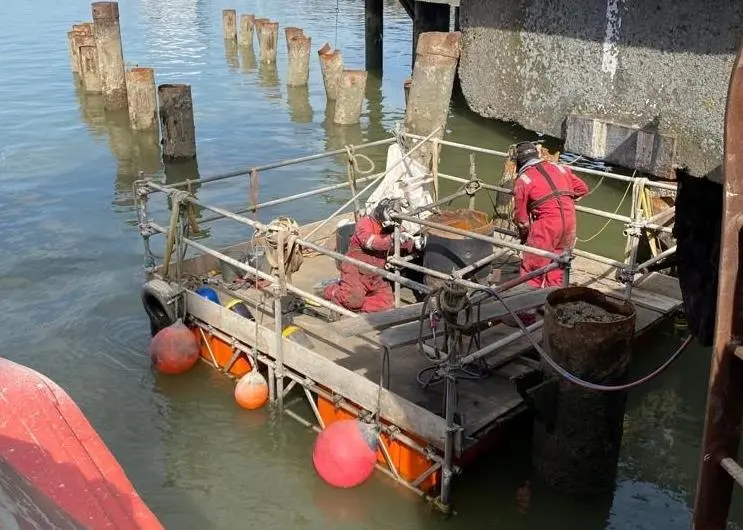
A 4m x 4m ScaffFloat pontoon has just completed its first commercial hire in the UK port of Felixstowe. The patented ScaffFloat™ system utilises a set of custom made plastic floats that have been specifically designed to integrate with standard scaffolding parts to make strong floating pontoons and versatile floating structures.
WorkFloat™, the company that won the European Commercial Marine Awards at Seawork last year with their folding work platform, launched the new product online a few months ago and were immediately contacted by Keynvor MorLift Ltd (KML), a marine contractor that had been awarded the contract to decommission a ro-ro facility in the port of Felixstowe.
CONFUSED WATERS
For the project, they needed access to individual piles so that they could cut them away from the concrete structure above, and then weld on reinforcements before craning the piles out. Initially, they hired a plastic modular pontoon but soon found it was too unstable to work from in the confused waters in the harbour. They considered a number of alternatives but needed a very specific-sized pontoon that was big enough to work from, but also small enough to fit in between the tight pile pattern, while giving full access to the outside of the pile
They contacted the ScaffFloat™ team who proposed a custom 3.8m wide x 4m long pontoon with a recess that could accommodate the pile while it was being worked on. The proposal was approved on a Friday and the pontoon was built onsite the following Tuesday.
EASY TWEAKS
Project Manager from KML, Gary Brown, said ‘’There are a few things that really impressed us about the ScaffFloat pontoon. First, was versatility, we had to make a number of tweaks to the layout when it arrived on the dockside in Felixstowe. Being scaffolding, these changes were easy to accommodate by quickly cutting tubes and boards to fit. Second, was the safety aspect, normally we don’t get any real paperwork with a pontoon hire but the ScaffFloat team’s Naval Architect provided a full and comprehensive set of structural, buoyancy and stability calculations for the pontoon, which greatly assisted risk assessment of processes and procedures. Third, was general performance: it weighed around a ton so was surprisingly stable, the solid handrails were used to lash equipment to and it generally stood up very well over three winter months in what was quite a harsh environment. An impressive piece of kit, we are planning to have it back later this year.’’
RUST?
One of the concerns raised by customers has been corrosion of the scaffold parts in the marine environment, so this three-month test was invaluable for this concern.
Toby Budd, Founder and MD said ‘’We have had scaffold parts submerged in Falmouth Harbour for months now and have been surprised how well the scaffolding parts stand up to corrosion. It was interesting to see the KML pontoon when I collected it, there was some surface rust on a few of the couplers, but certainly, nothing that came close to affecting the integrity of the structure – so yes, we were really pleased it stood up so well, and all the parts can be used again.’’
He added ‘’It’s busy, we have ScaffFloat bookings coming in and are just about to start phase two of our R&D where we will be building and testing a range of what we call ‘bolt-ons’ – modules like spud legs, propulsion, welfare huts, lifting A-frames, deck cranes and loading ramps.’’
Uses for ScaffFloat span several sectors including survey, drilling, geotechnical, renewables, oil & gas, civils, events, disaster relief and access.
Particular interest has also been shown for bridge projects, where ScaffFloat™ pontoons are lifted up under a bridge to provide access for maintenance or scaffolding installation.
By Jake Frith
Related Articles
 ELECTRICAL SYSTEMS
 VESSELS
 INDUSTRY NEWS