




First of class fast pilot boat for French Navy
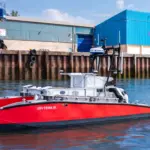
In early 2009 the Stockport UK headquartered Delta Power Group signed a contract with the French Ministry of Defence, the DGA (Direction Generale de l’Armement), for five pilot boats for operation in the French naval bases of Toulon, Brest and Cherbourg.
Delta, founded in 1979, had been selected by the DGA a few months earlier after an international competitive tendering process. With spares, training, documentation and other items the total value of the five boat contract was in excess of €2.5m.
To meet the French Navy’s requirements, Delta offered a development of its 12m fast pilot boat design that had been previously built for Poole Harbour Authority.
Delta Power Group has delivered over 2,000 RIBs and boats to military, government agency and commercial operators worldwide. All aspects of construction and fit out are carried out in-house including moulding and inflatable tube manufacture.
The pilot boat project commenced with a visit of the entire French Navy and DGA project to team to the Poole pilot boat Vanguard prior to the first project review meeting at Delta’s facility. The boat visit and demonstration of the Poole pilot boat enabled the detailed requirements of the customer to be confirmed and enabled the design programme to commence.
A requirement of the French Navy was that the new boats be designed, built and approved to Classification Society requirements as well as to various divisions of the French Marine Marchande regulations. Delta appointed Bureau Veritas (BV) as Classification Society and the pilot boats are classed to the BV Class notation: 1+HULL MACH Light ship/Fast Pilot Boat Coastal Area Sea area: Restricted open sea service – Hs < 3.25
Plan approval was carried out by BV Nantes, and in-build surveys and trials conducted by surveyors from BV’s Lorient and Newcastle offices. To meet Classification Society requirements on such a small boat was a challenge for the boat’s naval architects and designers. Moreover, a combination of the French Navy’s requirements, BV rules and Marine Marchande regulations brought a particular challenge to source type approved materials and equipment for the boat and this aspect took a considerable amount of time and effort. Whilst type approved GRP materials are readily available, type approved hoses, fittings and electrical components in sizes required for a 12m boat are less easy to source.
The design of the pilot boats was fully developed in 3D using Solidworks prior to construction. This enabled a high degree of accuracy and conformity to be achieved across the five boats, a specific French Navy requirement.
The hullform of the pilot boats is Delta’s ‘Triple X’ deep V hullform which has been proven on many boats and is ideal for the specified sterndrive propulsion system. The entire structure of the pilot boats is of hand-laid GRP construction. The Poole Pilot Boat had an aluminium alloy deckhouse, but for this five boat contract the investment was made in a new deckhouse design and tooling. The structure was designed and approved under the BV High Speed Craft rules. The single skin hull shell is supported by conventional transverse and longitudinal framing and marine grade plywood bulkheads and incorporates four integral lift points which are accessed through screwed deck plates. The deck and deckhouse are of vacuum consolidated sandwich construction with an end-grain balsa core. Prior to starting production BV audited and approved Delta’s moulding facility and ENISO 9001-2008 quality assurance system.
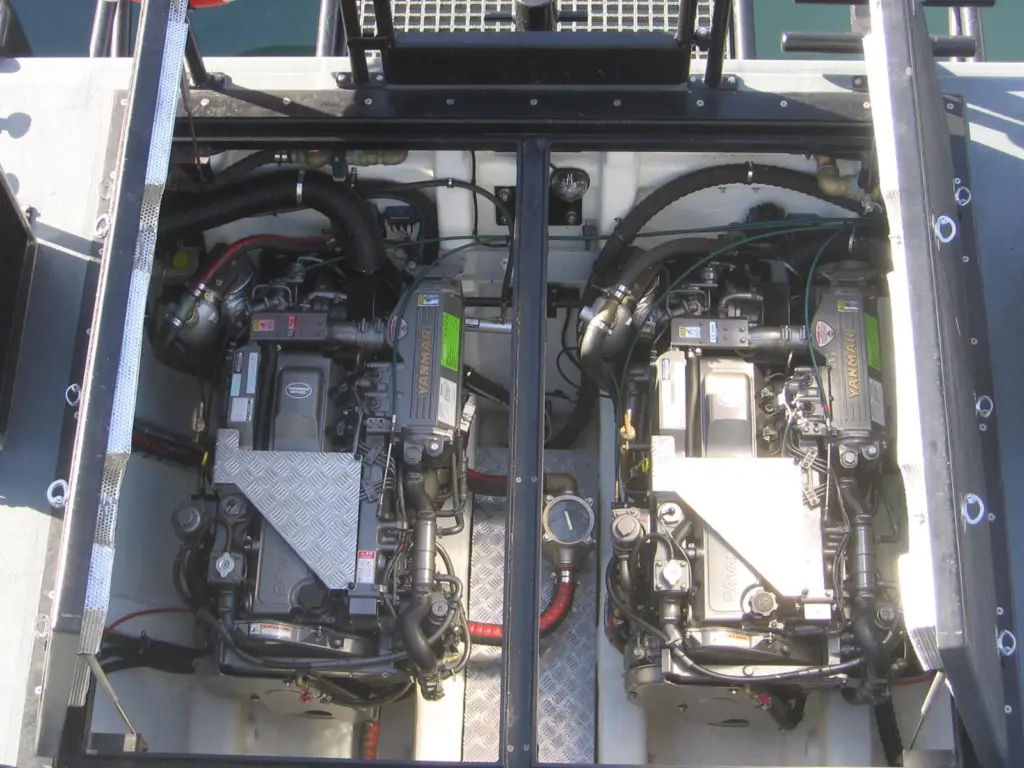
The propulsion package consists of twin Yanmar 6LPA-STZP engines and Bravo 2X sterndrives supplied by E P Barrus. To extend machinery life the engines were de-rated to 255bhp at 3,600rpm. This package provides a maximum speed in the Full Load condition of approaching 30 knots. To meet BV Classification Society requirements Yanmar and Mercruiser submitted engine and sterndrive drawings to BV for plan approval.
A specific requirement of the French Navy was a high level of Availability, Reliability and Maintainability (ARM) for the pilot boats. The availability requirement was 350 days per year and an ARM study was conducted to ensure this could be achieved. The machinery installation provides a good example of the ARM principles being applied. To ensure a high level of maintainability the engine compartment length was increased to ensure good access to the engines and other equipment items.
The boat’s electrical system was supplied by Switchcraft Taplins and consists of a conventional 12V DC system with battery link box and main distribution panel and three console mounted switch panels for navigation lights, bilge system and other services. The navigation and communication system was supplied and integrated by Ambex Limited and is built around Furuno navigation equipment with a Sailor Class A VHF DSC radio and Jotron GMDSS equipment. A loudhailer and police siren is also fitted.
To ensure no electro-magnetic interference between the various systems, and to identify any hazardous areas around antennas, EMC and RADHAZ (Radiation Hazard) studies were carried out and the results validated by trials.
The French Navy specified a fixed CO2 fire suppression system for the engine compartment and this was sourced from Chubb along with the fire detection system. Both systems areType Approved by BV. The Offshore Systems ‘Multitank’ tank contents monitoring system was selected for the twin 550 litre stainless steel fuel tanks.
To protect the hull from damage during pilot transfer a large heavy duty foam elastomer fender is fitted around the entire gunwale. The requirement to transfer pilots to/from three classes of French Navy submarine led to additional fixed ‘submarine fenders’ being fitted below the main fender of the boat to prevent contact between the hull of the submarine and pilot boat. 3D modelling the pilot boat and a section of the submarines enabled the fender design to be optimised and trials have now proven the arrangement.
The wheelhouse windows and door were supplied by Seaglaze Limited and a Hadrian rail is fitted to the aft deck, wheelhouse and foredeck rails.
The first of class boat La Mitre was put through an extensive trials programme both in the UK and France prior to acceptance by the French Navy. In total, thirty two trials procedures were carried out. In the UK, Delta’s commissioning and trials was followed by BV trials and then customer trials with French Navy and DGA representatives. Approval was then given by the customer to deliver La Mitre to Toulon where a week of interface trials with French Naval ships and submarines was carried out. Trials included simulated and real pilot transfer operations with eight different classes of French Navy warships and submarines in both sheltered waters and in more exposed conditions, and in day and night operations. To enable the trials to take place in French waters and with French ships and personnel with the boat still in Delta’s hands, the first of class boat was surveyed under the MCA Small Commercial Vessel code of practice and certified for operation on Category 3 waters (up to 20 miles from a safe haven in day and night operations).
During trials the first of class boat achieved a maximum speed of over 29 knots in the end of service life Full Load condition. Noise levels in the wheelhouse at the cruising speed of 21 knots are a little over 70 db(A), enabling comfortable conversation. The twin sterndrives provide excellent manoeuvrability both at high and low speeds. Handling alongside a ship or submarine at pilot transfer speeds has proven to be excellent and there are no difficulties during approach, station keeping, alongside or when peeling away.
To manage the project and to provide naval architectural and design services Delta appointed Vectis Marine Design. Vectis Marine Design was established in 2008 by Andrew Humphries, a naval architect and former Design Manager at VT Halmatic, as a specialist design and project management consultancy for professional boat projects. Andrew has previous experience of managing a project for the French Navy and had worked with a number of the DGA and French Navy team.
The first two boats were handed over to the French Navy at the beginning of February and are now in service in Toulon. The following three boats will be delivered to Brest and Cherbourg by the end of February for acceptance in March
The new pilot boats will take over pilotage duties in the Toulon, Brest and Cherbourg naval bases from various boats and tugs that previously performed the role. The high speed, manoeuvrability and comfort of the new pilot boats have already greatly enhanced the pilotage operation of these busy naval ports. The Delta 12m pilot boat offers a fast, manoeuvrable and economical alternative to the traditional semi-displacement pilot boat and the validation of the design by the French Navy and Bureau Veritas classification provides Delta with an excellent reference project for future sales of the design.
Related Articles
 ELECTRICAL SYSTEMS
 VESSELS
 INDUSTRY NEWS